
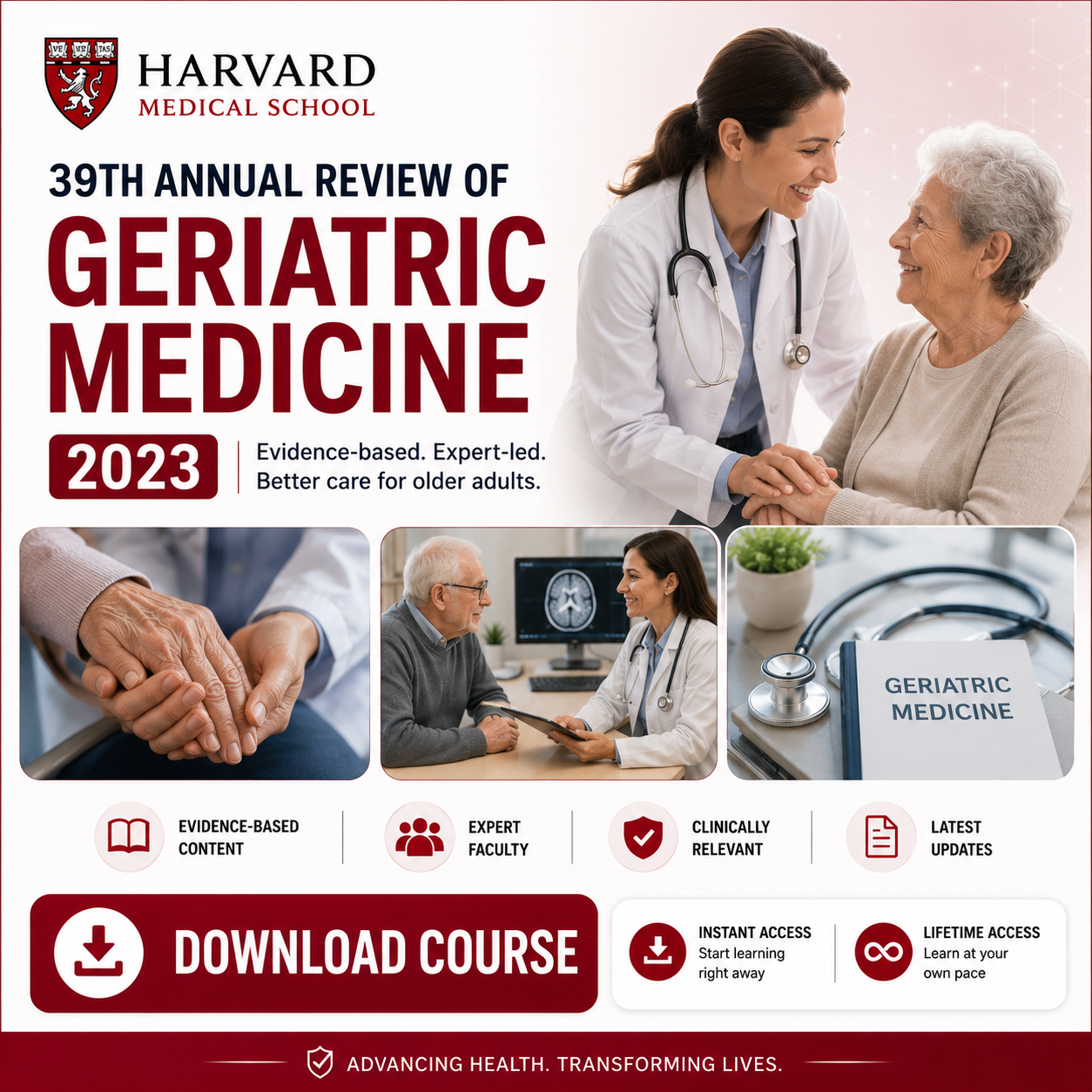

Harvard 39th Annual Review of Geriatric Medicine 2023
A comprehensive Harvard geriatric medicine course focused on the specialized clinical management of older adults, with practical updates in primary care geriatrics, medical illness, neurologic disease, psychiatric care, frailty, falls, cognition, medications, care transitions, nursing home care, and complex decision-making across aging populations.
Course Details:
Harvard 39th Annual Review of Geriatric Medicine 2023 is a recorded five-day course providing an authoritative update on the clinical management of older adults. The program focuses on common and complex problems encountered in primary care, hospitals, nursing homes, and other care settings.
Focus: Geriatric assessment, frailty, falls, mobility, polypharmacy, deprescribing, dementia, delirium, depression, anxiety, sleep, pain, osteoporosis, cardiovascular disease, diabetes, kidney disease, neurologic illness, psychiatric illness, hospital care, nursing home care, palliative care, caregiver support, functional decline, transitions of care, and multidisciplinary management of older adults.
About This Course
The care of older adults requires a specialized clinical approach that integrates medical, neurologic, psychiatric, functional, social, and ethical dimensions of aging.
Harvard 39th Annual Review of Geriatric Medicine 2023 provides a broad and practical update for clinicians who care for older patients in outpatient practices, hospitals, rehabilitation settings, assisted living, long-term care, and nursing homes.
The program combines lectures and practical workshop-style teaching to help clinicians approach complex geriatric problems with confidence, improve patient-centered decision-making, and coordinate care across multiple disciplines and care environments.
Why Choose This Course
- Harvard 39th Annual Review of Geriatric Medicine 2023
- Five-day comprehensive update on the specialized clinical management of older adults
- Focuses on common problems encountered in primary care, hospital medicine, rehabilitation, and nursing home settings
- Integrates medical, neurologic, psychiatric, functional, social, and ethical aspects of geriatric care
- Includes practical approaches to frailty, falls, cognition, delirium, dementia, polypharmacy, pain, depression, and complex chronic illness
- Designed to improve clinical decision-making and care coordination for older patients with multiple comorbidities
- Useful for physicians, nurses, nurse practitioners, physician assistants, social workers, pharmacists, trainees, and all professionals involved in the care of older adults
Core Learning Areas
Geriatric Assessment
Functional assessment, frailty, mobility, falls, cognition, goals of care, risk stratification, and practical evaluation of older adults.
Medical Complexity
Chronic disease management, polypharmacy, cardiovascular disease, diabetes, kidney disease, pain, osteoporosis, infections, and hospital care.
Brain & Behavioral Health
Dementia, delirium, depression, anxiety, sleep disorders, neuropsychiatric symptoms, capacity, caregiver stress, and behavioral management.
Care Systems & Aging
Nursing home care, transitions of care, rehabilitation, palliative care, end-of-life care, caregiver support, and multidisciplinary planning.
Complete Curriculum
- Principles of clinical care for older adults
- Comprehensive geriatric assessment
- Functional status and activities of daily living
- Frailty recognition and clinical implications
- Individualized care planning for older patients
- Balancing disease-specific guidelines with patient goals
- Multidisciplinary care models for aging populations
- Frailty assessment and management strategies
- Falls risk evaluation and prevention
- Gait impairment and mobility limitation
- Functional decline in older adults
- Exercise, rehabilitation, and physical function preservation
- Home safety and environmental risk reduction
- Practical approaches to maintaining independence
- Cognitive screening and clinical evaluation
- Dementia diagnosis and management
- Neuropsychiatric symptoms in dementia
- Delirium prevention, recognition, and treatment
- Distinguishing dementia, depression, and delirium
- Caregiver counseling and support strategies
- Safety, capacity, and decision-making in cognitive disorders
- Depression in late life
- Anxiety and sleep disorders in older adults
- Behavioral symptoms and agitation
- Substance use and medication-related psychiatric symptoms
- Psychopharmacology considerations in geriatric patients
- Non-pharmacologic behavioral interventions
- Integrating mental health into geriatric primary care
- Polypharmacy and medication safety
- Deprescribing strategies for older adults
- High-risk medications and adverse drug events
- Medication reconciliation across care settings
- Balancing benefits and harms of long-term therapies
- Medication adherence and patient-centered prescribing
- Practical medication review for complex older patients
- Hypertension management in older adults
- Heart failure and cardiovascular disease in aging patients
- Atrial fibrillation and anticoagulation considerations
- Diabetes management in older adults
- Lipid management and cardiovascular prevention
- Balancing treatment targets with frailty and life expectancy
- Shared decision-making for cardiometabolic disease care
- Chronic kidney disease in older adults
- Acute illness and hospitalization risks
- Infections in geriatric patients
- Urinary symptoms and urinary tract infection considerations
- Anemia, dehydration, and electrolyte disorders
- Clinical presentation differences in older adults
- Practical management of common geriatric medical problems
- Osteoporosis prevention and treatment
- Fracture risk assessment
- Chronic pain management in older adults
- Osteoarthritis and musculoskeletal function
- Safe use of analgesics and non-drug pain strategies
- Mobility preservation and rehabilitation planning
- Improving quality of life through functional pain care
- Hospitalization risks for older adults
- Preventing functional decline during hospitalization
- Delirium prevention in hospital settings
- Discharge planning and medication reconciliation
- Care transitions between hospital, home, rehabilitation, and nursing homes
- Reducing readmissions and post-discharge complications
- Coordinating care among patients, families, and clinical teams
- Care of older adults in nursing home settings
- Long-term care medical management
- Rehabilitation and recovery after acute illness
- Managing complex chronic illness in facility-based care
- Communication with families and care teams
- Quality and safety in long-term care environments
- Practical approaches to improving comfort, function, and dignity
- Goals-of-care conversations with older adults and families
- Palliative care principles in geriatric medicine
- Advanced care planning and decision support
- Symptom management in serious illness
- End-of-life care in hospital, home, and nursing home settings
- Balancing life-prolonging treatment with quality of life
- Supporting patients and caregivers through advanced illness
- Practical workshop-style approaches to complex geriatric problems
- Case-based clinical reasoning for older adults with multiple conditions
- Integrating medical, neurologic, and psychiatric illness management
- Care planning across office, hospital, and nursing home settings
- Managing competing priorities and patient-centered goals
- Improving communication with families and multidisciplinary teams
- Applying geriatric principles to real-world clinical practice
Learning Objectives
- Apply geriatric assessment principles to the care of older adults
- Recognize and manage frailty, falls, mobility impairment, and functional decline
- Evaluate cognitive impairment, dementia, delirium, depression, anxiety, and behavioral symptoms
- Improve medication safety through polypharmacy review and deprescribing strategies
- Manage common cardiovascular, metabolic, renal, musculoskeletal, and infectious problems in older adults
- Coordinate care across office practices, hospitals, rehabilitation settings, and nursing homes
- Support patients and caregivers through complex illness, cognitive decline, and care transitions
- Use patient-centered decision-making for older adults with multiple comorbidities
- Integrate palliative care, advanced care planning, and goals-of-care conversations into geriatric practice
- Apply multidisciplinary approaches to improve outcomes for aging patients
Who Should Take This Course
This course is designed for all medical professionals seeking training in the care of older adults, including geriatricians, internists, family physicians, primary care clinicians, hospitalists, neurologists, psychiatrists, nurses, nurse practitioners, physician assistants, pharmacists, social workers, residents, fellows, and long-term care professionals.
It is especially useful for clinicians who manage older adults with multiple chronic conditions, cognitive impairment, frailty, falls, polypharmacy, functional decline, psychiatric illness, hospitalization risks, long-term care needs, or serious illness.
Delivery & Access
Recorded Course
Review the geriatric medicine sessions at your own pace.
2023 Edition
Authoritative update on the specialized clinical management of older adults.
5-Day Program
Comprehensive teaching with practical approaches to complex geriatric problems.
Support
Course Highlights
Older Adult Care Focus
Practical update on common clinical problems encountered in the care of older adults across primary care, hospital, and nursing home settings.
Multidisciplinary Approach
Integrates medical, neurological, psychiatric, functional, social, and ethical aspects of geriatric medicine.
Practical Case Learning
Includes workshop-style teaching that emphasizes real-world approaches to complex geriatric problems.
FAQ
Who is this course best suited for?
This course is best suited for geriatricians, internists, family physicians, primary care clinicians, hospitalists, neurologists, psychiatrists, nurses, nurse practitioners, physician assistants, pharmacists, social workers, residents, fellows, and professionals involved in the care of older adults.
What topics are covered?
Topics include geriatric assessment, frailty, falls, mobility, functional decline, polypharmacy, deprescribing, dementia, delirium, depression, anxiety, sleep, pain, osteoporosis, cardiovascular disease, diabetes, kidney disease, infections, hospital care, nursing home care, rehabilitation, palliative care, caregiver support, transitions of care, and end-of-life planning.
Is this course focused on primary care geriatrics?
Yes. The course focuses strongly on common clinical problems encountered in primary care practice, while also covering hospital, nursing home, rehabilitation, and long-term care settings.
Does this course cover dementia and delirium?
Yes. The course includes cognitive impairment, dementia, delirium, behavioral symptoms, caregiver support, safety issues, and practical care strategies for older adults with cognitive disorders.
Is this a recorded course?
Yes. This product is provided as recorded course access so you can review the material at your own pace.
Does this course include CME or a certificate?
No. CME credits and certificates are not included with this course package.
Who can I contact for support?
You can contact support at [email protected].
Reviews
There are no reviews yet.