
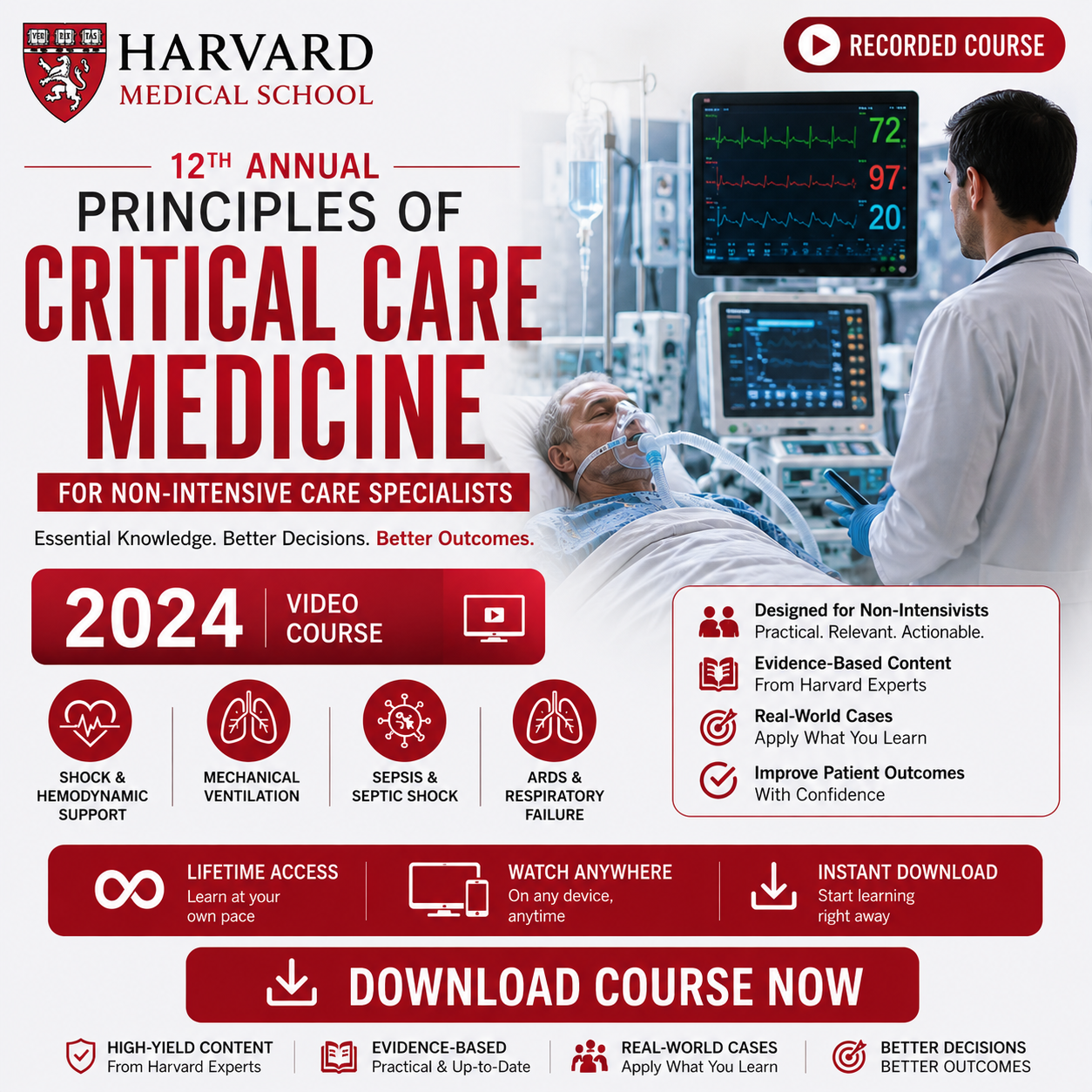
Harvard 12th Annual Principles Of Critical Care Medicine For Non-Intensive Care Specialists 2024
A practical Harvard critical care medicine course designed for clinicians who care for critically ill patients outside intensive care specialty training, with focused updates in mechanical ventilation, sepsis, shock, respiratory failure, POCUS, sedation, pulmonary embolism, toxicology, cardiac emergencies, electrolyte disorders, and ICU best practices.
Course Details:
Harvard 12th Annual Principles Of Critical Care Medicine For Non-Intensive Care Specialists 2024 is a recorded video course focused on core critical care skills for clinicians whose practice involves evaluating and managing critically ill patients.
Focus: Mechanical ventilation, ventilator troubleshooting, ventilator liberation, non-invasive ventilation, high-flow nasal cannula, VV ECMO, sedation, agitation, sepsis, shock physiology, vasopressors, POCUS, pulmonary embolism, anticoagulant reversal, oncologic emergencies, toxicology emergencies, infectious disease emergencies, cardiac emergencies, electrolyte abnormalities, post-intensive care syndrome, and end-of-life care in the ICU.
About This Course
Caring for critically ill patients requires rapid clinical judgment, strong physiologic understanding, familiarity with high-risk therapies, and the ability to act decisively in complex emergency situations.
This course provides a practical and comprehensive update in critical care medicine for clinicians who are not specialty-trained intensivists but who routinely encounter acutely ill patients in emergency, hospital, perioperative, procedural, and inpatient settings.
The program emphasizes evidence-based critical care strategies, case-based discussions, equipment demonstrations, clinical reasoning, and practical recommendations that can be applied immediately to patient care.
Why Choose This Course
- Harvard 2024 critical care course designed for non-intensive care specialists
- Focuses on practical skills needed to manage critically ill patients
- Covers mechanical ventilation, non-invasive ventilation, high-flow nasal cannula, ventilator troubleshooting, and ventilator liberation
- Reviews sepsis, shock, vasopressors, POCUS, hypoxic respiratory failure, proning, and ECMO concepts
- Includes pulmonary embolism, anticoagulant reversal, toxicology emergencies, infectious disease emergencies, and oncologic emergencies
- Addresses sedation, agitation, post-intensive care syndrome, electrolyte abnormalities, cardiac emergencies, and end-of-life care
- Designed for emergency physicians, hospitalists, family practitioners, cardiologists, surgeons, anesthesiologists, OB/GYN physicians, NPs, PAs, nurses, pharmacists, and clinicians involved in critical care settings
Core Learning Areas
Ventilation & Respiratory Failure
Mechanical ventilation, ventilator troubleshooting, liberation, non-invasive ventilation, high-flow nasal cannula, hypoxic failure, proning, and ECMO.
Sepsis, Shock & Hemodynamics
Evidence-based sepsis care, shock physiology, IV and oral vasopressors, POCUS, volume status, and critical care resuscitation.
ICU Emergencies
Massive and submassive pulmonary embolism, anticoagulant reversal, cardiac emergencies, toxicology, oncologic emergencies, and infections.
ICU Patient Management
Sedation, agitation, electrolyte disorders, post-intensive care syndrome, end-of-life care, multidisciplinary teamwork, and practical bedside decisions.
Complete Curriculum
- Core clinical skills for managing critically ill patients
- Recent evidence-based advances in modern critical care medicine
- Practical strategies for non-intensive care specialists
- Rapid evaluation, diagnosis, and treatment of unstable patients
- Critical care reasoning across emergency, inpatient, and procedural settings
- Team-based care for complex ICU and high-acuity patients
- Applying updated practice recommendations to daily patient care
- Basic principles of mechanical ventilation
- Indications for non-invasive and invasive ventilation
- Ventilator troubleshooting and practical bedside problem-solving
- Ventilator liberation and readiness for extubation
- Best practices in non-invasive ventilation
- High-flow nasal cannula use in acute respiratory failure
- Clinical strategies for safer respiratory support
- Evidence-based management of hypoxic respiratory failure
- Lung-protective ventilation strategies
- PEEP optimization and oxygenation improvement
- Proning in severe hypoxic respiratory failure
- Identifying patients who may require VV ECMO
- Escalation of respiratory support in critically ill patients
- Clinical reasoning for advanced respiratory failure management
- Evidence-based treatment of sepsis
- Diagnosis and management of common infections in the ICU
- Infectious disease emergencies in critically ill patients
- Approach to antimicrobial selection and escalation
- Recognition of sepsis physiology and organ dysfunction
- Resuscitation priorities in infection-related critical illness
- Practical infection management in high-acuity settings
- Categorizing different types of shock
- Pathophysiologic mechanisms behind shock states
- Formulating appropriate treatment strategies for shock
- Best practices for IV and oral vasopressor use
- POCUS in the diagnosis of shock
- POCUS assessment of volume status
- Integrating bedside ultrasound into critical care decision-making
- Management of submassive pulmonary embolism
- Management of massive pulmonary embolism
- Treatment options for high-risk pulmonary emboli
- Risk stratification and escalation of care
- Anticoagulant reversal strategies
- Balancing thrombosis and bleeding risk in critical illness
- Practical emergency decision-making in PE and anticoagulation complications
- Contemporary approaches to sedation in the ICU
- Tangible strategies for managing sedation to minimize harm
- Best practices for managing agitation in critically ill patients
- Balancing comfort, safety, delirium prevention, and ventilator synchrony
- Recognizing medication-related complications
- Improving patient safety during high-acuity care
- Practical bedside strategies for complex ICU behavior and sedation issues
- Assessment of cardiac emergencies in critically ill patients
- Heart failure in high-acuity and ICU settings
- Unstable arrhythmias and urgent management principles
- Critical care approaches for patients with cardiovascular instability
- Integration of hemodynamics, POCUS, and clinical exam
- Management priorities for critically ill cardiac patients
- Practical decision-making for clinicians caring for acute cardiac deterioration
- Updates in oncologic emergencies
- Recognition and treatment of toxicology emergencies
- Critical care considerations in patients with cancer
- Approach to poisoning and medication toxicity
- Managing rapidly evolving high-risk clinical presentations
- Interdisciplinary coordination in special critical care emergencies
- Practical emergency strategies for non-intensive care specialists
- Diagnosis of commonly encountered electrolyte abnormalities
- Treatment strategies for critical electrolyte derangements
- Clinical prioritization in unstable patients
- Laboratory interpretation in high-acuity care
- Medication and fluid considerations in electrolyte management
- Preventing complications from rapid correction or undertreatment
- Practical approach to common metabolic problems in the ICU
- Recognition of post-intensive care syndrome
- Best practices for post-ICU recovery and management
- Communication with patients and families after critical illness
- Functional, cognitive, and psychological complications of ICU care
- Best practices for end-of-life care in the ICU
- Goals-of-care conversations and patient-centered decision-making
- Improving compassion, communication, and continuity in critical care practice
Learning Objectives
- Review the basic principles of mechanical ventilation and indications for non-invasive and invasive ventilation
- Describe evidence-based approaches to diagnosis and management of common ICU infections
- Categorize types of shock and formulate appropriate treatment strategies
- Identify evidence-based management of hypoxic respiratory failure, including high-flow nasal cannula, lung-protective ventilation, PEEP optimization, proning, and ECMO
- Describe the importance of POCUS in the diagnosis of shock and volume status
- Recognize post-intensive care syndrome and describe best practices for management
- Identify contemporary approaches to sedation in the ICU
- Recognize and manage common toxicology emergencies
- Assess cardiac emergencies such as heart failure and unstable arrhythmias
- Describe treatment options for massive and submassive pulmonary emboli
- Diagnose and treat commonly encountered electrolyte abnormalities
- Describe best practices for end-of-life care in the ICU
Who Should Take This Course
This course is designed for emergency medicine physicians, hospitalists, nocturnists, family practitioners, critical care physicians, cardiologists, obstetrician-gynecologists, surgeons, anesthesiologists, physician assistants, nurse practitioners, nurses, pharmacists, and healthcare professionals involved in the care of critically ill patients.
It is especially useful for clinicians who are not intensive care specialists but who frequently manage critically ill patients in emergency departments, hospitals, procedural areas, perioperative settings, step-down units, and intensive care environments.
Delivery & Access
Recorded Videos
Review the critical care medicine sessions at your own pace.
2024 Edition
Updated critical care content for modern clinical practice.
Practical Focus
Ventilation, sepsis, shock, POCUS, sedation, PE, toxicology, and ICU emergencies.
Support
Reviews
Dr. Emily R.
A very practical and well-structured course for clinicians who need more confidence managing critically ill patients.
Dr. Michael T.
Strong review of mechanical ventilation, shock, sepsis, and high-acuity bedside decision-making.
Dr. Sarah L.
Excellent for emergency and hospital medicine clinicians who care for critically ill patients outside the ICU specialist role.
FAQ
Who is this course best suited for?
This course is best suited for emergency medicine physicians, hospitalists, family practitioners, critical care physicians, cardiologists, OB/GYN physicians, surgeons, anesthesiologists, NPs, PAs, nurses, pharmacists, and clinicians involved in the care of critically ill patients.
What topics are covered?
Topics include mechanical ventilation, ventilator troubleshooting, ventilator liberation, non-invasive ventilation, high-flow nasal cannula, VV ECMO, sedation, agitation, sepsis, shock, vasopressors, POCUS, pulmonary embolism, anticoagulant reversal, toxicology emergencies, oncologic emergencies, infections, cardiac emergencies, electrolyte disorders, post-intensive care syndrome, and end-of-life care.
Is this course useful for non-intensive care specialists?
Yes. The course is specifically designed for clinicians who are not specialty-trained intensivists but whose clinical duties involve caring for critically ill patients.
Does this course cover mechanical ventilation?
Yes. The course reviews principles of mechanical ventilation, non-invasive ventilation, high-flow nasal cannula, ventilator troubleshooting, ventilator liberation, lung-protective ventilation, PEEP optimization, proning, and ECMO concepts.
Is this a recorded course?
Yes. This product is provided as recorded video access so you can review the material at your own pace.
Does this course include CME or a certificate?
No. CME credits and certificates are not included with this course package.
Who can I contact for support?
You can contact support at [email protected].


Dr. James K., Family Medicine Doctor –
“Fantastic course! The instructors were knowledgeable and engaging. The flexibility of having recorded sessions on Google Drive allowed me to balance my busy schedule while still gaining valuable skills.”
Dr. Emily R., Primary Care Physician –
“This course was incredibly informative and well-structured! The ability to access all materials on Google Drive made it so convenient to study at my own pace. The expert insights helped me feel more confident in managing critical cases in my practice.”
Dr. Michael T., Hospitalist –
“The course provided a solid foundation in critical care principles. The recorded lectures were comprehensive and easy to follow. Having access to the content on Google Drive meant I could revisit complex topics whenever I needed.”
Dr. Sarah L., Emergency Medicine Clinician –
“I highly recommend this course for anyone who deals with critically ill patients outside the ICU. The real-life case discussions were particularly helpful, and the Google Drive access allowed me to review materials efficiently.”
Dr. Linda M., Internal Medicine Specialist –
“This course exceeded my expectations! It’s a must for anyone in primary care. The resources provided via Google Drive were invaluable for ongoing learning and review.”