
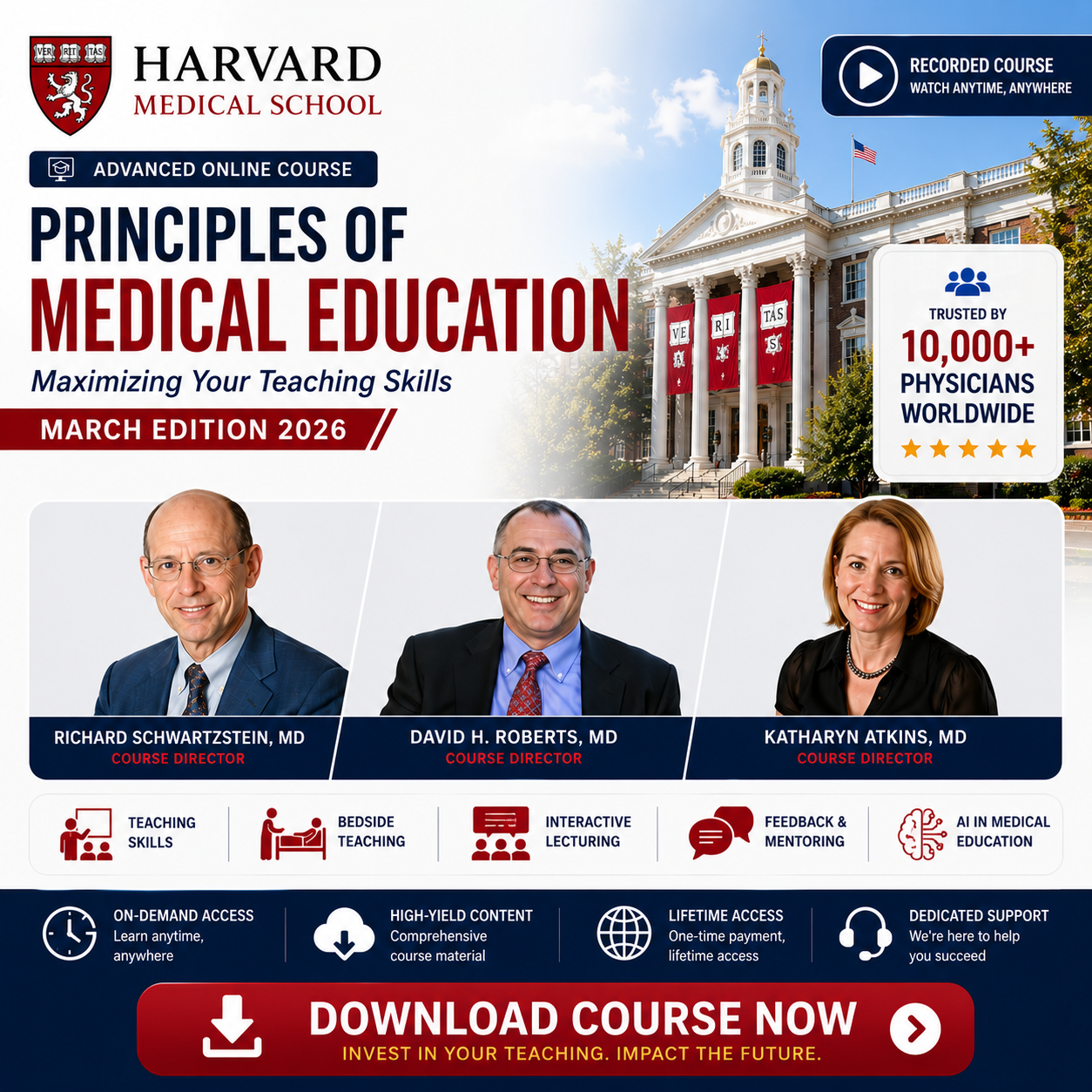
Harvard Principles of Medical Education: Maximizing Your Teaching Skills 2026
A practical medical education course designed to help clinical faculty, medical educators, program directors, and healthcare professionals improve teaching skills, learner engagement, curriculum design, feedback, mentoring, assessment, and modern educational strategies.
Harvard Principles of Medical Education: Maximizing Your Teaching Skills March Edition 2026 — recorded medical education course package focused on clinical teaching, adult learning, curriculum development, assessment, feedback, mentorship, and educational leadership.
About This Course
Harvard Principles of Medical Education: Maximizing Your Teaching Skills 2026 provides a structured and practical review of modern teaching strategies for clinical faculty and medical educators.
The course focuses on effective teaching, bedside instruction, small group learning, curriculum design, assessment of competence, learner feedback, professionalism, simulation, interprofessional education, mentoring, well-being, implicit bias, and the growing role of artificial intelligence and emerging technologies in medical education.
Why Choose This Course
Key Highlights
- Designed for medical educators and clinical faculty
- Practical strategies for bedside, ambulatory, and classroom teaching
- Modern approaches to learner engagement and adult learning science
- Sessions on AI, digital tools, simulation, and emerging technologies
- Guidance on feedback, assessment, mentoring, professionalism, and well-being
Topics Covered
Effective teaching, learner engagement, bedside teaching, and small group instruction.
Best practices for creation, implementation, evaluation, and educational improvement.
Determining competence, coaching learners, and giving powerful, efficient feedback.
Teaching in the world of AI, emerging technology, simulation, and digital learning.
Complete Curriculum
Foundations of Effective Teaching
- Effective Teaching: Setting the Stage
- Teaching in the 21st Century: Leveraging the Science of Learning
- Designing and Delivering More Effective Lectures
- Skills and Strategies to Improve Small Group Teaching
- Clinical Bedside Teaching: Effective Techniques and Overcoming Barriers
Clinical Reasoning, Professionalism & Bias
- Defining, Teaching, and Assessing Critical Thinking and Clinical Reasoning
- Teaching Professionalism: Strategies for the Frontline
- Strategies to Reduce Implicit Bias
- Interprofessional Teaching: From Parallel Practice to Partnership
Assessment, Feedback & Learner Support
- Assessment of Learning: Determining Competence
- Feedback: Making it Powerful, Effective, and Efficient
- Coaching for Success: Supporting Trainee Well-Being and Your Own
- Mentoring for the Future: Combating Burnout and Attrition
Curriculum, Simulation & Leadership
- Curriculum Design: Best Practices for Creation, Implementation and Evaluation
- Meeting Learners Where They Practice: Bringing Simulation to the Clinical Environment
- Leading Effective Change in Medical Education
- Teaching in the Brave New World: AI and Emerging Technologies
Tangible Take-Home Sessions
- TANGIBLE TAKE HOME — SNAPPS
- Tangible Take Home Series — Concept Mapping Practice
- TANGIBLE TAKE HOME — Concept Mapping Part 1
- Faculty Introduction Videos
- Participant Introduction Videos
Who Should Take This Course
This course is designed for medical educators, clinical faculty, program directors, academic physicians, residency and fellowship educators, nurse practitioners, physician assistants, interprofessional clinical instructors, and healthcare professionals involved in teaching medical students, residents, fellows, or clinical teams.
Delivery & Access
Study at your own pace with recorded sessions.
Teaching skills, feedback, curriculum, assessment, and mentoring.
Includes AI, simulation, digital learning, and adult learning science.
[email protected]


Dr. Emily Carter, Medical Educator –
“Excellent course for improving medical teaching skills. The sessions on learner engagement, feedback, and curriculum design are very practical for clinical educators.”
Dr. Michael Anderson, Clinical Faculty Physician –
“This course gave me better strategies for teaching residents and medical students in busy clinical environments. Very clear and useful.”
Dr. Sarah Mitchell, Residency Program Director –
“A strong course for program directors. The assessment, feedback, mentoring, and learner support topics are highly relevant to graduate medical education.”
Dr. James Bennett, Internal Medicine Educator –
“Very practical and well organized. The course helped me improve how I teach clinical reasoning and bedside decision-making.”
Dr. Laura Thompson, Clerkship Director –
“The curriculum design and learner assessment sections are excellent. This course is very useful for anyone involved in medical student education.”
Dr. Daniel Roberts, Academic Physician –
“A valuable course for academic clinicians. The lectures provide practical tools for teaching, coaching, and evaluating learners.”
Dr. Olivia Harris, Simulation Educator –
“The simulation and clinical teaching sections are very helpful. I appreciated the focus on bringing learning into real clinical environments.”
Dr. Christopher Wilson, Faculty Development Director –
“Excellent faculty development course. The content is practical, modern, and directly applicable to improving teaching quality.”
Dr. Amanda Lewis, Medical Education Consultant –
“A comprehensive course for medical educators. It covers adult learning, curriculum planning, feedback, assessment, professionalism, and AI in education.”
Dr. Jonathan Miller, Clinical Instructor –
“This course helped me become more intentional in my teaching. The small group teaching and bedside teaching strategies are especially useful.”
Dr. Rebecca Collins, Associate Program Director –
“Very useful for residency leadership. The mentoring, trainee well-being, and assessment sessions provide practical guidance for everyday program challenges.”
Dr. David Parker, Emergency Medicine Educator –
“The course is excellent for physicians who teach in fast-paced clinical settings. The strategies are realistic and easy to apply.”
Dr. Natalie Brooks, Pediatric Medical Educator –
“I found the teaching and feedback frameworks very helpful. The course provides clear methods for improving learner engagement.”
Dr. Kevin Adams, Medical School Faculty –
“A strong course for faculty who teach medical students. The lectures on effective teaching and curriculum design are especially valuable.”
Dr. Maria Gonzalez, Health Professions Educator –
“The course gives a clear, practical approach to modern medical education. I especially liked the sessions on interprofessional teaching and learner support.”
Dr. Robert Evans, Hospital Medicine Educator –
“As a hospitalist who teaches on rounds, I found the bedside teaching and clinical reasoning sections extremely relevant.”
Dr. Hannah Morgan, Fellowship Program Director –
“The mentoring and coaching content is excellent. It offers practical strategies to support fellows and reduce burnout.”
Dr. William Turner, Clinical Skills Instructor –
“The course improved my approach to teaching clinical reasoning, critical thinking, and patient-centered communication.”
Dr. Sophia Ramirez, Medical Education Fellow –
“This is a great course for medical education fellows. It gives a strong foundation in teaching, assessment, feedback, and curriculum development.”
Dr. Brian Scott, Academic Hospitalist –
“Very practical course for academic hospitalists. The bedside teaching and learner feedback sessions are especially useful.”