
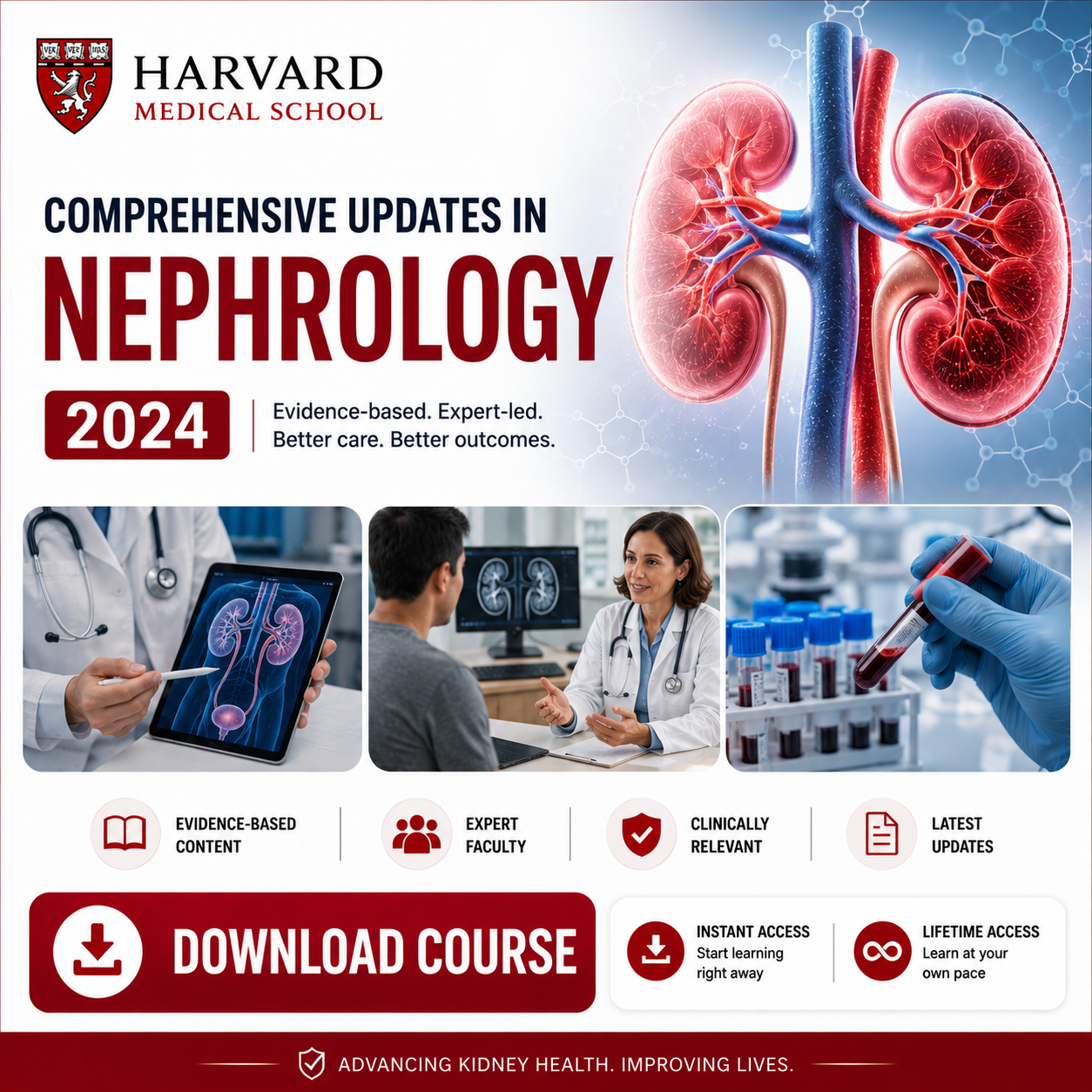

Harvard Comprehensive Updates in Nephrology 2024
A comprehensive Harvard nephrology update focused on the most important advances in kidney disease diagnosis, treatment, and management, with practical guidance in glomerular disease, acute kidney injury, dialysis, transplantation, hypertension, electrolytes, acid-base disorders, genetic kidney disease, renal imaging, lupus nephritis, and complex renal care.
Course Details:
Harvard Comprehensive Updates in Nephrology 2024 is a recorded 6-day course designed to provide clinicians with practical updates, evidence-based recommendations, and case-based teaching across the major areas of nephrology.
Focus: Glomerular disease, acute renal failure, kidney transplantation, xenotransplantation, immunosuppressive management, hypertension, pregnancy and renal disease, COVID-19, acid-base disorders, fluid and electrolyte disorders, potassium balance, renal imaging, bone mineral disorders, lupus nephritis, diuretic resistance, dialysis, renal stones, polycystic kidney disease, genetic renal diseases, cardiorenal syndrome, and hepatorenal syndrome.
About This Course
Nephrology continues to change quickly, with new evidence, updated guidelines, emerging diagnostic tools, evolving transplant strategies, advances in genetic testing, and new approaches to complex kidney disease management.
Harvard Comprehensive Updates in Nephrology 2024 provides a broad and practical review of important developments affecting kidney care. The course is designed to help clinicians incorporate new information into clinical practice and improve outcomes for patients with renal disease.
The program combines interactive lectures, expert discussions, and case-based sessions covering core nephrology topics, from glomerular disease and electrolyte disorders to transplantation, dialysis, hypertension, and genetic kidney disease.
Why Choose This Course
- Harvard 2024 comprehensive update covering the most important advances in nephrology
- Includes more than 50 interactive lectures and case-based sessions
- Reviews practical changes in diagnosis, screening, treatment, and management of kidney disease
- Covers glomerular disease, AKI, transplantation, dialysis, hypertension, electrolytes, acid-base disorders, and genetic renal diseases
- Includes expert discussions on IgA nephropathy, membranous nephropathy, minimal change disease, FSGS, and lupus nephritis
- Provides up-to-date guidance on kidney transplantation, immunosuppression, infections, malignancy, and transplant complications
- Useful for nephrologists, internists, hospitalists, primary care physicians, renal fellows, dialysis clinicians, nurses, NPs, PAs, and kidney care teams
Core Learning Areas
Glomerular & Immune Kidney Disease
IgA nephropathy, membranous nephropathy, minimal change disease, FSGS, lupus nephritis, immunosuppression, and evolving treatment approaches.
AKI, Electrolytes & Acid-Base
Acute kidney injury, acid-base disorders, fluid balance, potassium disorders, diuretic resistance, renal imaging, and complex inpatient nephrology.
Dialysis & Transplantation
Hemodialysis, peritoneal dialysis, dialysis access, transplant complications, infections, malignancies, immunosuppression, and xenotransplantation.
Chronic & Genetic Kidney Disease
Hypertension, polycystic kidney disease, renal stones, genetic testing, CKD clinic care, bone mineral disorders, pregnancy, cardiorenal and hepatorenal syndromes.
Complete Curriculum
- Most important updates and advances impacting nephrology practice
- Diagnosis and treatment of common and complex kidney diseases
- Practical clinical recommendations to improve patient care
- Case-based nephrology problem solving
- Evidence-based management strategies for renal disorders
- Integration of new guidelines into everyday nephrology practice
- Optimizing outcomes through updated screening, diagnosis, and treatment pathways
- Expert updates on IgA nephropathy
- Management of membranous nephropathy
- Minimal change disease diagnosis and treatment
- Focal segmental glomerulosclerosis updates
- Proteinuria evaluation and treatment planning
- Use of biopsy, biomarkers, and clinical risk stratification
- Practical approaches to treatment selection and monitoring response
- Clinical updates in lupus nephritis
- Modern treatment strategies for immune-mediated kidney disease
- Immunosuppressive treatment selection and monitoring
- Balancing efficacy, toxicity, and long-term renal preservation
- Risk stratification for progressive kidney injury
- Managing relapsing and refractory disease
- Coordinating nephrology and rheumatology care for complex patients
- Diagnosis and management of acute renal failure
- Risk factors and clinical patterns of acute kidney injury
- Renal imaging in acute and chronic kidney disease
- Fluid assessment and inpatient nephrology decision-making
- Kidney support strategies in hospitalized patients
- Recognizing reversible causes of kidney dysfunction
- Practical approaches to consultation, monitoring, and escalation of care
- State-of-the-art physiology of electrolyte disorders
- Acid-base disorder evaluation and interpretation
- Fluid balance and volume assessment
- Potassium balance and potassium disorder management
- Hyponatremia, hypernatremia, metabolic acidosis, and metabolic alkalosis
- Clinical reasoning for complex electrolyte cases
- Practical management strategies for inpatient and outpatient nephrology
- Latest guidelines and management options for hypertension
- Resistant hypertension and treatment intensification
- Hypertension in chronic kidney disease
- Cardiorenal syndrome and complex cardiovascular-kidney interactions
- Diuretic resistance and practical therapeutic approaches
- Risk reduction strategies for patients with kidney disease
- Optimizing blood pressure control while preserving kidney function
- Best practices for dialysis care
- Managing dialysis access and access complications
- Peritoneal dialysis principles and clinical management
- Complications of hemodialysis and peritoneal dialysis
- Fluid, electrolyte, and blood pressure issues in dialysis patients
- Care coordination for patients receiving renal replacement therapy
- Improving safety, access outcomes, and quality of dialysis care
- Comprehensive overview of kidney transplantation
- Infections after kidney transplantation
- Malignancies and transplant-related complications
- General complications in kidney transplant recipients
- Immunosuppressive management and treatment updates
- Novel therapies for transplant recipients
- Long-term monitoring and multidisciplinary care after transplantation
- Overview of xenotransplantation in kidney disease care
- Emerging transplant science and future clinical implications
- Transplant immunology and immunosuppression considerations
- Potential role of novel approaches in organ shortage challenges
- Clinical, ethical, and practical issues in emerging transplant strategies
- Monitoring advances in transplant research
- Preparing for future changes in renal replacement therapy
- Genetic renal diseases in nephrology practice
- Up-to-date guidance on genetic testing in the CKD clinic
- When genetic testing should be considered
- Interpreting genetic results in kidney disease evaluation
- Polycystic kidney disease updates
- Family counseling and risk assessment
- Integrating genetics into chronic kidney disease management
- Renal stone evaluation and prevention strategies
- Bone mineral disorders in kidney disease
- Calcium, phosphate, PTH, and vitamin D considerations
- Complication management in chronic kidney disease
- Metabolic evaluation of recurrent stones
- Long-term monitoring of CKD-related mineral disorders
- Practical treatment plans for reducing complications and preserving kidney health
- Pregnancy and renal disease
- Risk assessment for kidney disease during pregnancy
- Management of hypertension and proteinuria in pregnancy
- COVID-19 and kidney disease considerations
- Renal complications in medically complex populations
- Patient counseling and multidisciplinary care planning
- Special considerations for high-risk kidney disease patients
- Cardiorenal syndrome evaluation and management
- Hepatorenal syndrome and renal complications of liver disease
- Volume management in heart, liver, and kidney disease overlap
- Diuretic resistance and complex fluid balance problems
- Risk stratification in multiorgan disease
- Coordinating nephrology, cardiology, hepatology, and critical care management
- Practical strategies for complex renal syndromes in hospitalized patients
Learning Objectives
- Apply recent updates and advances in the diagnosis and management of kidney diseases
- Use current guidance for hypertension management in patients with renal disease
- Improve clinical decision-making in glomerular diseases including IgA nephropathy, membranous nephropathy, minimal change disease, FSGS, and lupus nephritis
- Manage acute kidney injury, renal imaging decisions, and inpatient nephrology problems more effectively
- Interpret and treat complex acid-base, fluid, electrolyte, and potassium disorders
- Apply best practices for dialysis access, peritoneal dialysis, and dialysis complications
- Understand kidney transplantation complications, infections, malignancies, immunosuppression, and novel therapies
- Recognize the role of genetic testing in the CKD clinic and hereditary renal disease evaluation
- Evaluate renal stones, bone mineral disorders, polycystic kidney disease, pregnancy-related renal disease, and special kidney populations
- Use practical strategies for cardiorenal syndrome, hepatorenal syndrome, diuretic resistance, and complex multidisciplinary kidney care
Who Should Take This Course
This course is designed for nephrologists, internists, hospitalists, primary care physicians, renal fellows, dialysis clinicians, nurses, nurse practitioners, physician assistants, pharmacists, and healthcare professionals involved in kidney disease care.
It is especially useful for clinicians who manage patients with glomerular disease, acute kidney injury, chronic kidney disease, hypertension, electrolyte disorders, dialysis needs, kidney transplantation, renal stones, genetic renal disease, lupus nephritis, or complex cardiorenal and hepatorenal syndromes.
Delivery & Access
Recorded Course
Review the comprehensive nephrology update sessions at your own pace.
2024 Edition
Updated kidney disease education with practical clinical recommendations.
50+ Sessions
Includes lectures and case-based discussions across major nephrology topics.
Support
Reviews
Dr. Jessica Chen
A valuable nephrology update with strong emphasis on recent advances and practical clinical applications.
Dr. Michael Patel
Excellent multidisciplinary teaching with useful guidance for kidney disease diagnosis and management.
Dr. Sarah Thompson
A thorough course that provides clear updates in current nephrology practice and patient care.
FAQ
Who is this course best suited for?
This course is best suited for nephrologists, internists, hospitalists, primary care physicians, renal fellows, dialysis clinicians, nurses, nurse practitioners, physician assistants, pharmacists, and kidney care teams.
What topics are covered?
Topics include glomerular disease, acute renal failure, kidney transplantation, xenotransplantation, immunosuppressive management, hypertension, pregnancy and renal disease, COVID-19, acid-base disorders, fluid and electrolyte disorders, potassium balance, renal imaging, bone mineral disorders, lupus nephritis, diuretic resistance, dialysis, renal stones, polycystic kidney disease, genetic renal diseases, cardiorenal syndrome, and hepatorenal syndrome.
Does this course cover glomerular disease?
Yes. The course includes expert discussion of IgA nephropathy, membranous nephropathy, minimal change disease, FSGS, lupus nephritis, and immune-mediated kidney disease.
Does this course cover kidney transplantation?
Yes. The course reviews kidney transplantation, transplant-related infections, malignancies, general complications, immunosuppressive management, and novel therapies.
Is this course practical for daily nephrology practice?
Yes. The course is designed to provide practical updates, case-based learning, diagnostic guidance, treatment strategies, and recommendations that can be incorporated into patient care.
Is this a recorded course?
Yes. This product is provided as recorded course access so you can review the material at your own pace.
Does this course include CME or a certificate?
No. CME credits and certificates are not included with this course package.
Who can I contact for support?
You can contact support at [email protected].


Dr. Jessica Chen, Clinical Researcher –
"This course exceeded my expectations! The emphasis on recent advancements in nephrology and their clinical applications was invaluable for my research and practice."
Dr. Emily Garcia, Dialysis Nurse –
"A fantastic learning experience! The course not only updated my knowledge but also equipped me with practical skills to improve my daily practice in nephrology."
Dr. Michael Patel, Renal Fellow –
"The faculty's expertise was remarkable. I appreciated the focus on multidisciplinary approaches to kidney disease management—definitely a must for any nephrology professional!"
Dr. Sarah Thompson, Nephrologist –
"The Harvard Comprehensive Updates in Nephrology course was outstanding! The latest research and clinical practices shared by experts have significantly enhanced my patient care."
Dr. James Lee, Internal Medicine Physician –
"This course provided a thorough overview of current nephrology trends. The engaging format and case discussions made the complex material accessible and applicable."