
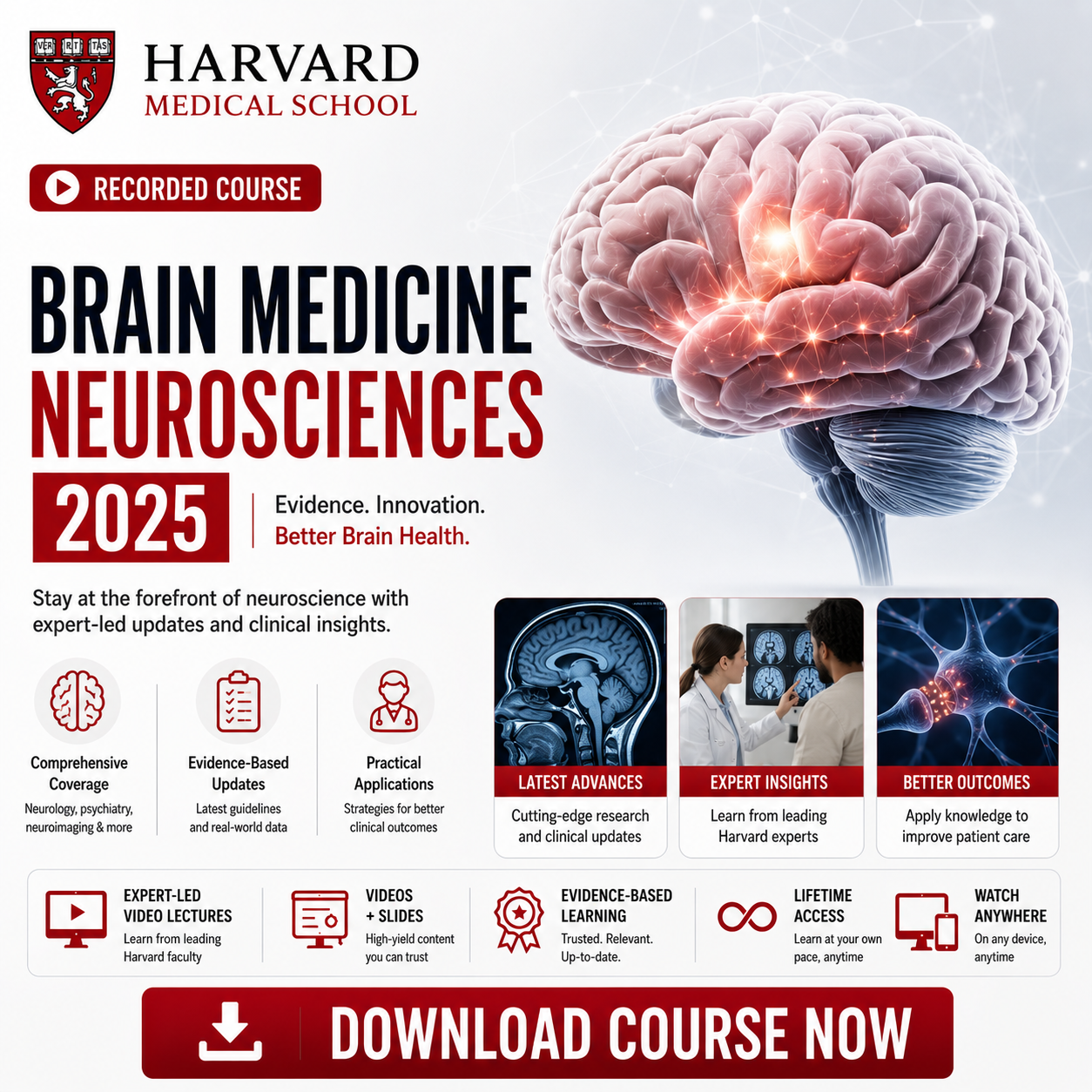
Harvard Brain Medicine: Integrating the Clinical Neurosciences 2025
A focused brain medicine course designed to integrate clinical and neuroscientific perspectives across neurology, psychiatry, neurorehabilitation, brain health, behavioral neurology, neuropsychiatry, geriatric neurology, and geriatric psychiatry for patients with complex brain disorders.
Harvard Brain Medicine: Integrating the Clinical Neurosciences 2025 is a recorded medical course focused on the integration of clinical neuroscience specialties involved in the care of individuals with complex brain disorders.
Focus: Brain medicine, brain health, biopsychosocial formulation, integrated neuroscience care, Alzheimer’s disease, gut-brain interactions, psychiatric care within neurology, chronic pain, functional restoration, frontotemporal dementia, cerebellar cognitive-affective syndrome, and collaborative care models.
About This Course
Brain medicine brings together the clinical and neuroscientific perspectives of neurology, psychiatry, neurorehabilitation, psychology, behavioral neurology, neuropsychiatry, geriatric neurology, and geriatric psychiatry. This integrated approach is especially important for patients whose symptoms affect cognition, behavior, emotion, perception, social cognition, pain, function, and sensorimotor ability.
This course provides a structured update on how clinicians can apply biopsychosocial formulation, precision medicine principles, and collaborative care models to complex brain disorders that do not fit neatly into one specialty.
Why Choose This Course
Key Highlights
- Focused 2025 Harvard course on brain medicine and clinical neuroscience integration
- Designed for clinicians caring for patients with complex brain disorders
- Covers cognition, behavior, emotion, perception, social cognition, pain, and sensorimotor function
- Emphasizes biopsychosocial formulation and patient-centered precision medicine
- Reviews integrated and collaborative care models across clinical neuroscience programs
- Includes topics in Alzheimer’s disease, gut-brain interactions, psychiatric care in neurology, chronic pain, functional restoration, FTD, and cerebellar cognitive-affective syndrome
- Useful for physicians, psychologists, NPs, PAs, nurses, social workers, and neuroscience care teams
Core Learning Areas
Complete Curriculum
Brain Medicine and Biopsychosocial Complexity
- Brain medicine as an integrated clinical neuroscience framework
- Addressing biopsychosocial complexity in complex brain disorders
- Applying patient-centered precision medicine principles
- Understanding how cognition, behavior, emotion, perception, and function interact
- Building a clinical formulation that integrates neurological, psychiatric, and rehabilitation perspectives
- Improving care for patients whose symptoms cross traditional specialty boundaries
Brain Health and Alzheimer’s Disease
- Brain health and Alzheimer’s disease: state of the science
- Current neuroscience perspectives on Alzheimer’s disease
- Cognitive decline and brain health risk concepts
- Clinical implications for multidisciplinary care
- How brain health strategies intersect with neurology, psychiatry, and geriatric care
- Patient-centered approaches to complex cognitive disorders
Integrative and Collaborative Care Programs
- How to build integrative and collaborative care programs
- Developing clinical neuroscience models across specialties
- Creating practical workflows between neurology, psychiatry, psychology, and rehabilitation
- Embedding psychiatric care within neurology
- Improving access to interdisciplinary brain disorder care
- Team-based care for complex clinical neuroscience patients
Gut-Brain Interactions and Integrated Care
- Disorders of gut-brain interactions
- Integrating care for patients with functional and neuropsychiatric overlap
- Clinical models for gut-brain symptom management
- Psychological, neurological, and medical perspectives in gut-brain disorders
- Interdisciplinary management of complex symptom presentations
- Applying biopsychosocial formulation to gut-brain interaction disorders
Psychiatry Within Neurology
- Embedding psychiatric care within neurology
- Recognition of neuropsychiatric symptoms in neurological patients
- Consultation-liaison psychiatry principles in clinical neuroscience care
- Behavioral and emotional symptoms in brain disorders
- Collaborative care between neurologists, psychiatrists, psychologists, and therapists
- Practical strategies for integrated clinic models
Chronic Pain and Functional Restoration
- The neural circuitry of chronic pain
- Psychosocial interventions for chronic pain
- Evidence-based approaches to chronic pain care
- Functional restoration as an interdisciplinary approach
- Enhancing function while managing pain
- Integrating neuroscience, psychology, rehabilitation, and patient goals
Frontotemporal Dementia and Clinical Translation
- Frontotemporal dementia: translating neuroscience to the clinic
- Clinical and behavioral manifestations of frontotemporal dementia
- Neuroscience-informed approaches to evaluation and management
- Communication with patients and families
- Interdisciplinary care needs in dementia syndromes
- Applying brain medicine principles to neurodegenerative disease
Cerebellar Cognitive-Affective Syndrome
- Cerebellar cognitive-affective syndrome
- Translating cerebellar neuroscience to clinical care
- Cognitive, emotional, and behavioral features of cerebellar disorders
- Recognition of underappreciated cerebellar presentations
- Integration of neurological and neuropsychiatric assessment
- Clinical implications for rehabilitation and multidisciplinary care
Case Integration and Clinical Application
- Applying integrated brain medicine principles in complex brain disorders
- Using biopsychosocial formulation in real-world clinical scenarios
- Developing collaborative care models across neuroscience disciplines
- Improving coordination across neurology, psychiatry, psychology, rehabilitation, and primary care
- Supporting patients with complex symptoms affecting cognition, behavior, emotion, perception, and function
- Practical strategies for building patient-centered treatment plans
Learning Objectives
By Completing This Course, You Will Be Able To:
- Apply biopsychosocial formulation to patients with complex brain disorders
- Work toward a patient-centered precision medicine approach in clinical neuroscience care
- Develop integrated and collaborative care models across the clinical neurosciences
- Apply brain medicine principles to complex disorders affecting cognition, behavior, emotion, perception, social cognition, and function
- Recognize how neurological, psychiatric, psychological, rehabilitation, and social factors interact in brain disorders
- Use interdisciplinary strategies for chronic pain, gut-brain disorders, neurodegeneration, and functional restoration
- Improve coordination between specialty physicians, primary care clinicians, psychologists, nurses, social workers, and rehabilitation teams
Who Should Take This Course
This course is designed for specialty physicians, neurologists, psychiatrists, physiatrists, geriatricians, primary care physicians, psychologists, nurse practitioners, physician assistants, nurses, social workers, rehabilitation professionals, residents, fellows, and clinicians involved in the care of patients with complex brain disorders.
Delivery & Access
This course package is provided for recorded learning access. No CME points are associated with this product.
Reviews
A valuable course for clinicians who care for complex brain disorder patients. The biopsychosocial framework and collaborative care sections are especially useful.
Excellent integration of neurology, psychiatry, psychology, and rehabilitation. The course gives a broader and more practical way to approach brain medicine.
Strong clinical neuroscience update. The chronic pain, gut-brain, dementia, and functional restoration topics are clear and applicable to patient care.
FAQ
Who is this course best suited for?
It is ideal for specialty physicians, primary care physicians, neurologists, psychiatrists, psychologists, NPs, PAs, nurses, social workers, rehabilitation professionals, residents, fellows, and clinicians involved in complex brain disorder care.
What topics are covered?
The course covers brain medicine, brain health, biopsychosocial formulation, integrated neuroscience care, Alzheimer’s disease, gut-brain interactions, psychiatric care within neurology, chronic pain, psychosocial pain interventions, functional restoration, frontotemporal dementia, cerebellar cognitive-affective syndrome, neuropsychiatry, behavioral neurology, geriatric neurology, and collaborative care models.
Is this course practical for clinical care?
Yes. The course focuses on practical integration across neurology, psychiatry, psychology, rehabilitation, primary care, and social care for patients with complex brain disorders.
Does this product include CME?
No. This course package does not include CME points.
Who can I contact for support?
You can contact us at [email protected].


Dr. Emily Carter –
“The course is recorded and uploaded to Google Drive, which made it incredibly convenient for me to revisit the material whenever I needed. The flexibility allowed me to learn at my own pace!”
Dr. Michael Nguyen –
“I loved that the entire course was recorded and available on Google Drive. It made accessing the lectures and slides so easy, and I could study whenever it fit my schedule.”
Dr. Angela Rodriguez –
: “This is the best online course I’ve taken. The material is up-to-date and very applicable to real-world scenarios.”
Dr. Peter Wong –
“I was struggling with certain neurological concepts, but this course clarified everything for me.”
Dr. Mark Robinson –
“I’ve gained a new perspective on patient care. My confidence in treating neurological disorders has significantly improved.”
Dr. Amanda Brooks –
“The community discussions were insightful. Sharing experiences with peers added a lot of value to the learning process.”
Dr. Sophia Martinez –
“I feel more equipped to handle complex cases now. Thank you for this outstanding educational experience!”
Dr. Kevin Smith –
“The combination of videos and slides makes learning engaging and effective. I look forward to each session!”