
Harvard NeuroRehabilitation 2025
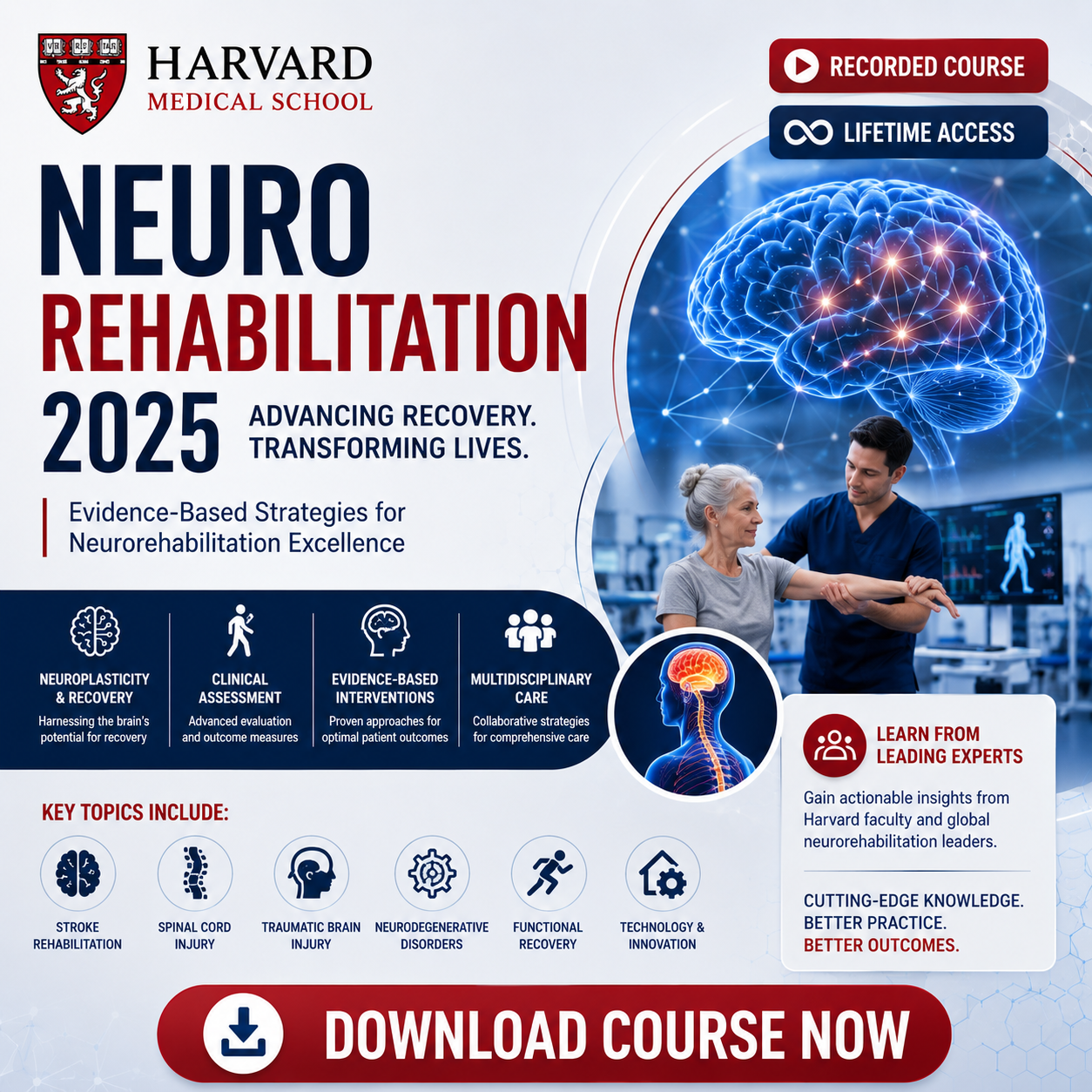
A comprehensive neurorehabilitation update focused on evidence-based strategies, practical tools, and emerging treatments for patients recovering from stroke, spinal cord injury, traumatic brain injury, functional neurologic disorders, degenerative neurologic disease, and complex rehabilitation conditions.
Harvard NeuroRehabilitation 2025 is a recorded medical course package focused on modern neurorehabilitation practice, recovery optimization, interdisciplinary care, functional outcomes, and quality-of-life strategies for patients with complex neurologic conditions.
Included: 44 videos, 47 PDF files, total size 21.2 GB.
About This Course
Patients with stroke, spinal cord injury, traumatic brain injury, functional neurologic disorders, and degenerative neurological disease often face major disruptions in mobility, cognition, communication, independence, emotional health, family life, and long-term function.
This course provides practical updates from experienced neurorehabilitation experts, with a focus on helping clinicians guide patients toward improved recovery, better participation, stronger function, and enhanced quality of life.
Why Choose This Course
Key Highlights
- Comprehensive 2025 neurorehabilitation update
- Includes 44 recorded videos and 47 downloadable PDF resources
- Covers stroke, TBI, SCI, functional neurologic disorders, ALS, dementia, and Parkinson’s disease
- Includes practical case studies, take-home tools, and evidence-based rehabilitation strategies
- Reviews emerging options such as AI, gamified treatment, brain-computer interfaces, and brain-spinal interfaces
- Useful for physicians, physiatrists, neurologists, therapists, psychologists, nurses, NPs, PAs, and rehabilitation teams
Core Learning Areas
Complete Curriculum
Neurorehabilitation Foundations
- Comprehensive updates in neurorehabilitation practice
- Evidence-based approaches to complex rehabilitation cases
- Guiding patients toward maximum function and participation
- Case-based strategies for clinical decision-making
- Take-home tools for practical rehabilitation care
- Interdisciplinary rehabilitation team coordination
Stroke Recovery & Post-Stroke Rehabilitation
- Models of stroke neurorecovery
- Life Participation Approach to Aphasia
- Vision rehabilitation after stroke
- Neglect and inattention after stroke
- The shoulder after stroke
- Lower extremity orthotics after stroke
- Wellness groups for stroke survivors
- Music therapy in stroke and Parkinson’s disease
Traumatic Brain Injury & Disorders of Consciousness
- Rehabilitation of memory disorders after TBI and stroke
- Rehabilitation of executive dysfunction after TBI and stroke
- Pediatric traumatic brain injury
- Mild TBI and PTSD in the military
- Chronic traumatic brain injury
- Severe TBI and disorders of consciousness
- Covert consciousness in severe TBI
- Common causes of diagnostic error in severe brain injury
- Domestic violence and traumatic brain injury
Spinal Cord Injury Rehabilitation
- Update on ASIA classification
- The perspective of people living with SCI
- Aging with spinal cord injury
- Autonomic dysfunction after SCI
- Women’s health after SCI
- Endocrine issues after SCI
- Resilience and adjustment during rehabilitation after SCI
- Musculoskeletal overuse in people with SCI
- Sports and exercise for people with SCI
Spasticity, Mobility & Musculoskeletal Care
- The management of spasticity
- Cryoneurolysis for spasticity
- Lower extremity orthotics after stroke
- The shoulder after stroke
- Early mobilization of patients in the ICU
- Functional mobility restoration
- Musculoskeletal rehabilitation after neurologic injury
Cognition, Behavior & Mental Health
- Rehabilitation of memory disorders after TBI and stroke
- Rehabilitation of executive dysfunction after TBI and stroke
- Improving psychological health after mild TBI
- Emotional and behavioral dyscontrol after TBI
- Pharmacologic approaches to aggressive behavior after TBI
- Pharmacologic treatment of dementia
- Psycho-pharmacogenomics in neurorehabilitation
- Resilience and psychological adjustment after neurological injury
Functional Neurologic Disorders & Degenerative Conditions
- Rehabilitation of functional neurologic disorders
- Update on amyotrophic lateral sclerosis
- Forced exercise for Parkinson’s disease
- Music therapy in Parkinson’s disease
- Chronic traumatic encephalopathy
- Functional and degenerative neurological disease management
- Quality-of-life strategies for long-term neurologic conditions
Pressure Ulcers, Obesity & Whole-Person Care
- Assessment and treatment of pressure ulcers after SCI
- Obesity and cardiometabolic disease in TBI, stroke, and SCI
- Approaches to obesity in neurorehabilitation
- Wellness interventions for stroke survivors
- Women’s health in SCI
- Improving participation, independence, and long-term quality of life
Technology, AI & Emerging Treatment Options
- Artificial intelligence and machine learning in neurorehabilitation
- Gamified neurorehabilitation strategies
- Brain-computer interfaces
- Brain-spinal cord interfaces
- Functional neuroimaging in disorders of consciousness
- Technology-supported recovery and future treatment directions
- When emerging treatments may impact patient outcomes
Learning Objectives
By Completing This Course, You Will Be Able To:
- Apply updated neurorehabilitation strategies for stroke, SCI, TBI, and functional neurologic disorders
- Use evidence-based approaches to improve recovery, function, participation, and quality of life
- Improve management of spasticity, mobility limitations, cognition, behavior, aphasia, and visual dysfunction
- Recognize rehabilitation needs in complex conditions such as ALS, Parkinson’s disease, dementia, and disorders of consciousness
- Integrate interdisciplinary care across medicine, therapy, nursing, psychology, and rehabilitation teams
- Evaluate emerging neurorehabilitation tools such as AI, gamified therapy, brain-computer interfaces, and brain-spinal interfaces
- Use practical tools and case-based strategies to support patients in achieving higher levels of function
Who Should Take This Course
This course is designed for physiatrists, neurologists, geriatricians, internists, family practitioners, physical therapists, occupational therapists, speech-language pathologists, nurse practitioners, physician assistants, nurses, psychologists, rehabilitation physicians, residents, fellows, and other healthcare professionals interested in neurological rehabilitation.
Delivery & Access
This course package is provided for recorded learning access. No CME points are associated with this product.
Reviews
A strong neurorehabilitation update. The stroke recovery, spasticity, and TBI sections are practical and useful for interdisciplinary rehabilitation care.
Excellent coverage of modern rehabilitation strategies. The course combines evidence-based updates with real-world clinical application.
Very useful for therapy teams. The cognitive rehabilitation, executive function, aphasia, and participation-focused sessions are especially helpful.
FAQ
Who is this course best suited for?
It is ideal for physiatrists, neurologists, geriatricians, internists, family practitioners, PTs, OTs, SLPs, NPs, PAs, nurses, psychologists, rehabilitation physicians, residents, fellows, and healthcare professionals interested in neurological rehabilitation.
What is included in the course package?
The package includes 44 recorded videos and 47 PDF files, with a total size of 21.2 GB.
What topics are covered?
The course covers stroke recovery, spinal cord injury, traumatic brain injury, functional neurologic disorders, mild TBI and PTSD, chronic traumatic encephalopathy, severe TBI and disorders of consciousness, aphasia, memory rehabilitation, executive dysfunction, spasticity, pressure ulcers, Parkinson’s disease, ALS, dementia, autonomic dysfunction after SCI, visual rehabilitation, AI, gamified treatment, psycho-pharmacogenomics, brain-computer interfaces, and brain-spinal interfaces.
Is this course practical for rehabilitation teams?
Yes. The course includes practical updates, case studies, take-home tools, and interdisciplinary strategies for helping patients improve recovery, function, participation, and quality of life.
Does this product include CME?
No. This course package does not include CME points.
Who can I contact for support?
You can contact us at [email protected].


Dr. Alex Vance, Neurologist: –
“The module on non-invasive brain stimulation (NIBS) protocols is worth the price alone. Clear, evidence-based, and immediately applicable. Finally, a course that bridges the gap between research and my clinic.”
Dr. Samira Khan, Physiatrist –
“As a busy rehab director, I can’t travel for conferences. This on-demand access to Harvard’s latest frameworks is a game-changer. The spasticity management section has already improved our interdisciplinary rounds.”
Dr. Leo Chen, Rehabilitation Physician –
“Comprehensive and current. The lectures on integrating robotics and VR gave my team the confidence to propose new equipment and protocols to our hospital admin, backed by solid data.”
Dr. Elena Rossi, Physical Therapist & Clinic Owner: –
“This isn’t just for physicians. As a PT, the advanced gait analysis and retraining techniques have revolutionized my approach to stroke rehab. My patients are hitting milestones faster.”
Dr. Ben Carter, Sports Neurologist –
“Applied the concussion and mild TBI protocols to my athletic population. The return-to-cognitive-activity framework is nuanced and far superior to the generic guidelines we were using.”
Dr. Priya N. , Neurohospitalist –
“Finally, a resource that doesn’t end at acute care. The early mobilization and neuroprotection strategies for inpatients are brilliant. It’s helping us set up better transitions to rehab.”
Dr. Marcus Thorne, MS Specialist –
“The fatigue and energy conservation module for progressive MS is a masterpiece. It provides practical, compassionate strategies that actually improve my patients’ quality of life.”
Dr. Anya Sharma, Occupational Therapist –
“The cognitive rehab section, especially on executive functions and dual-tasking, gave me a structured curriculum I’d been missing. My patients feel more engaged in their recovery.”
Dr. David Park, Resident in PM&R –
“This is the ultimate study guide for board prep and beyond. It synthesizes years of journals into clear clinical pathways. The downloadable slides are gold.”
Dr. Clara Mendez, Speech-Language Pathologist –
“The integrated approach to aphasia and cognitive-communication disorders is exceptional. It shows true collaboration between neurology and rehab, which is often lacking.”
Dr. Raj Patel, General Practitioner with Geriatric Focus –
“Even in primary care, this is invaluable. The falls prevention and mobility sections for patients with neurodegenerative conditions have made my consultations much more effective.”
Dr. Hannah Ford, Neuro-Psychologist –
“Addressing the behavioral and mood components of rehab is often an afterthought. This course places it front and center with actionable interventions. Highly recommended.”
Dr. Felix J. , Spinal Cord Injury Specialist –
“The updates on epidural stimulation and activity-based therapies for SCI are cutting-edge. It’s hard to find this level of detail compiled in one place. Excellent resource.”
Dr. Maria Torres, Nurse Practitioner in Neurology –
“This empowers me to have deeper, more informed conversations with our patients and their families about the rehab journey. A fantastic tool for advanced practice providers.”
Dr. Kenji Tanaka, Researcher & Clinician –
“A superb review of the mechanisms of neuroplasticity. It reinvigorated my clinical thinking and inspired new angles for my research. Accessible yet profoundly deep.”
Dr. Chloe Dubois, Pediatric Rehab Specialist –
“While adult-focused, the principles of motor learning and neuroplasticity are perfectly adaptable to my pediatric population. A very stimulating and thought-provoking course.”
Dr. Aris K., Hospital Administrator (former clinician): –
“To justify rehab resources, you need data and clear protocols. This course provides the clinical evidence and standardized frameworks needed to advocate for better department funding.”
Dr. Nora S., Tele-Rehabilitation Provider –
“In the remote care era, the course’s emphasis on functional outcome measures and home-based strategies is perfectly timed. It has directly shaped my virtual practice.”
Dr. Silas Reed, Pain Management Specialist –
“The neuropathic pain management component within the rehab context is outstanding. It offers a multimodal approach that goes beyond medication, which is exactly what my patients need.”
Dr. Lena Chow, Community Rehab Lead –
“This course bridges the gap between high-tech academic centers and real-world community clinics. The ‘low-tech/high-concept’ strategies are incredibly useful for resource-limited settings.”