
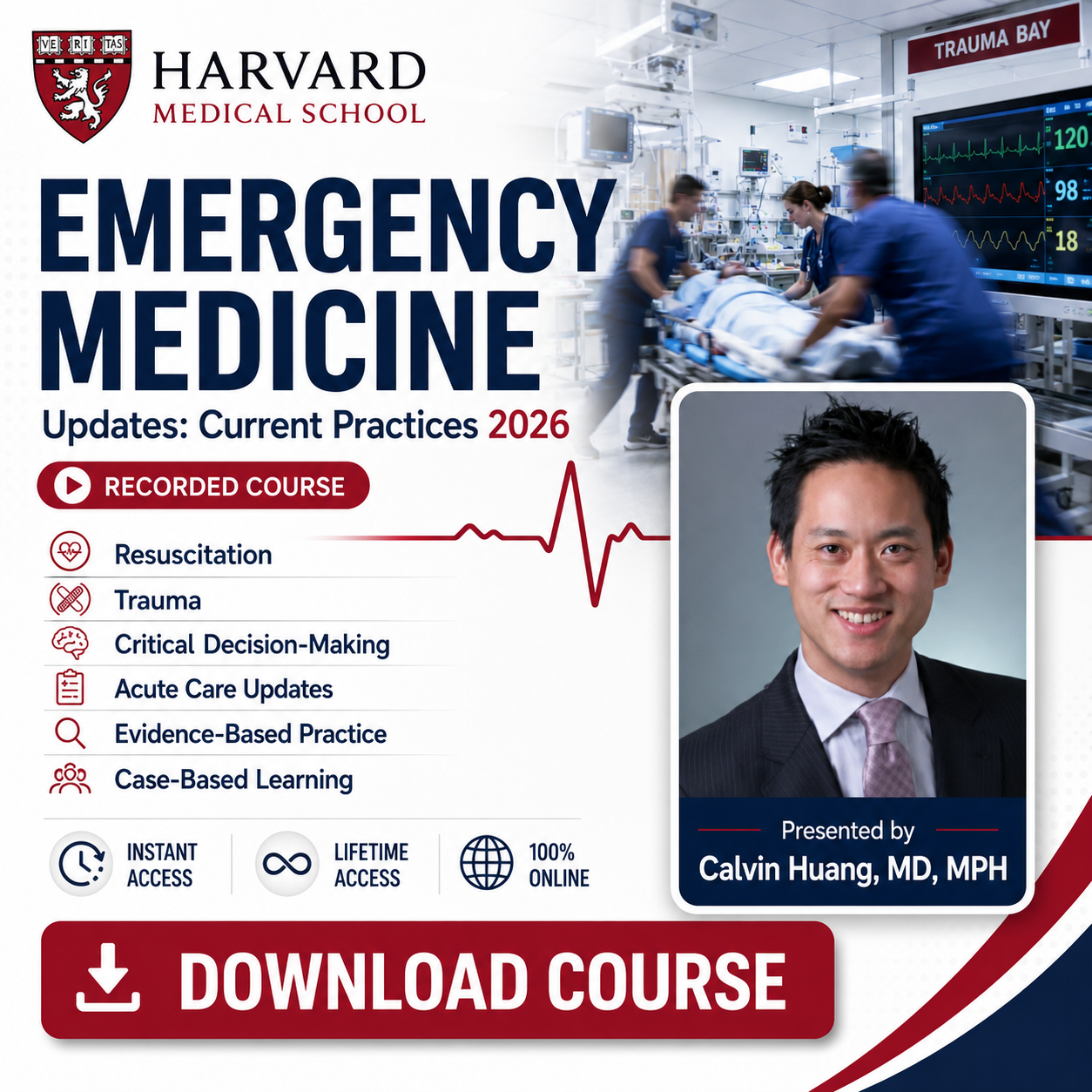
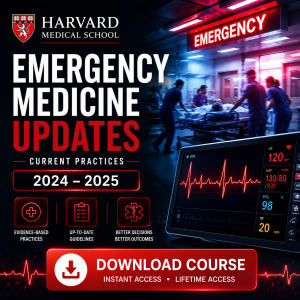
Harvard Emergency Medicine Updates & Current Practices 2026
A comprehensive, high-yield emergency medicine update covering POCUS, airway management, resuscitation, stroke protocols, trauma, AI in the ED, telemedicine, and practical clinical decision-making.
Harvard Emergency Medicine Updates & Current Practices 2026 — MGH Department of Emergency Medicine. Recorded course package with HD videos and downloadable PDF resources.
About This Course
Harvard Emergency Medicine Updates & Current Practices 2026 is designed for clinicians who want practical, evidence-based updates in modern emergency medicine. The course reviews critical advances across acute care, trauma, resuscitation, stroke, POCUS, airway management, emergency operations, clinical informatics, and patient-centered emergency care.
The program brings together expert-led teaching, real-world case discussions, and focused clinical updates to help emergency medicine professionals strengthen confidence in urgent decision-making.
Why Choose This Course
Key Highlights
- MGH Department of Emergency Medicine faculty
- 40+ topics covering emergency, trauma, critical care, and POCUS updates
- Focused review of cardiac arrest, stroke, airway, PE, septic shock, and ARDS
- AI, clinical informatics, telemedicine, and innovation in emergency medicine
- Recorded access designed for flexible learning
Learning Objectives
Complete Curriculum — 40+ Topics
Section 1 — Cardiac Emergencies & Resuscitation
- Cardiac Arrest
- Update on Ventricular Fibrillation Cardiac Arrest Treatment
- How to Read Ischemia on ECGs
- Recent Cardiologic Advances in EM
- 10 Things You Never Imagined About Monitoring Blood Pressure
Section 2 — Stroke, Trauma & Critical Care
- The 2026 Acute Ischemic Stroke Guidelines — Top 10 Take-homes
- Mild Head Trauma
- Cranial Nerve Deficits
- ARDS
- Current Concepts in Septic Shock Management
- Vasopressors and Shock Pearls
Section 3 — Airway & Respiratory Emergencies
- Airway Advances
- Echo in Pulmonary Embolism
- Practice Updates in Acute PE
Section 4 — POCUS Comprehensive
- POCUS — Cardiac and Lung
- POCUS — eFAST
- POCUS — Procedures
- POCUS — Pediatric Cases
Section 5 — Pediatric Emergency Medicine
- Current Practice in Newborn Fever
- Pediatrics — Bronchiolitis: What’s Known and What’s New
- Top Updates in PEM Literature 2025–2026
Section 6 — Geriatric Emergency Medicine
- Geriatric Falls
- Impact of Boarding on Geriatric Patients
- Atypical Presentations of Disease in Older Adults
- Multi-Factorial Fall Prevention Interventions
Section 7 — AI, Innovation & Telemedicine
- AI in the ED
- Clinical Informatics in the ED
- Predictive Model Evaluation
- Innovation in Emergency Medicine — Challenges and Opportunities
- Tele-Disaster Medicine
Section 8 — Trauma, Surgical & Environmental
- Emergency Management of Burns
- Hand Injuries — Case-Based Updates
- Wilderness Medicine & High Altitude Illness
- Frostbite Management in the ED
- On-Field Management of Medical Emergencies in Elite Athletes
Section 9 — Specialty Emergencies
- Ocular Emergencies
- Scrotal Pain in the ED
- Management of Postpartum Hemorrhage
- STIs in the ED
- ED Evaluation of Acute Psychiatric Complaints
Section 10 — Health Equity, Sustainability & Professional Practice
- Improving ED Patient Experience
- Practical Sustainability in Healthcare
- Health Equity as the Business of Emergency Medicine
- Professionalism in Emergency Medicine
Who Should Take This Course
Delivery & Access
Reviews
Very practical and clinically relevant. The POCUS and resuscitation sections were especially useful for daily ED practice.
Clear, organized, and easy to review. The recorded format made it simple to revisit key topics between shifts.
Excellent update course covering stroke, airway, shock, and emergency department innovations in a very practical way.
FAQ
Is this course recorded?
Yes. This is a recorded course package with HD videos and PDF resources.
When will I get access?
Access is provided after purchase so you can start learning right away.
Can I watch on any device?
Yes. You can access the course on phone, tablet, laptop, or desktop.
Who can I contact for help?
You can contact us at [email protected].
Start Learning Today
Get instant access to the complete Harvard Emergency Medicine 2026 course package.
DOWNLOAD COURSE


Dr. Emily Carter, Emergency Medicine Physician –
“Excellent emergency medicine update. The course gives a practical review of cardiac arrest, stroke, airway management, trauma, and POCUS in a very organized way.”
Dr. Michael Anderson, Acute Care Physician –
“A very useful course for clinicians working in acute care. The resuscitation and critical care sections are especially relevant for daily emergency practice.”
Dr. Sarah Mitchell, Critical Care Physician –
“The ARDS, septic shock, vasopressors, and respiratory failure topics are very practical. This course is valuable for physicians managing unstable patients.”
Dr. James Bennett, Emergency Department Physician –
“A strong and clinically focused course. The lectures are clear, updated, and directly applicable to ED decision-making.”
Dr. Laura Thompson, Urgent Care Physician –
“This course helped me refresh important emergency medicine topics, especially stroke, trauma, pulmonary embolism, and acute respiratory presentations.”
Dr. Daniel Roberts, Emergency Medicine Consultant –
“Excellent coverage of modern emergency care. The POCUS, airway, cardiac arrest, and shock sections are especially helpful.”
Dr. Olivia Harris, Trauma Physician –
“The trauma-related topics are practical and well presented. I appreciated the updates on mild head trauma, burns, hand injuries, and emergency stabilization.”
Dr. Christopher Wilson, Emergency Medicine Specialist –
“A comprehensive course for emergency physicians who want a concise but high-yield update on current ED practice.”
Dr. Amanda Lewis, Hospital Medicine Physician –
“Very helpful for hospital-based clinicians who receive patients from the ED. The course improves understanding of resuscitation, shock, and acute care pathways.”
Dr. Jonathan Miller, Emergency Medicine Resident –
“This course is excellent for residents. The topics are organized clearly, and the case-based approach makes the material easier to remember.”
Dr. Rebecca Collins, POCUS Instructor –
“The POCUS content is excellent. The cardiac, lung, eFAST, procedural, and pediatric ultrasound topics are very useful for emergency practice.”
Dr. David Parker, Critical Care Consultant –
“Strong review of emergency critical care. The lectures on septic shock, ARDS, vasopressors, and ICU-level decisions are very practical.”
Dr. Natalie Brooks, Pediatric Emergency Physician –
“The pediatric emergency medicine sections are very helpful, especially newborn fever, bronchiolitis, and recent PEM literature updates.”
Dr. Kevin Adams, Emergency Physician –
“Excellent update on cardiac emergencies. The cardiac arrest, ventricular fibrillation treatment, ECG ischemia, and cardiology advances are very relevant.”
Dr. Maria Gonzalez, Stroke Medicine Physician –
“The stroke content is very useful. The course provides a clear review of acute ischemic stroke updates and practical ED decision-making.”
Dr. Robert Evans, Emergency Medicine Attending –
“A well-structured course with practical updates across resuscitation, airway, trauma, stroke, pulmonary embolism, and emergency operations.”
Dr. Hannah Morgan, Emergency Medicine Fellow –
“The course helped me strengthen my confidence in high-acuity emergency cases. The recorded format makes it easy to revisit difficult topics.”
Dr. William Turner, Pulmonary & Critical Care Physician –
“The respiratory emergency sections are excellent. I found the PE, ARDS, airway, and shock discussions especially valuable.”
Dr. Brian Scott, Emergency Department Director –
“A practical course for ED leaders and clinicians. The innovation, clinical informatics, AI, and patient experience sections add strong value.”
Dr. Rachel Green, Family Medicine Physician –
“This course is useful for family physicians working in urgent care or emergency settings. The acute care topics are clear and clinically relevant.”
Dr. Mark Phillips, Emergency Medicine Specialist –
“Excellent balance between critical care, trauma, POCUS, pediatric emergencies, geriatric care, and professional practice topics.”
Dr. Jessica Allen, Women’s Emergency Care Physician –
“The postpartum hemorrhage and specialty emergency topics are very useful. The course gives practical ED-focused management updates.”
Dr. Thomas Rivera, EMS Medical Director –
“The on-field emergencies, tele-disaster medicine, and resuscitation sections are highly relevant for EMS and emergency response planning.”
Dr. Katherine Moore, Emergency Nurse Practitioner –
“Very practical for advanced practice providers in the ED. The course is organized, clinically focused, and easy to review.”
Dr. Patrick Young, Sports Medicine Physician –
“The emergency management of elite athlete medical events and wilderness medicine topics are excellent additions to the course.”
Dr. Melissa Cooper, Emergency Medicine Physician –
“The airway and respiratory topics are very helpful. The lectures provide clear updates that can be applied immediately in the ED.”
Dr. Victoria Reed, Acute Care Nurse Practitioner –
“The recorded format is very convenient. The videos and PDF resources make it easy to study around clinical shifts.”
Dr. Benjamin Foster, Trauma and Emergency Physician –
“Great review of trauma, burns, hand injuries, head trauma, and critical emergency management. Very useful for real ED practice.”
Dr. Elizabeth Howard, Emergency Medicine Consultant –
“The AI, clinical informatics, and predictive model sections are very interesting and relevant to the future of emergency medicine.”
Dr. Samuel Price, Internal Medicine Physician –
“This course is helpful for internists who manage acute deterioration, sepsis, pulmonary embolism, respiratory failure, and urgent inpatient transfers.”
Dr. Caroline Baker, Emergency Physician –
“The specialty emergency topics are very practical, including ocular emergencies, scrotal pain, STIs, psychiatric complaints, and postpartum hemorrhage.”
Dr. Nicholas Ward, Critical Care Fellow –
“Excellent emergency critical care review. The shock, vasopressor, ARDS, and resuscitation topics are especially useful for ICU and ED practice.”
Dr. Grace Edwards, Emergency Medicine Specialist –
“A complete and clinically useful emergency medicine update. The course covers modern ED practice, patient safety, equity, innovation, and high-acuity care.”