
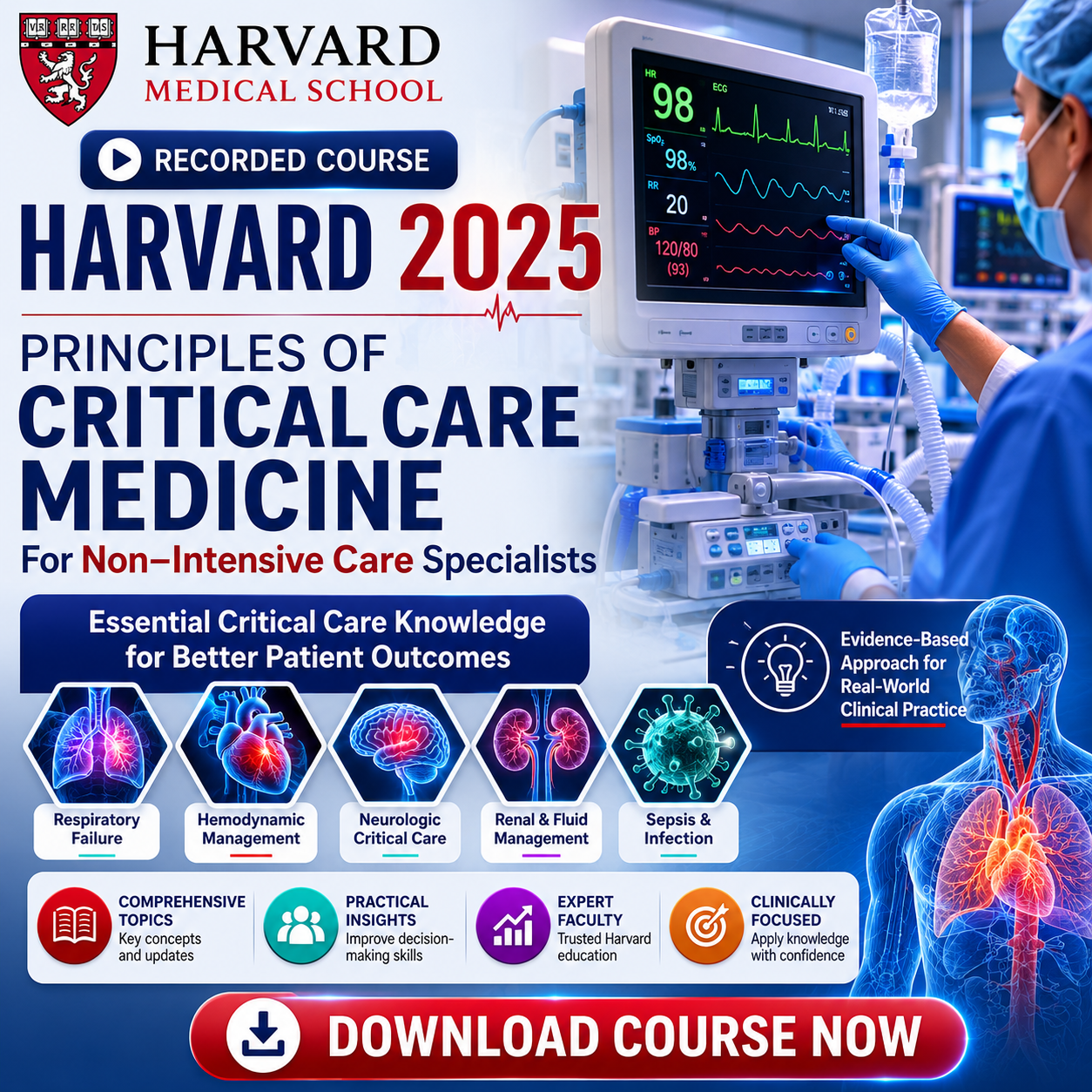
Harvard 2025 Principles of Critical Care Medicine for Non-Intensive Care Specialists
A comprehensive critical care medicine course designed for clinicians who manage high-acuity patients outside the ICU. This program translates core ICU concepts into clear, practical strategies for emergency, inpatient, perioperative, and acute care settings.
Harvard 2025 Principles of Critical Care Medicine for Non-Intensive Care Specialists is a recorded medical course package focused on the practical management of critically ill patients for clinicians who regularly encounter high-acuity situations but are not formally trained intensivists.
Included: 81 recorded videos, 67 PDF resources, total size 160.66 GB.
About This Course
Critically ill patients are frequently managed first by emergency physicians, hospitalists, surgeons, cardiologists, primary care physicians, advanced practice providers, nurses, pharmacists, and other acute care clinicians before ICU teams become fully involved.
This course bridges that gap by providing practical, evidence-based updates in core critical care topics including respiratory failure, shock, hemodynamics, oxygenation, mechanical ventilation, POCUS, ARDS, pulmonary embolism, sedation, delirium, and patient-centered ICU care.
Why Choose This Course
Key Highlights
- Comprehensive 2025 critical care course for non-intensivist clinicians
- Includes 81 recorded videos and 67 downloadable PDF resources
- Practical focus on high-acuity patients and early critical care decision-making
- Covers mechanical ventilation, shock, ARDS, pulmonary embolism, POCUS, sedation, and delirium
- Designed for emergency medicine physicians, hospitalists, primary care physicians, surgeons, cardiologists, PAs, NPs, nurses, pharmacists, and acute care clinicians
- Helps clinicians strengthen confidence and competence in managing critically ill patients
Core Learning Areas
Complete Curriculum
Critical Care Foundations
- Core principles of critical care medicine for non-intensivists
- Approach to the unstable patient
- Early recognition of high-acuity clinical deterioration
- Initial stabilization before ICU transfer
- Clinical reasoning in high-pressure environments
- Team-based acute care and escalation of care
Mechanical Ventilation & Oxygenation
- Mechanical ventilation fundamentals
- Initial ventilator settings and practical management
- Ventilator troubleshooting
- Non-invasive ventilation strategies
- Oxygenation and respiratory support
- High-risk respiratory failure scenarios
- Practical ventilator pearls for non-ICU clinicians
Shock, Hemodynamics & Resuscitation
- Management of shock and hemodynamic instability
- Identifying shock phenotypes
- Initial vasopressor management
- Fluid resuscitation and volume assessment
- Bedside hemodynamic evaluation
- Approach to hypotension and crashing patients
- Safe stabilization while awaiting ICU support
ARDS, Pulmonary Embolism & Respiratory Emergencies
- Evidence-based approaches to ARDS
- Respiratory failure management
- Pulmonary embolism diagnosis and treatment considerations
- Hypoxemia and oxygenation failure
- Multidisciplinary care for severe pulmonary emergencies
- Risk stratification in acute respiratory disease
Point-of-Care Ultrasound in Critical Care
- POCUS for rapid bedside assessment
- Cardiac ultrasound basics for acute care
- Lung ultrasound in respiratory failure
- Volume status and shock evaluation
- Using ultrasound to guide urgent decision-making
- Practical POCUS integration into non-ICU settings
Sedation, Analgesia, Delirium & ICU Patient Care
- Sedation principles in critically ill patients
- Analgesia and comfort in acute care
- Delirium recognition and management
- Humanizing critical care
- Patient-centered ICU practice
- Communication with families and care teams
- Safe transitions and continuity of critical care
High-Acuity Clinical Practice
- Critical care concepts for emergency physicians
- Critical care concepts for hospitalists and nocturnists
- Post-operative and surgical critical care issues
- Cardiovascular critical care considerations
- Acute care frameworks for rural and resource-limited settings
- Interdisciplinary decision-making in critically ill patients
Learning Objectives
By Completing This Course, You Will Be Able To:
- Strengthen confidence in managing critically ill patients outside the ICU
- Apply practical strategies for mechanical ventilation and ventilator troubleshooting
- Recognize and manage shock and hemodynamic instability
- Use non-invasive ventilation and oxygenation strategies appropriately
- Apply evidence-based approaches to ARDS and pulmonary embolism
- Use point-of-care ultrasound for rapid bedside assessment
- Improve sedation, analgesia, delirium management, and patient-centered ICU practice
- Bridge knowledge gaps between emergency stabilization and definitive ICU care
Who Should Take This Course
This course is designed for emergency medicine physicians, hospitalists, nocturnists, primary care physicians, cardiologists, surgeons, physician assistants, nurse practitioners, nurses, pharmacists, residents, fellows, and other clinicians involved in acute care or the early management of critically ill patients.
Delivery & Access
This course package is provided for recorded learning access. No CME points or certificate are associated with this product.
Reviews
A practical course for clinicians who need to bridge the gap between emergency stabilization and ICU-level care. The ventilator and shock sections are very useful.
Excellent for hospitalists managing unstable patients before ICU transfer. The modules on shock and initial vasopressor management are highly applicable.
Clear, practical, and confidence-building. The systematic approach to dyspneic and hypotensive patients is especially valuable for acute care settings.
FAQ
Who is this course best suited for?
It is ideal for emergency medicine physicians, hospitalists, nocturnists, primary care physicians, cardiologists, surgeons, PAs, NPs, nurses, pharmacists, residents, fellows, and clinicians involved in acute care.
What is included in the course package?
The package includes 81 recorded videos and 67 PDF resources, with a total size of 160.66 GB.
What topics are covered?
The course covers mechanical ventilation, ventilator troubleshooting, shock, hemodynamic instability, non-invasive ventilation, oxygenation strategies, ARDS, pulmonary embolism, POCUS, sedation, analgesia, delirium management, and patient-centered critical care.
Is this course useful for non-ICU clinicians?
Yes. The course is specifically designed for clinicians who encounter critically ill patients but are not formally trained intensivists.
Does this product include CME or a certificate?
No. This course package does not include CME points or a certificate.
Who can I contact for support?
You can contact us at [email protected].


Dr. Ben Carter, Emergency Medicine –
“A must-do for any ER doc. It bridges the gap between emergency stabilization and definitive ICU care. The lectures on ventilator management for the first 30 minutes were a game-changer for my practice. The Harvard faculty explain complex concepts with stunning clarity.”
Dr. Anya Sharma, Hospitalist –
“This course is exactly what I needed. As a hospitalist, I’m often the first to manage a crashing patient before the ICU team arrives. The modules on shock identification and initial vasopressor management were worth the price alone. Incredibly practical and immediately applicable.”
Dr. Maria Flores, General Surgeon –
“Finally, a critical care course that speaks to surgeons! It covers post-op complications, hemodynamic monitoring, and fluid management in a way that is directly relevant to my work. The downloadable PDFs are perfect for a quick review before a complex case.”
Sarah Jenkins, PA-C, Urgent Care –
“As a PA in an urgent care that sometimes gets unstable patients, this course has massively boosted my confidence. The systematic approach to the dyspneic or hypotensive patient is brilliant. The video format is engaging, and I could pause and rewind complex sections.”
Dr. David Chen, Neurology –
“Essential for neurohospitalists managing sick stroke or seizure patients. The section on managing BP and ICP in neuro-critical cases was exceptional. It provided a solid foundation for my collaborations with the ICU team. The knowledge feels current and evidence-based.”
Dr. Rebecca Jones, Family Medicine (Rural) –
“When you’re hours from a tertiary care center, these skills are vital. This course is like having a Harvard intensivist in your pocket. The practical procedures module and the ‘what to do while waiting for transfer’ scenarios are invaluable for rural providers.”
Dr. Mark Williams, Internal Medicine Resident –
“This was the best educational investment I made this year. It prepared me incredibly well for my ICU rotation. The faculty don’t just list facts; they teach you how to think like an intensivist. The Google Drive access made it easy to study on my own schedule.”
Dr. Alicia Brown, Cardiology Fellow –
“While I know the heart, this course filled the gaps in my knowledge of multi-system organ failure and sepsis management. The integration of cardiac output in the context of various shock states was expertly explained. Highly relevant for any cardiologist consulting in the ICU.”
Dr. Kevin Lee, Gastroenterology –
“I took this to better manage my patients with GI bleeds or hepatic failure on the wards. The lectures on coagulopathy and managing the crashing cirrhotic patient were outstanding. It has definitely improved my patient outcomes and my communication with critical care teams.”
Jennifer Lee, NP, Cardiology –
“A comprehensive yet digestible course. The breakdown of acid-base disorders and electrolyte management is the clearest I’ve ever encountered. The PDF slides are a fantastic resource I refer to constantly. Perfect for an NP looking to specialize or enhance their skills.”
Dr. Omar Patel, Anesthesiology (Ambulatory) –
“Even with my background, this was a fantastic refresher on the latest protocols in critical care medicine. It’s focused, high-yield, and cuts through the noise. Great for staying sharp and understanding the continuum of care after the patient leaves the OR.”
Dr. Chloe Davis, Pediatrics –
“While adult-focused, the core principles of hemodynamics and respiratory failure are universal. The thought processes and frameworks are directly transferable. A very valuable perspective for a pediatrician who occasionally admits to a higher level of care.”