
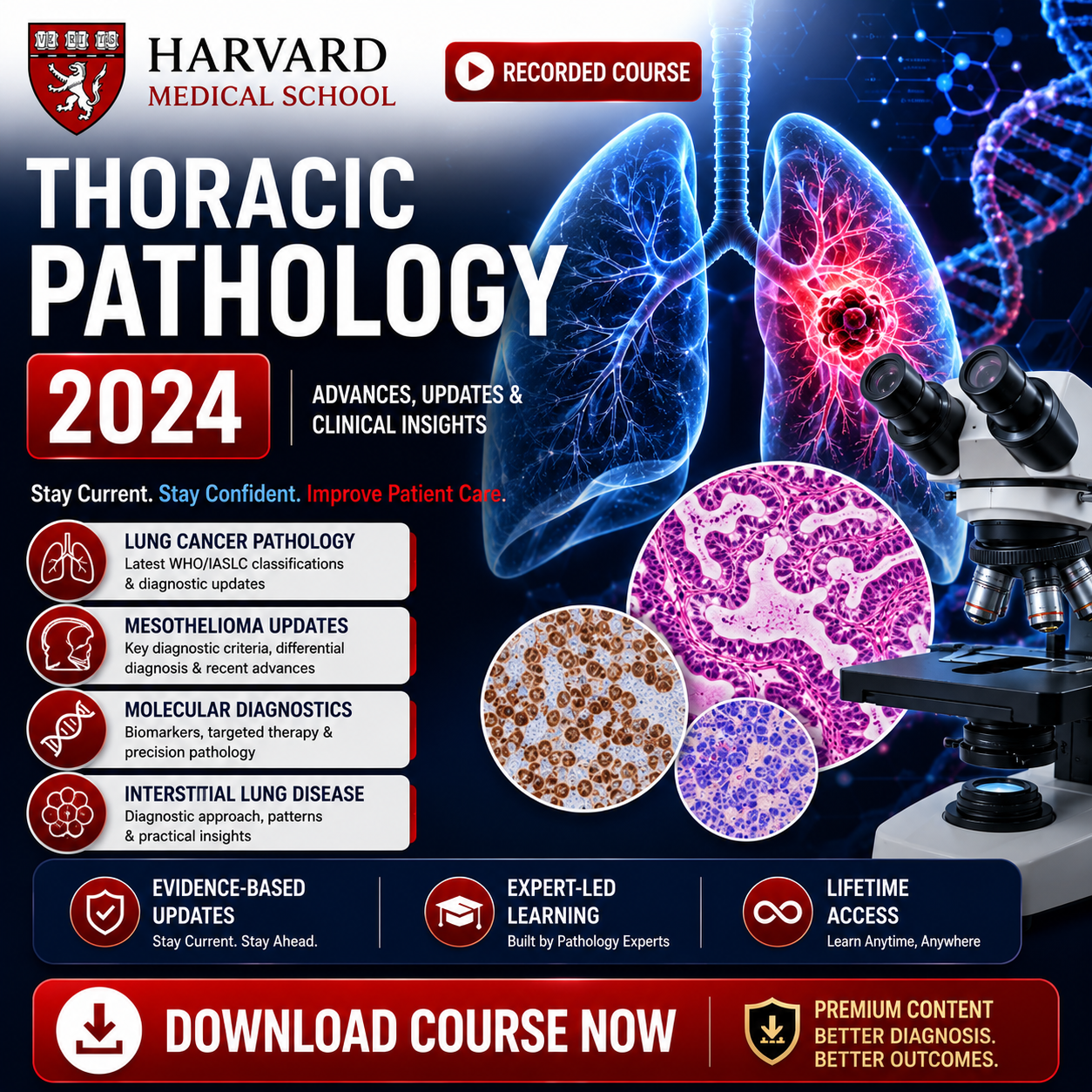
Harvard Thoracic Pathology 2024
A comprehensive thoracic pathology course focused on lung cancer, interstitial lung disease, molecular pathology, thoracic oncology, mesothelioma, mediastinal tumors, pulmonary infections, transplant pathology, radiologic-pathologic correlation, and multidisciplinary diagnostic practice.
Course Details:
Harvard Thoracic Pathology 2024 presents a broad review of thoracic pathology with clinical, radiologic, and molecular correlation. The course is designed to support diagnosis using conventional morphology, immunohistochemistry, molecular analysis, staging systems, and multidisciplinary discussion.
Focus: Lung cancer classification, molecular subsets of lung cancer, thoracic oncology, immunohistochemistry, small biopsies and cytology, lung cancer staging, radiologic-pathologic correlation, adenocarcinoma and squamous cell carcinoma variants, neuroendocrine tumors, interstitial lung disease, pulmonary infection, transplant pathology, malignant mesothelioma, mediastinal tumors, thymomas, lymphomas, tracheal tumors, soft tissue tumors, and thoracic tumor board discussion.
About This Course
Thoracic pathology is a rapidly evolving field that requires integration of morphology, immunohistochemistry, radiology, clinical information, molecular testing, surgical input, oncology treatment implications, and multidisciplinary collaboration.
Harvard Thoracic Pathology 2024 provides an in-depth review of pulmonary and mediastinal diseases, including neoplastic, inflammatory, infectious, interstitial, transplant-related, and tumor-like processes.
The course features didactic lectures, case-based presentations, extensive discussion, and multidisciplinary sessions designed to help clinicians and pathologists solve difficult diagnostic problems in thoracic disease.
Why Choose This Course
- Comprehensive 2024 thoracic pathology update with clinical, radiologic, and molecular correlation
- Focuses on diagnostic updates in lung cancer, interstitial lung disease, mesothelioma, mediastinal tumors, and thoracic neoplasia
- Covers conventional morphology, immunohistochemistry, cytology, small biopsy interpretation, and molecular analyses
- Includes multidisciplinary topics involving pathology, radiology, surgery, oncology, and pulmonology
- Reviews updated staging guidelines for lung cancer and diagnostic criteria for mesothelioma
- Includes tumor board discussion, mystery cases, Q&A sessions, and practical diagnostic pitfalls
- Useful for pathologists, pulmonologists, thoracic surgeons, radiologists, oncologists, residents, fellows, and physicians in training
Core Learning Areas
Lung Cancer Diagnosis
Lung cancer classification, molecular subsets, immunohistochemistry, small biopsies, cytology, predictive markers, staging, and tumor variants.
Interstitial Lung Disease
Pathology, radiology, clinical profiles, multidisciplinary discussion, hypersensitivity reactions, systemic disorders, and acute lung injury.
Thoracic Tumors
Mesothelioma, thymomas, mediastinal epithelial tumors, lymphomas, tracheal tumors, salivary gland-type tumors, and thoracic soft tissue tumors.
Molecular & Multidisciplinary Care
Molecular guidelines, radiologic-pathologic correlation, tumor board review, thoracic oncology updates, and multidisciplinary diagnostic practice.
Complete Curriculum
- Updates in classification and diagnosis in lung cancer
- Therapeutically relevant molecular subsets of lung cancer
- Current update in thoracic oncology and implications for pathologists
- What thoracic surgeons need from pathologists
- Diagnosis of lung cancer in small biopsies and cytology
- Variants of lung adenocarcinoma and squamous cell carcinoma
- Practical diagnostic strategies for lung cancer classification and reporting
- Immunohistochemistry for lung cancer diagnosis
- Immunohistochemistry for predictive markers in lung cancer
- Update on IASLC/AMP/CAP molecular guidelines for lung tumors
- Tissue requirements for clinical management of advanced lung cancer patients
- Integrating molecular analysis with morphology and immunohistochemistry
- Practical considerations in small biopsy and cytology specimens
- Using molecular results to support treatment-relevant diagnosis
- Staging of lung cancer
- Updated staging guidelines and clinical implications
- Radiologic-pathologic correlations in thoracic neoplasia
- Minimally invasive endobronchial techniques including robotic bronchoscopy
- Thoracic tumor board discussion
- Communication between pathology, surgery, oncology, radiology, and pulmonology
- Multidisciplinary approach to difficult thoracic cancer cases
- Neuroendocrine tumors of the lung
- Diagnostic criteria and classification of pulmonary neuroendocrine neoplasms
- Tumor-like lesions of the lung
- Distinguishing neoplastic from reactive and inflammatory mimics
- Clinical and radiologic correlation in tumor-like lesions
- Diagnostic pitfalls in challenging lung lesions
- Case-based learning for complex thoracic pathology presentations
- Pathology of interstitial lung disease
- Radiology of interstitial lung disease
- Clinical profile of interstitial lung disease
- International guidelines for care of patients with interstitial lung disease
- The pathologist’s role in multidisciplinary discussion for interstitial lung disease
- Multidisciplinary approach to interstitial lung disease diagnosis
- Integration of clinical, radiologic, and pathologic findings in ILD cases
- The spectrum of hypersensitivity reactions in the lung
- Lung manifestations of systemic disorders including IgG4-related disease and vasculitis
- Diagnostic approach to acute lung injury
- COVID-related lung disease
- Inflammatory and immune-mediated lung pathology
- Clinicopathologic correlation in acute and chronic lung injury
- Practical diagnostic considerations in complex inflammatory thoracic disease
- Pulmonary infection in thoracic pathology practice
- Recognizing infectious patterns in lung tissue
- Differentiating infection from inflammatory and neoplastic mimics
- Pathology of lung transplantation
- Transplant-related lung pathology and diagnostic challenges
- Clinical correlation in transplant and infection-related cases
- Practical approach to thoracic infection and transplant biopsies
- Pitfalls in intraoperative consultation for thoracic diseases
- Quality assurance issues in thoracic pathology
- Frozen section challenges and diagnostic limitations
- Communication with surgeons during intraoperative consultation
- Reducing diagnostic error in thoracic specimens
- Best practices for quality and safety in thoracic pathology workflow
- Practical pearls for difficult real-time diagnostic decisions
- Malignant mesothelioma
- Current diagnostic criteria for mesothelioma
- Clinicopathologic staging system for mesothelioma
- Unusual mediastinal and thoracic epithelial tumors
- NUT, SMARCA4, germ cell, and other unusual thoracic tumors
- Thymomas and their differential diagnoses
- Practical distinction of mediastinal tumors and mimics
- Pulmonary and mediastinal lymphomas
- Approach to lymphoid lesions in thoracic specimens
- Differentiating lymphoma from inflammatory and epithelial mimics
- Clinical and pathologic correlation in mediastinal lymphoid disease
- Immunohistochemical and ancillary testing considerations
- Diagnostic pearls for challenging lymphoma cases
- Reporting considerations for thoracic lymphoid neoplasms
- Tumors of the trachea
- Salivary gland-type tumors of the thorax
- Thoracic soft tissue tumors
- Diagnostic approach to rare thoracic neoplasms
- Use of morphology, immunohistochemistry, and molecular findings
- Differential diagnosis of uncommon thoracic tumors
- Practical case-based review of rare thoracic lesions
- Mystery thoracic pathology cases
- Expert faculty discussion of challenging diagnostic problems
- Case-based learning across lung, pleura, mediastinum, and thoracic soft tissue
- Diagnostic pearls and pitfalls from real-world cases
- Multidisciplinary problem-solving strategies
- Practical application of updated guidelines and diagnostic criteria
- Closing synthesis of major thoracic pathology updates
Learning Objectives
- Evaluate individual tests and tissue requirements for clinical management of advanced lung cancer patients
- Apply updated staging guidelines for lung cancer
- Analyze current diagnostic criteria for mesothelioma, including clinicopathologic staging systems
- Determine when to apply international guidelines for the care of patients with interstitial lung disease
- Improve diagnostic accuracy using morphology, immunohistochemistry, molecular testing, and radiologic correlation
- Recognize key thoracic oncology updates and their implications for pathologists
- Differentiate lung cancer variants, neuroendocrine tumors, tumor-like lesions, and inflammatory mimics
- Apply multidisciplinary approaches to thoracic pathology, including tumor board and ILD case discussion
- Identify diagnostic pitfalls in intraoperative consultation, small biopsies, cytology, and complex thoracic specimens
- Strengthen practical diagnostic confidence across lung, pleural, mediastinal, transplant, infectious, and soft tissue pathology
Who Should Take This Course
This course is designed for pathologists, pulmonologists, thoracic surgeons, radiologists, oncologists, specialty physicians, physician assistants, nurse practitioners, residents, fellows, and physicians in training involved in thoracic disease diagnosis and management.
It is especially useful for clinicians and diagnostic specialists who work with lung cancer, interstitial lung disease, thoracic tumors, mediastinal lesions, pulmonary infections, transplant pathology, and multidisciplinary thoracic disease care.
Delivery & Access
Recorded Course
Review the thoracic pathology sessions at your own pace.
2024 Edition
Updated thoracic pathology education with molecular and multidisciplinary correlation.
3-Day Program
Comprehensive review of lung cancer, ILD, mesothelioma, mediastinal tumors, and thoracic disease.
Support
Reviews
Dr. Anna T.
An excellent thoracic pathology course with strong case studies and practical discussion of complex pulmonary diseases.
Dr. Emily L.
A comprehensive overview of thoracic disease with useful diagnostic pearls for pathology practice.
Dr. John D.
Highly relevant content covering lung cancer, molecular testing, interstitial lung disease, and diagnostic techniques.
FAQ
Who is this course best suited for?
This course is best suited for pathologists, pulmonologists, thoracic surgeons, radiologists, oncologists, specialty physicians, physician assistants, nurse practitioners, residents, fellows, and physicians in training.
What topics are covered?
Topics include lung cancer classification, molecular subsets, thoracic oncology, immunohistochemistry, lung cancer staging, small biopsies and cytology, radiologic-pathologic correlation, neuroendocrine tumors, interstitial lung disease, pulmonary infection, lung transplantation, mesothelioma, mediastinal tumors, thymomas, lymphomas, tracheal tumors, salivary gland-type tumors, thoracic soft tissue tumors, and mystery cases.
Does this course cover molecular pathology?
Yes. The course reviews molecular subsets of lung cancer, molecular guidelines for lung tumors, predictive markers, and the role of molecular testing in clinical management.
Is this course practical for diagnostic thoracic pathology?
Yes. The course emphasizes morphology, immunohistochemistry, molecular testing, small biopsy diagnosis, cytology, staging, radiologic correlation, multidisciplinary discussion, and diagnostic pitfalls.
Is this a recorded course?
Yes. This product is provided as recorded course access so you can review the material at your own pace.
Does this course include CME or a certificate?
No. CME credits and certificates are not included with this course package.
Who can I contact for support?
You can contact support at [email protected].


Dr. Michael R., Pulmonologist –
“I found this course to be incredibly informative and well-structured. The combination of lectures and interactive discussions made it easy to engage with the material. I highly recommend it to anyone looking to deepen their knowledge in thoracic pathology.”
Michael Chen –
“I would recommend this course to anyone in the field. It was worth every penny, and having the recordings on Google Drive means I can revisit the material anytime!”
Dr. Anna T., Pathologist –
“The Harvard Thoracic Pathology Course was exceptional! The lectures were insightful and delivered by leading experts in the field. The detailed case studies provided practical applications that enhanced my understanding of complex thoracic conditions.”
Dr. Sarah K., Resident Physician –
“The Thoracic Pathology Course exceeded my expectations! The faculty were knowledgeable and approachable, and the course materials provided on Google Drive made it easy to review important topics later.”
Dr. John D., Internal Medicine Specialist –
“This course covered a broad range of topics in thoracic pathology, with a focus on the latest research and diagnostic techniques. I appreciated the flexibility of being able to access recorded sessions.”
Dr. Emily L., Anatomic Pathologist –
“A fantastic learning experience! The course provided a comprehensive overview of thoracic diseases, and the interactive components were particularly helpful. I feel much better equipped to handle thoracic pathology in my practice.”
Dr. Karen Smith –
“The recorded lectures were engaging, and the discussions provided a platform for deep dives into challenging topics. I learned so much!”
Emily Davis –
Well-Structured and Accessible
“The course was well-structured and accessible. The Google Drive format allowed me to learn at my own pace, which was a huge plus.”
Dr. Brian Thompson –
“The course content is highly relevant to current practices. It covers the latest advancements in thoracic pathology that every practitioner should know, all accessible via Google Drive.”
Jessica Lee –
“This course transformed my approach to thoracic pathology. The insights gained from the recorded sessions are invaluable for my career and patient care.”
Carlos Ramirez –
“The networking opportunities were fantastic! Connecting with other professionals in the field made the experience even more valuable, especially through shared resources.”
Dr. Lisa Nguyen –
“The practical applications discussed in this course were incredibly helpful. Having access to the recordings on Google Drive allowed me to revisit key concepts frequently.”
Sarah Patel –
“This course was comprehensive and engaging. The combination of recorded lectures and case studies made complex topics much easier to grasp.”
Michael Chen –
“The faculty were exceptional, and the resources provided, including the Google Drive recordings, were top-notch. They helped me deepen my expertise in thoracic pathology.”
Dr. Emily Johnson –
“I purchased the Thoracic Pathology course, and the recorded lectures on Google Drive provided in-depth knowledge that has significantly enhanced my understanding of pulmonary diseases. Highly informative!”