
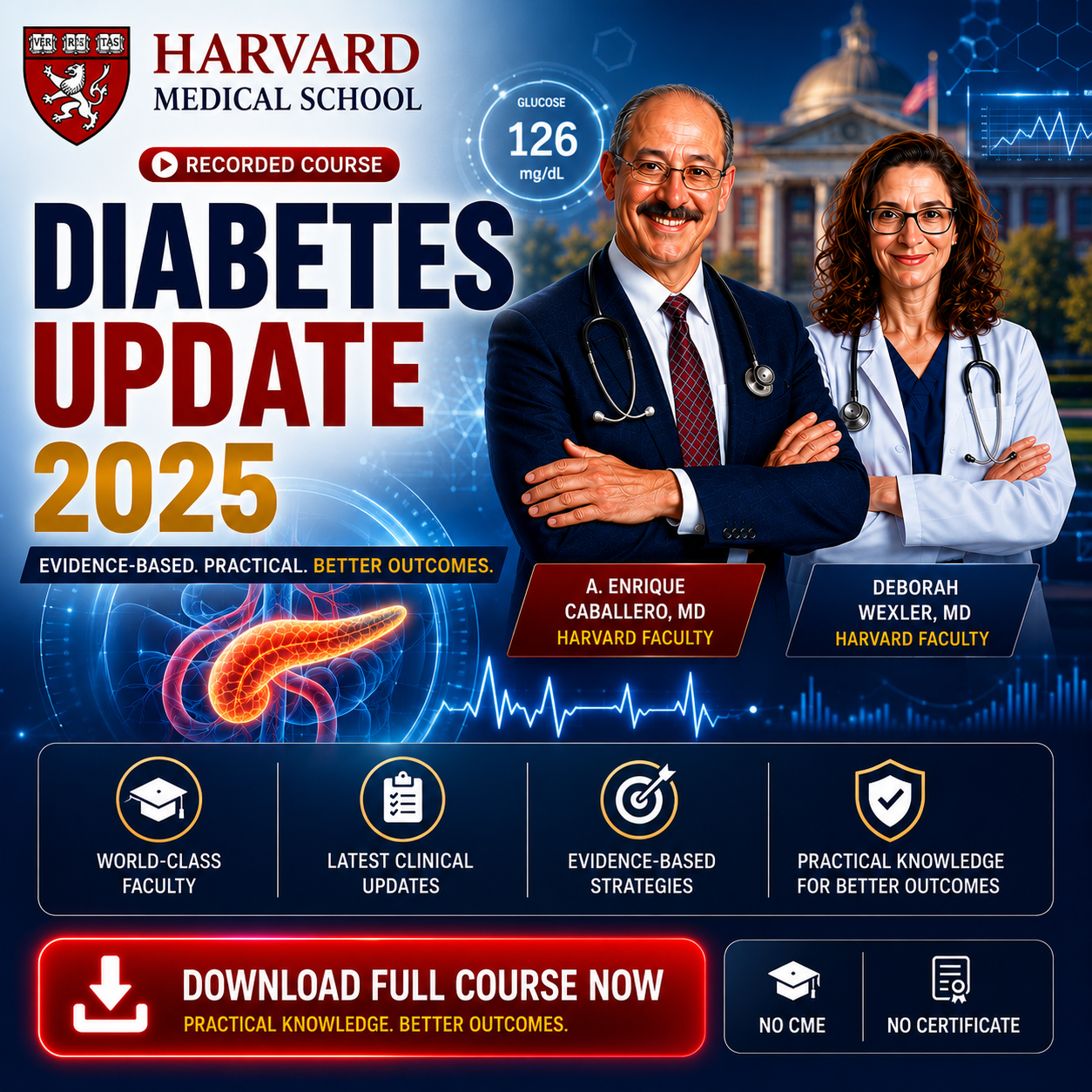
Harvard Diabetes Update 2025
A comprehensive Harvard diabetes update course designed to help clinicians stay current with practical, evidence-based strategies for modern diabetes care, including diagnosis, medication selection, technology advances, obesity management, cardiovascular and renal complications, nutrition, exercise, and long-term patient outcomes.
Course Details:
Harvard Diabetes Update 2025 is a complete recorded learning package focused on the latest clinical strategies, treatment options, and practice recommendations for improving diabetes outcomes in diverse patient populations.
Focus: Diabetes diagnosis, anti-diabetes medications, treatment planning, obesity care, lifestyle medicine, nutrition, exercise, cardiovascular disease, heart failure, renal disease, hypertension, dyslipidemia, MASLD, continuous glucose monitoring, insulin pumps, SGLT-2 inhibitors, GLP-1 receptor agonists, and practical patient-centered care.
About This Course
Diabetes care continues to evolve quickly with new medications, technologies, guidelines, and clinical strategies. At the same time, many patients still struggle to reach optimal control due to complex biological, psychological, social, financial, educational, cultural, and health-system factors.
Harvard Diabetes Update 2025 is designed to help clinicians meet these challenges with practical, evidence-based approaches that can be applied directly in clinical practice. The program focuses on designing more effective treatment plans, selecting and using current diabetes medications, identifying different types of diabetes, and using technology advances in daily care.
The course also provides guidance for optimizing care in patients with obesity, cardiovascular disease, heart failure, renal disease, metabolic-associated steatotic liver disease, hypertension, dyslipidemia, low engagement in therapy, low health literacy, depression or emotional distress, and other high-risk clinical situations.
Why Choose This Course
- Harvard 2025 diabetes update focused on practical clinical care
- Comprehensive review of current diabetes treatment strategies and best practices
- Covers anti-diabetes medications, diagnosis, technology, lifestyle medicine, nutrition, and physical activity
- Includes obesity management, medical and surgical approaches, and patient-centered care strategies
- Reviews cardiovascular disease, heart failure, renal disease, hypertension, dyslipidemia, and MASLD
- Provides practical guidance for diverse and high-risk patient populations
- Designed for endocrinologists, primary care physicians, internists, family physicians, residents, fellows, NPs, PAs, pharmacists, and diabetes care professionals
Core Learning Areas
Diagnosis & Treatment Planning
Identify different types of diabetes, design more effective treatment plans, and personalize therapy based on patient-specific clinical and social factors.
Medications & Technology
Review traditional and newer diabetes medications, insulin therapy, SGLT-2 inhibitors, GLP-1 receptor agonists, CGM, insulin pumps, and AI in diabetes care.
Obesity, Nutrition & Exercise
Explore medical nutrition therapy, physical activity, obesity management, lifestyle modification, pharmacologic obesity treatment, and surgical options.
Complications & Risk Reduction
Strengthen management of cardiovascular disease, heart failure, renal disease, hypertension, dyslipidemia, and metabolic-associated steatotic liver disease.
Complete Curriculum
- Is it Type 1 diabetes, Type 2 diabetes, or something else?
- Diabetes phenotypes and clinical classification
- Connection between diabetes phenotypes and social determinants of health
- Practical recommendations for identifying different diabetes presentations
- Patient-specific factors that influence diagnosis and treatment selection
- Improving diabetes care through better clinical recognition and classification
- Does when you eat matter?
- Intermittent fasting, circadian rhythms, and food order
- Current dietary recommendations in diabetes and obesity
- Medical nutrition therapy for patients with diabetes
- Practical nutrition counseling strategies
- Guiding patients on sustainable lifestyle and dietary changes
- Exercise recommendations in Type 2 diabetes and obesity
- Practical exercise planning for clinical practice
- Using physical activity as part of diabetes treatment
- Patient-centered approaches to improve adherence
- Exercise counseling for patients with obesity and metabolic disease
- Applying lifestyle medicine interventions in daily care
- Health implications of overweight and obesity
- Sleep disorders and obesity-related health risk
- Lifestyle modification in obesity
- Pharmacological management: what intervention and when
- Surgical management of obesity updates
- Medical vs. surgical management considerations
- Optimizing care for people with obesity and diabetes
- Dyslipidemia management in patients with diabetes
- Hypertension management in patients with diabetes
- Cardiovascular risk assessment and treatment planning
- Evidence-based risk reduction strategies
- Practical recommendations for lipid and blood pressure control
- Improving long-term outcomes through cardiometabolic care
- MASLD in patients with diabetes and metabolic disease
- 2025 vision for metabolic liver disease management
- Risk assessment and practical clinical considerations
- Relationship between obesity, diabetes, and liver disease
- Patient counseling and long-term monitoring
- Integrating metabolic liver care into diabetes management
- Coronary artery disease evaluation and management
- Heart failure in the patient with diabetes
- Cardiovascular complication prevention
- Practical recommendations for high-risk patients
- Linking diabetes treatment to cardiovascular outcomes
- Coordinated care for patients with complex cardiometabolic disease
- Evaluation of chronic kidney disease
- Prevention and management of chronic kidney disease
- Latest information on reducing renal disease risk in Type 2 diabetes
- Kidney protection strategies in modern diabetes care
- Clinical monitoring and risk stratification
- Integrating renal care into diabetes treatment planning
- Continuous glucose monitoring: a 2025 vision
- Insulin pumps and closing the loop
- New technologies in diabetes care and daily practice implications
- Using technology to support patient monitoring and treatment decisions
- Artificial intelligence in diabetes care: fact or fiction?
- Applying technology updates to improve patient outcomes
- Traditional medications: biguanides, sulfonylureas, TZDs, and alpha-glucosidase inhibitors
- Insulin therapy in patients with diabetes
- SGLT-2 inhibitors update
- GLP-1 receptor agonists update
- Mineralocorticoid receptor antagonists and their role in diabetes care
- Medication selection, safety, and practical treatment recommendations
- Overcoming lack of adherence to therapy and clinical inertia
Learning Objectives
- Identify different types of diabetes and apply appropriate clinical evaluation strategies
- Design more effective, individualized diabetes treatment plans
- Review current anti-diabetes medications and practical approaches to using them
- Apply new data and practice recommendations for nutrition and physical activity
- Evaluate medical and surgical approaches to obesity management
- Assess and treat cardiovascular disease, heart failure, renal disease, hypertension, dyslipidemia, and MASLD in patients with diabetes
- Understand technology advances including CGM, insulin pumps, and AI applications in diabetes care
- Use strategies to overcome low engagement, clinical inertia, and barriers within healthcare systems
- Provide more effective care for diverse and high-risk patient populations
- Apply evidence-based diabetes updates to improve patient outcomes in daily practice
Who Should Take This Course
This course is designed for endocrinologists, diabetologists, primary care physicians, internists, family medicine physicians, hospitalists, cardiologists, nephrologists, residents, fellows, nurse practitioners, physician assistants, pharmacists, diabetes educators, dietitians, and healthcare professionals involved in diabetes diagnosis, treatment, risk reduction, and long-term patient care.
Delivery & Access
Recorded Course
Review the course content at your own pace.
2025 Edition
Updated diabetes care, medication, technology, and complication management content.
Clinical Focus
Diagnosis, treatment planning, obesity, cardio-renal risk, lifestyle care, and technology.
Support
Reviews
Dr. Michael Carter
Excellent update for clinicians who want a clear and practical review of modern diabetes care and patient management.
Dr. Sarah Thompson
Very useful for daily clinical practice, especially the sections on medications, complications, and treatment planning.
Dr. Daniel Brooks
A well-structured course with clinically relevant insights for physicians managing diabetes and metabolic disorders.
FAQ
Who is this course best suited for?
This course is best suited for endocrinologists, primary care physicians, internists, family physicians, residents, fellows, NPs, PAs, pharmacists, diabetes educators, dietitians, and clinicians involved in diabetes care.
What topics are covered?
Topics include diabetes diagnosis, treatment planning, current anti-diabetes medications, obesity care, nutrition, exercise, cardiovascular disease, heart failure, renal disease, hypertension, dyslipidemia, MASLD, CGM, insulin pumps, SGLT-2 inhibitors, GLP-1 receptor agonists, MRAs, and AI in diabetes care.
Is this course practical for daily diabetes care?
Yes. The course focuses on practical, evidence-based strategies that can help clinicians improve treatment planning, medication selection, risk reduction, patient engagement, and long-term outcomes.
Does this product include CME?
No. CME points and certificates are not included with this course.
Is this a live course?
This product is provided as recorded course access, allowing you to review the material at your own pace.
Who can I contact for support?
You can contact support at [email protected].


Dr. Michael Carter, Endocrinologist –
“An excellent update on modern diabetes care. Dr. A. Enrique Caballero and Dr. Deborah Wexler explain complex concepts clearly. Highly recommended.”
Dr. Sarah Thompson, Internal Medicine –
“Fantastic course. The lectures from Dr. Caballero and Dr. Wexler were very practical for daily clinical practice.”
Dr. Daniel Brooks, Family Physician –
“A very well-structured course. The clinical insights shared by Dr. Caballero and Dr. Wexler are extremely valuable.”
Dr. Linda Foster, Endocrinologist –
“I learned several new strategies for managing difficult diabetes cases. Great explanations by Dr. Caballero.”
Dr. Ahmed Rahman, Internal Medicine –
“Excellent review of current diabetes therapies and technologies. Dr. Wexler’s lectures were outstanding.”
Dr. John Miller, Primary Care –
“Very practical course. The teaching style of Dr. Caballero makes complex topics easy to understand.”
Dr. Emily Chen, Endocrinology Fellow –
“A must-watch course for anyone treating diabetes patients.”
Dr. Kevin Hughes, Family Medicine –
“Great updates on GLP-1 and SGLT2 therapies. Very informative.”
Dr. Mark Patel, Internal Medicine –
“Excellent course organization and high-quality lectures.”
Dr. Susan Kim, Endocrinologist –
“The clinical case discussions were extremely helpful.”
Dr. Michael Anderson – Endocrinologist –
Excellent course with very practical updates on diabetes medications and technology. The lectures are clear and highly relevant to daily clinical practice.
Dr. Sarah Patel – Internal Medicine –
A very comprehensive update on diabetes care. The sections on GLP-1 and SGLT2 inhibitors were especially useful.
Dr. Daniel Roberts – Family Physician –
Great learning experience. The lectures are concise but full of important clinical pearls.
Dr. Ahmed Khalil – Endocrinologist –
Outstanding educational program. I appreciated the evidence-based discussion on cardiovascular risk management in diabetes.
Dr. Laura Mitchell – Primary Care Physician –
One of the best diabetes update courses I have taken. Very practical and well organized.
Dr. Kevin Brooks – Internal Medicine –
Excellent overview of modern diabetes therapy and complications. Highly recommended.
Dr. James Chen – Endocrinologist –
Very informative course with clear explanations of the newest treatment strategies.
Dr. Maria Gonzalez – Family Medicine –
I learned many practical strategies that I can immediately apply in my clinic.
Dr. David Thompson – Internist –
Fantastic course. The faculty presentations are engaging and clinically relevant.
Dr. Robert Wilson – Endocrinologist –
Excellent update on diabetes technology and modern pharmacologic therapies.
Dr. Emily Carter – Internal Medicine –
Very clear explanations of current guidelines and treatment options.
Dr. Emily Carter – Internal Medicine –
Very clear explanations of current guidelines and treatment options.
Dr. Omar Hassan – Primary Care –
Highly valuable educational resource for physicians managing diabetes patients.
Dr. Thomas Green – Endocrinologist –
Great lectures with practical tips on optimizing diabetes treatment plans.
Dr. Hannah Lee – Family Physician –
Well-structured course with a good balance between theory and clinical practice.
Dr. Carlos Ramirez – Internal Medicine –
Very helpful review of modern diabetes management and complications.
Dr. Patrick Sullivan – Endocrinologist –
Excellent update on emerging therapies and patient-centered care.
Dr. Rachel Kim – Primary Care Physician –
This course provides valuable insights into real-world diabetes management.
Dr. Steven Wright – Internist –
Very well presented. I particularly liked the discussions on obesity and cardiovascular risk.
Dr. Jonathan Miller – Endocrinologist –
Clear, concise, and extremely informative. Highly recommended for clinicians.
Dr. Linda Park – Internal Medicine –
Very informative course. The discussions on diabetes complications and prevention were particularly helpful.
Dr. Paul Richardson – Internal Medicine –
The course delivers a thorough review of diabetes care in a clear and engaging way.
Dr. William Carter – Endocrinologist –
Excellent educational material and well-organized lectures.
Dr. Nicole Bennett – Primary Care Physician –
Great course for clinicians managing patients with diabetes and metabolic disorders.
Dr. Jonathan Adams – Endocrinologist –
Highly detailed lectures that cover both fundamentals and advanced topics.
Dr. Megan Peterson – Internal Medicine –
A very valuable course with excellent educational content.
Dr. Anthony Baker – Family Physician –
I appreciated the clinical focus and real-world case discussions.
Dr. Sophia Martinez – Endocrinologist –
Very helpful update on diabetes medications and patient management.
Dr. Brian Foster – Internal Medicine –
One of the best educational resources on diabetes I’ve seen recently.
Dr. Samantha Hughes – Endocrinologist –
Clear, concise, and full of clinically relevant information.
Dr. Matthew Rivera – Family Physician –
The course provides practical strategies that can be applied immediately in patient care.
Dr. Olivia Turner – Primary Care –
A fantastic course for physicians who want to stay updated on diabetes management.