
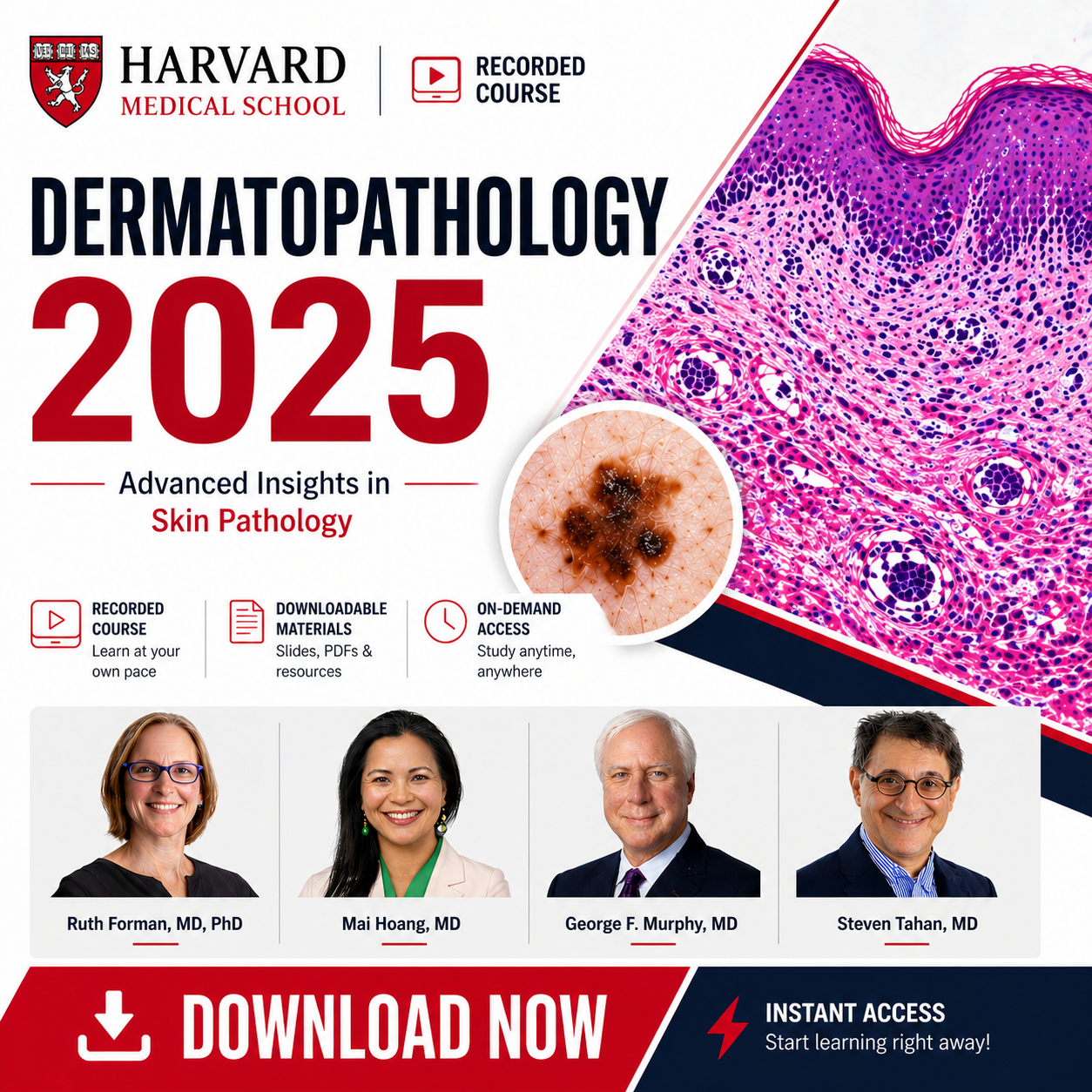

Harvard Dermatopathology Update 2025
A focused dermatopathology update designed for dermatologists, pathologists, and dermatopathology fellows seeking a practical review of current challenges in skin pathology, diagnostic criteria, cutaneous tumors, inflammatory dermatoses, molecular pathology, immunohistochemistry, and case-based diagnostic reasoning.
Harvard Dermatopathology Update 2025 is a recorded medical course package focused on challenges in current and future dermatopathology practice. The course reviews diagnostic criteria, conventional morphology, clinical-pathologic correlation, molecular diagnostic updates, immunohistochemistry, digital pathology, cutaneous neoplasms, and inflammatory skin disease.
Included: 21 videos, 19 PDF files, total size 7.15 GB.
About This Course
Dermatopathology requires precise interpretation of morphology, clinical context, evolving diagnostic criteria, molecular findings, immunohistochemical stains, and communication between dermatology and pathology teams. This course presents a broad update across many areas of dermatopathology, including special-site topics and difficult diagnostic scenarios.
The program is built around the theme of challenges in the current and future practice of dermatopathology. It combines didactic teaching with case-based sessions, practical diagnostic approaches, and updates on new techniques that support modern skin pathology interpretation.
Why Choose This Course
Key Highlights
- Focused 2025 update in dermatopathology from Harvard Medical School faculty and expert guests
- Includes 21 recorded videos and 19 downloadable PDF resources
- Covers melanocytic tumors, adnexal tumors, cutaneous soft tissue tumors, and inflammatory dermatoses
- Reviews molecular pathology, immunohistochemistry, modern staging systems, and diagnostic criteria
- Includes practical case-based dermatopathology discussion sessions
- Addresses diagnostic pitfalls, patient safety, laboratory quality, digital pathology, and medical liability lessons
- Useful for dermatologists, pathologists, dermatopathology fellows, dermatology residents, pathology residents, and skin pathology professionals
Core Learning Areas
Complete Curriculum
Dermatopathology Practice and Diagnostic Challenges
- Challenges in dermatopathology: an overview
- Current and future challenges facing practicing dermatopathologists
- New criteria for pathologic diagnoses
- Modern staging systems for tumors
- Clinical-pathologic correlation in dermatopathology
- Conventional morphologic analysis with modern diagnostic updates
- Case-based learning for diagnostic confidence
Melanocytic Tumors and Melanoma Mimics
- Differential diagnosis of melanoma of unknown primary
- Work-up of melanocytic lesions from routine to challenging
- Melanocytic mimics of melanoma: diagnoses not to miss
- Diagnostic algorithms for difficult melanocytic lesions
- Evaluating melanocytic tumors and mimics
- Integrating morphology, clinical context, and ancillary testing
Pediatric and Special-Site Dermatopathology
- Pediatric dermatopathology: common and uncommon cases
- Practical approach to special-site topics
- Intersection of dermatopathology and ophthalmologic pathology
- Diagnosing lesions in challenging anatomic locations
- Clinical-pathologic correlation in pediatric and special-site cases
- Recognition of rare or easily missed entities
Alopecia, Small Biopsies and Inflammatory Dermatoses
- Practical approach to alopecia biopsies
- Challenges in inflammatory skin diseases
- Updates in cutaneous vasculitis
- Challenges of the small skin biopsy
- Clinical-pathologic correlation in inflammatory dermatoses
- Distinguishing inflammatory mimics and diagnostic pitfalls
Adnexal Tumors and Acral Neoplasms
- Cutaneous adnexal tumors: a case-based approach
- Challenging cutaneous adnexal tumors
- Acral neoplasms
- Adnexal tumor mimics and diagnostic traps
- Practical tumor classification and reporting considerations
- Applying diagnostic criteria in complex adnexal lesions
Cutaneous Soft Tissue Pathology
- Challenges in diagnosis of soft tissue tumors of the skin
- Nomenclature and nosology of cutaneous soft tissue tumors
- Emerging entities in cutaneous soft tissue pathology
- Panniculitis: pearls and pitfalls
- Distinguishing cutaneous neoplasms from mimics
- Case-based interpretation of challenging soft tissue lesions
Immunohistochemistry, Molecular Pathology and Digital Pathology
- Immunohistochemistry for dermatopathologists
- Molecular diagnostic updates in dermatopathology
- Applying ancillary testing in difficult cases
- Digital pathology transition: lessons learned and future directions
- Integrating new techniques with conventional morphology
- Using modern tools to support diagnostic accuracy
Laboratory Practice, Quality and Safety
- Lessons learned from medical liability and daily practice applications
- Quality and safety challenges in an academic laboratory setting
- Laboratory billing and reimbursement challenges
- Diagnostic communication and reporting considerations
- Reducing diagnostic risk in dermatopathology practice
- Improving systems-based dermatopathology workflow
Case-Based Dermatopathology Discussion
- Interesting case discussions with expert faculty
- Digital slides and case questions for review
- Case-based approach to difficult diagnoses
- Practical diagnostic reasoning across multiple skin pathology categories
- Faculty-led discussion of challenging cases
- Integration of morphology, ancillary testing, and clinical presentation
Learning Objectives
By Completing This Course, You Will Be Able To:
- Discuss new criteria for pathologic diagnoses, including molecular diagnostic approaches
- Integrate modern tumor staging systems into dermatopathology practice
- Evaluate and distinguish cutaneous neoplasms including melanocytic, squamous, adnexal, soft tissue, and lymphoid lesions from mimics
- Apply clinical-pathologic correlation when evaluating inflammatory dermatoses
- Use immunohistochemistry and molecular pathology updates to support challenging diagnoses
- Improve diagnostic confidence in melanocytic lesions, adnexal neoplasms, soft tissue tumors, and inflammatory patterns
- Understand current and future challenges facing dermatopathology practice
Who Should Take This Course
This course is designed for dermatologists, pathologists, dermatopathology fellows, dermatology residents, pathology residents, academic physicians, practicing physicians, laboratory professionals, and clinicians seeking a comprehensive review of modern skin pathology.
Delivery & Access
This course package is provided for recorded learning access. No CME points are associated with this product.
Reviews
A strong dermatopathology update with practical coverage of melanocytic lesions, inflammatory dermatoses, adnexal tumors, and soft tissue pathology.
Excellent course for diagnostic review. The case-based sessions and PDF resources are very useful for pathology and dermatology practice.
Well organized and clinically relevant. The updates on molecular pathology, immunohistochemistry, and inflammatory skin disease are especially helpful.
FAQ
Who is this course best suited for?
It is ideal for dermatologists, pathologists, dermatopathology fellows, dermatology residents, pathology residents, and clinicians seeking a comprehensive review of skin pathology.
What is included in the course package?
The package includes 21 recorded videos and 19 PDF files, with a total size of 7.15 GB.
What topics are covered?
The course covers melanocytic tumors, melanoma mimics, pediatric dermatopathology, alopecia biopsies, inflammatory dermatoses, cutaneous vasculitis, small skin biopsies, adnexal tumors, acral neoplasms, cutaneous soft tissue tumors, panniculitis, immunohistochemistry, molecular pathology, digital pathology, laboratory quality and safety, medical liability, and case-based dermatopathology discussions.
Is this course useful for diagnostic practice?
Yes. The course focuses on morphology, diagnostic criteria, clinical-pathologic correlation, ancillary testing, case review, and practical approaches to difficult skin pathology diagnoses.
Does this product include CME?
No. This course package does not include CME points.
Who can I contact for support?
You can contact us at [email protected].


Dr. Eleanor Vance, Dermatopathologist (Private Practice) –
“This year’s update is exceptional. The deep dive on new molecular markers in melanoma and their practical application in reporting was exactly what I needed. It has already changed how I sign out my cases. The Harvard faculty are, as always, brilliant educators.”
Dr. Ben Carter, Surgical Pathologist –
“As a general pathologist who signs out a fair amount of skin, this course is my annual lifeline to the experts. The 2025 update on adnexal tumors and their mimics was worth the entire investment. The clarity and quality of the histology images in the PDFs are superb.”
Dr. Maria Flores, Dermatologist (Mohs Surgeon) –
“Incredibly valuable for a surgeon. The correlation between pathological features and surgical margins was emphasized in a way I haven’t seen before. My conversations with my dermatopathology colleagues have become much more precise. A must for any serious dermatologic surgeon.”
Dr. Samuel Jones, Dermatology Resident –
“This course single-handedly prepared me for my board exams. The systematic approach to inflammatory dermatoses is a game-changer. The video lectures make complex topics like psoriasiform and spongiotic dermatitis feel manageable. The Google Drive access was perfect for studying on my schedule.”
Dr. Alicia Chen, Academic Pathologist –
“The update on cutaneous lymphoproliferative disorders was cutting-edge. The integration of new WHO classifications with classic morphology is exactly the high-level content I expect from Harvard. I will be using these slides for my own teaching conferences.”
Dr. Robert Miller, Pathologist Assistant –
“Even as a PA, this course has greatly enhanced my understanding and grossing of complex skin specimens. Knowing what the dermatopathologist is looking for helps me orient and section specimens more effectively. The clinical correlations provided are fascinating.”
Dr. Chloe Davis, Pediatric Dermatologist –
“Finally, a comprehensive update that doesn’t overlook pediatric dermatopathology! The sessions on vascular anomalies and genodermatoses were incredibly detailed and clinically relevant. The faculty presented rare entities with stunning clarity.”
Dr. Omar Patel, Mohs Surgeon –
“The practical pearls on diagnosing and reporting difficult SCC variants have already prevented several potential ‘call-backs’ for me. The focus on what is clinically actionable for the surgeon is what sets this course apart. Highly recommended.”
Dr. Lisa Wang, Dermatologist (Medical) –
“This course bridges the gap between my clinical diagnosis and the pathological report. Understanding the ‘why’ behind the pathologist’s call on a tricky inflammatory case has improved my diagnostic accuracy immensely. The soft tissue tumor module was also a brilliant refresher.”
Dr. Mark Williams, Dermatopathology Fellow –
“This is the gold standard for fellow education. It covers the bread-and-butter with expert nuance while also introducing the rare and emerging entities. The case-based format in the videos is the next best thing to sitting at a dual-head scope with a world expert.”
Dr. Priya Singh, General Pathologist (Rural) –
“When you’re the only pathologist for miles, you need confidence in your diagnoses. This 2025 update gives me that. The algorithmic approaches to melanocytic lesions are a fantastic safety net. The PDFs are now my go-to quick reference.”
Dr. Kevin Lee, Dermatopathologist (Lab Director) –
“From a lab management perspective, the updates on diagnostic pitfalls and new immunohistochemical stains are directly influencing our lab’s protocol updates. This course provides an excellent return on investment by potentially reducing misdiagnoses.”
Dr. Anya Sharma, Dermatologist –
“The session on non-melanoma skin cancer and its variants was incredibly practical. I feel much more confident interpreting reports on desmoplastic trichoepithelioma vs. infiltrative BCC, for example. This knowledge directly impacts my patient management.”