
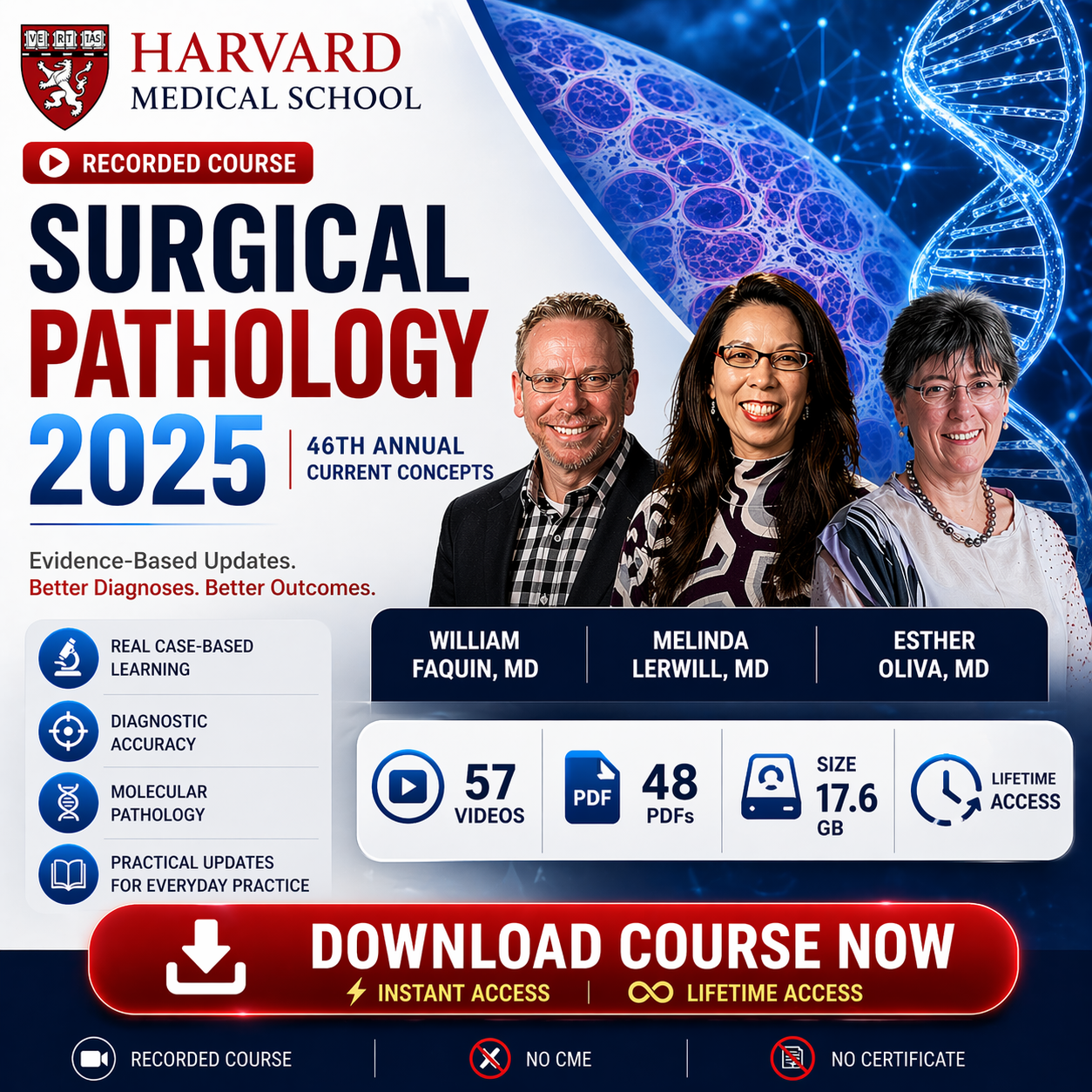

Harvard 46th Annual Current Concepts in Surgical Pathology 2025
A comprehensive surgical pathology update designed to sharpen diagnostic accuracy, improve case interpretation, and review current concepts across breast, GI, GU, pulmonary, gynecologic, dermatopathology, head and neck, hematopathology, soft tissue, bone, molecular pathology, and modern tumor classification.
Harvard 46th Annual Current Concepts in Surgical Pathology 2025 is a recorded medical course package focused on diagnostic surgical pathology, subspecialty updates, slide-based learning, immunohistochemistry, molecular testing, tumor classification, and practical case interpretation.
Included: 57 videos, 48 PDF resources, total size 17.6 GB.
About This Course
This course provides a practical and comprehensive update in surgical pathology, helping pathologists refine diagnostic criteria, recognize unusual entities, apply updated tumor classification systems, and approach challenging cases with more confidence.
The curriculum emphasizes real-world diagnostic problems, subspecialty pathology updates, slide seminars, reporting guidelines, immunohistochemistry, molecular studies, frozen section interpretation, and case-based diagnostic decision-making.
Why Choose This Course
Key Highlights
- Comprehensive 2025 surgical pathology update across multiple subspecialties
- 57 recorded video sessions with 48 PDF learning resources
- Includes diagnostic slide seminars and practical case-based learning
- Covers breast, GI, GU, pulmonary, gynecologic, dermatopathology, soft tissue, head and neck, and hematopathology
- Focus on tumor classification, reporting guidelines, immunohistochemistry, molecular studies, and diagnostic pitfalls
Core Learning Areas
Complete Curriculum
Breast, Gynecologic & Endocrine Pathology
- Updates in thyroid follicular-patterned tumors
- Challenging intraductal proliferations of the breast
- Benign versus malignant endocervical glandular proliferations
- Breast pathology slide seminar
- Uncommon breast neoplasms
- Fibroepithelial lesions of the breast
- Evaluation of breast biomarkers
- Ovarian pathology slide seminar
- Endometrial carcinoma histotyping and molecular characterization
- Gynecologic pathology mailbag
Gastrointestinal, Liver & Pancreaticobiliary Pathology
- The spectrum of fatty liver disease
- Diagnostic challenges in lower GI inflammatory conditions
- Cytology and small biopsy diagnosis of pancreatic tumors
- What’s new in esophageal and gastric neoplasia
- Update in appendiceal pathology
- Drug-induced disorders of the gastrointestinal tract
- Neoplastic lesions of the biliary tree and gallbladder
- Frozen sections in gastrointestinal pathology
GU, Pulmonary & Head and Neck Pathology
- Renal cell carcinoma and hereditary tumor syndromes
- Bladder pathology slide seminar
- Prostate cancer pathology updates and controversies
- Testicular germ cell neoplasia
- Small cell lung carcinoma differential diagnosis and updates
- Practical issues in lung cancer TNM classification
- Granulomatous lung disease
- Essentials of head and neck cytology
- Salivary neoplasia and molecular testing considerations
- The evolving landscape of sinonasal pathology
Hematopathology, Molecular & Precision Oncology
- Myeloproliferative and myelodysplastic/myeloproliferative neoplasms
- Large B-cell lymphomas: practical review and update
- Hodgkin lymphoma: diagnosis and differential diagnosis
- Recent advances in the diagnosis of mastocytosis
- Plasma cell neoplasms: diagnosis and differential diagnosis
- Molecular pathology and precision oncology care
- Interpretation of tumor biomarkers in gynecologic pathology
- Digital pathology and artificial intelligence
Bone, Soft Tissue, Dermatopathology & CNS Pathology
- Bone and soft tissue pathology slide seminar
- Practical approach to soft tissue tumor immunohistochemistry
- Non-meningothelial mesenchymal neoplasms of the CNS
- Neoplastic and non-neoplastic lesions of the synovium
- Dermatopathology slide seminar
- Cutaneous adnexal neoplasms and ancillary studies
- Inflammatory dermatoses by reaction pattern
- Melanocytic tumor terminology updates
- Pathology of vasculitis
Slide Seminars, Quality & Diagnostic Practice
- Real-world slide seminar cases across multiple subspecialties
- Diagnostic pitfalls and interpretation pearls
- Application of contemporary tumor classification systems
- Use of immunohistochemistry and molecular studies in diagnosis
- Quality assurance challenges in surgical pathology
- Question periods and practical faculty discussions
Learning Objectives
By Completing This Course, You Will Be Able To:
- Apply diagnostic criteria across multiple surgical pathology subspecialties
- Recognize unusual and newly described pathologic entities
- Evaluate the diagnostic reasoning process used to reach specific diagnoses
- Use contemporary tumor classification systems and reporting guidelines
- Apply immunohistochemistry and molecular studies appropriately
- Improve interpretation of complex slide-based and case-based pathology problems
- Strengthen confidence in surgical pathology sign-out and consultation work
Who Should Take This Course
This course is designed for practicing surgical pathologists, subspecialty pathologists, anatomic pathologists, residents, fellows, academic pathologists, researchers, and clinicians in multidisciplinary teams who rely on pathology for diagnosis and treatment planning.
Delivery & Access
This course package is provided for recorded learning access. No CME points or certificate are associated with this product.
Faculty Highlights
Reviews
Excellent surgical pathology update. The breast, GU, GI, and molecular pathology sections were directly relevant to daily sign-out.
Very practical and well organized. The slide seminars and diagnostic pitfalls make the course especially valuable for challenging cases.
Strong resource for boards and practice. The updates in tumor classification, IHC, and molecular testing helped clarify difficult diagnostic areas.
FAQ
Who is this course best suited for?
It is ideal for surgical pathologists, subspecialty pathologists, anatomic pathologists, residents, fellows, academic pathologists, researchers, and clinicians involved in multidisciplinary pathology-based care.
What is included in the course package?
The package includes 57 recorded videos and 48 PDF resources, with a total size of 17.6 GB.
What topics are covered?
The course covers breast pathology, GI pathology, GU pathology, bone and soft tissue pathology, pulmonary pathology, ovarian and gynecologic pathology, dermatopathology, head and neck pathology, hematopathology, molecular pathology, digital pathology, immunohistochemistry, and diagnostic slide seminars.
Does this product include CME or a certificate?
No. This course package does not include CME points or a certificate.
Who can I contact for support?
You can contact us at [email protected].


Dr. Michael R., Academic Surgical Pathologist –
“This course is the single most efficient way to catch up on a year’s worth of critical literature. As a busy academic pathologist, I don’t have time to sift through hundreds of articles. Harvard faculty did the synthesis for us. The updates on urinary tract and prostate pathology were immediately applicable to my sign-out.”
– Dr. Susan L., Director of Anatomic Pathology –
“The gold standard. I attend every year, and the 2025 edition might be the most crucial yet with the impending WHO updates. The clarity provided on evolving entities in soft tissue and gynecologic pathology has prevented several potential misclassifications in my practice.”
Dr. Robert T., Private Practice Pathologist –
5. “This is my annual ‘reset button.’ In private practice, we see it all, but not always frequently. This course ensures my diagnostic criteria are sharp for those rare entities that walk in the door. The cost is justified by avoiding just one send-out consultation.”
Dr. Jennifer M., Breast Pathology Specialist –
6. “Practical and direct. No fluff. The downloadable PDF slides are my new quick-reference guide at the scope. The session on ‘Pitfalls in Breast Core Biopsy’ alone changed my approach to borderline lesions.”
Fellow, Hematopathology –
“Invaluable for board preparation and beyond. It organizes the must-know updates in a way that textbooks simply can’t. The pattern-based review of lymphoma and sarcoma classifications has been a game-changer for my confidence on frozen section and final diagnosis.” –
Chief Resident, Anatomic Pathology –
This course gave me the framework to understand why classifications change, not just what they changed to. That deeper understanding is what separates a technician from a diagnostician. Essential for any senior resident.”
Dr. Elena F., Pathologist –
“The Google Drive delivery is flawless. I downloaded all the lectures and PDFs for a long flight. The ability to pause, rewind, and review complex sections at my own pace made the learning stick much better than a live conference.”
Dr. Thomas B., Surgical Pathologist –
“This course pays for itself. By applying the updated criteria for mesothelioma and appendiceal tumors, I’ve increased the accuracy and specificity of my reports, which directly improves patient care and reduces liability.”
Dr. Priya N., Lab Medical Director –
“It’s more than education; it’s professional insurance. In a field where standards evolve rapidly, this course ensures my practice remains defensible and at the standard of care. I recommend it to every colleague.”
Dr. Mark S., Surgical Pathologist –
“The organization by organ system allows for targeted learning. When a challenging liver case came in, I was able to directly review the hepatobiliary module that evening. It’s like a just-in-time consultation resource.”
Dr. Alex C., Surgical Pathologist –
“The faculty’s ability to anticipate daily diagnostic struggles is uncanny. They address the exact questions and uncertainties that arise at the multi-head microscope. It’s the most relevant pathology course available.”