
Harvard Infectious Diseases in Primary Care 2025
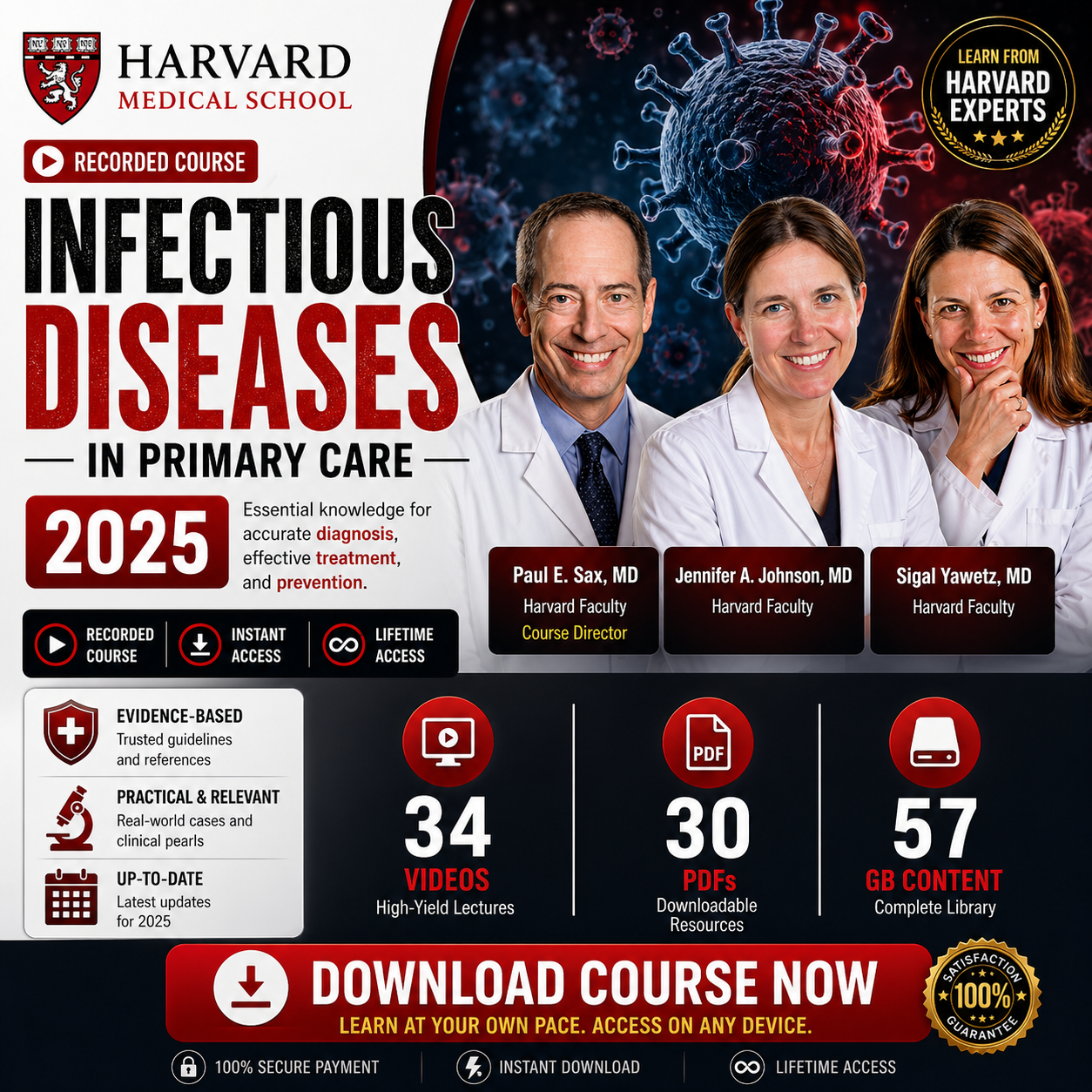
A practical infectious diseases update designed for front-line primary care and urgent care clinicians. This course focuses on prevention, diagnosis, treatment, antibiotic stewardship, vaccines, resistant infections, outpatient infection control, and real-world infectious disease decisions clinicians face every day.
Harvard Infectious Diseases in Primary Care 2025 is a recorded medical course package focused on practical infectious disease management for primary care, urgent care, internal medicine, family medicine, and outpatient clinical settings.
Included: 34 videos, 30 PDF files, total size 57.64 GB.
About This Course
Primary care clinicians manage infectious disease problems every day, from routine respiratory infections and UTIs to vaccine counseling, resistant organisms, travel-related infections, latent TB, STIs, C. difficile, and emerging public health threats.
This course provides practical, high-yield guidance for diagnosis, prevention, treatment, patient counseling, antimicrobial selection, infection control, and difficult outpatient infectious disease decisions.
Why Choose This Course
Key Highlights
- Focused 2025 infectious diseases update for primary care and urgent care clinicians
- Includes 34 recorded videos and 30 downloadable PDF resources
- Covers vaccines, respiratory infections, resistant infections, STIs, HIV PrEP, latent TB, C. difficile, and travel medicine
- Provides practical strategies for antibiotic stewardship and avoiding unnecessary antimicrobial use
- Includes guidance for immunocompromised patients and emerging infections such as H5N1, mpox, and measles
- Useful for primary care physicians, internists, family physicians, urgent care clinicians, NPs, PAs, residents, fellows, and outpatient care teams
Core Learning Areas
Complete Curriculum
Infectious Diseases in Primary Care Foundations
- Comprehensive infectious disease update for front-line clinicians
- Practical diagnosis and treatment strategies for outpatient care
- Approach to common and challenging ID problems in primary care
- When to treat, when to test, and when to refer
- Real-world answers to high-yield clinical questions
- Challenging outpatient infectious disease case discussions
Vaccines, Prevention & Patient Counseling
- What’s new in vaccines for 2025
- Vaccines on the horizon
- Pneumococcal vaccine updates
- Travel vaccines and pre-travel counseling
- How to counsel vaccine-hesitant patients effectively
- Vaccine safety conversations in outpatient practice
- Preventive strategies for high-risk populations
Respiratory Infections, COVID-19 & Influenza
- Respiratory infections: new diagnostics and therapies
- COVID-19 in 2025
- Influenza guidance for evolving variants
- Approach to atypical pneumonia
- Outpatient respiratory infection decision-making
- Post-COVID and persistent symptom considerations
- When respiratory infections require escalation or referral
Antibiotic Stewardship & Resistant Infections
- Antibiotic stewardship in primary care
- Avoiding antimicrobial overuse
- Managing complex infections without unnecessary broad-spectrum therapy
- Multidrug-resistant infections and practical treatment options
- Approach to antibiotic allergy
- Local resistance patterns and prescribing decisions
- Reducing inappropriate fluoroquinolone and broad-spectrum use
Urinary, GI and Soft Tissue Infections
- Updated guidance for urinary tract infections
- Recurrent UTI management
- Resistant UTI treatment strategies
- Initial and recurrent C. difficile infection
- H. pylori management updates
- Gastrointestinal infection decision-making
- Skin and soft tissue infections in outpatient and urgent care settings
HIV Prevention, STIs & Sexual Health
- Which patients should receive PrEP for HIV
- How to initiate PrEP in primary care
- STI testing updates
- Sexual health counseling in outpatient practice
- Prevention strategies for high-risk patients
- Practical workflows for screening, treatment, and follow-up
Latent TB, Lyme Disease & Travel Medicine
- Latent TB testing made simple
- Latent TB treatment approaches
- Lyme disease: evidence-based approaches to controversy and confusion
- Travel medicine updates for primary care
- Which travelers need which vaccines and when
- Post-travel fever workup
- Pre-travel counseling and risk reduction
Immunocompromised Patients & ID Emergencies
- Caring for immunocompromised patients in primary care
- What every primary care clinician should know about high-risk hosts
- ID emergencies every PCP should recognize
- Can’t-miss infectious disease diagnoses
- When urgent referral or hospital evaluation is needed
- Managing recurrent infections in older and immunocompromised adults
Emerging Threats & Public Health Updates
- H5N1 updates
- Mpox updates
- Measles and recrudescent infections
- Other emerging infectious threats
- Outpatient infection control best practices
- Lessons from the front lines of public health
- Microbiology lab questions every PCP should understand
Learning Objectives
By Completing This Course, You Will Be Able To:
- Apply updated infectious disease guidance in primary care and urgent care settings
- Improve diagnosis, treatment, and prevention of common outpatient infections
- Use antibiotic stewardship strategies to reduce unnecessary antimicrobial use
- Manage recurrent, resistant, and complicated infections more effectively
- Counsel patients about vaccine safety and vaccine decision-making
- Recognize infectious disease emergencies and emerging public health threats
- Identify appropriate patients for HIV PrEP and apply practical STI testing strategies
- Use updated approaches for latent TB, C. difficile, travel medicine, H. pylori, and vaccine-preventable infections
Who Should Take This Course
This course is designed for primary care physicians, family physicians, internists, urgent care clinicians, nurse practitioners, physician assistants, residents, fellows, pharmacists, clinic leaders, and outpatient healthcare professionals who diagnose, treat, prevent, or counsel patients about infectious diseases.
Delivery & Access
This course package is provided for recorded learning access. No CME points are associated with this product.
Reviews
A very practical infectious disease update for primary care. The vaccine, UTI, STI, and antibiotic stewardship sections are especially useful.
Clear and actionable. The course focuses on real outpatient decisions rather than abstract theory, which makes it highly useful for daily practice.
Excellent for NPs and PAs in urgent care and primary care. The case-based approach improves confidence with common and complex infections.
FAQ
Who is this course best suited for?
It is ideal for primary care physicians, family physicians, internists, urgent care clinicians, NPs, PAs, residents, fellows, pharmacists, clinic leaders, and outpatient healthcare professionals managing infectious diseases.
What is included in the course package?
The package includes 34 recorded videos and 30 PDF files, with a total size of 57.64 GB.
What topics are covered?
The course covers vaccines, vaccine counseling, respiratory infections, COVID-19, influenza, antibiotic stewardship, Lyme disease, ID emergencies, multidrug-resistant infections, immunocompromised patients, H5N1, mpox, measles, latent TB, infection control, urinary infections, GI infections, respiratory infections, soft tissue infections, recurrent C. difficile, PrEP for HIV, travel vaccines, H. pylori, and STI testing.
Is this course practical for primary care?
Yes. The course is designed specifically for primary care and urgent care clinicians, with practical strategies for diagnosis, treatment, prevention, counseling, and antimicrobial decision-making.
Does this product include CME?
No. This course package does not include CME points.
Who can I contact for support?
You can contact us at [email protected].


Dr. Linda P., Family Medicine Physician –
“As a family physician in a diverse community, I see everything from routine UTIs to complex post-travel fevers. This course is my annual ‘reset’ for ID management. The 2025 antibiotic stewardship and STI modules are practice-changing.”
Dr. Marcus T., Internal Medicine, Private Practice –
“Finally, an ID course made for primary care, not academia. It cuts through the theoretical and gives you clear, actionable protocols for the exam room. The diagnostic algorithms for fever of unknown origin are now posted in every exam room.”
Dr. Angela R., Geriatric Primary Care –
“The guidance on managing recurrent infections in elderly and immunocompromised patients is worth the entire course fee. It transformed my approach from reactive to proactive, significantly reducing unnecessary ER referrals.”
Dr. Ben K., Medical Director, Community Health Center –
“In the era of antimicrobial resistance, this course is essential. The stewardship framework is practical and immediately implementable. Our clinic has already seen a measurable drop in inappropriate fluoroquinolone and broad-spectrum prescribing.”
Dr. Chloe S., Urgent Care Medical Director –
“For urgent care, speed and accuracy are everything. This course’s modules on rapid differentials for skin/soft tissue infections and atypical pneumonia have made me faster and more confident. An invaluable tool for high-acuity, high-volume decision-making.”
Dr. David L., Urgent Care & Travel Medicine Specialist –
“The travel medicine section is a masterpiece. The pre-travel counseling templates and post-travel fever workup flowchart have standardized care across our multi-site practice. Patients feel safer, and we feel more prepared.”
Sarah M., FNP-C –
“As an NP, I appreciate how this course empowers me with the same diagnostic reasoning tools as my physician colleagues. The case-based learning on interpreting subtle presentation flags has greatly improved my diagnostic accuracy.”
– Mark J., PA-C –
“The course brilliantly addresses the ‘why’ behind treatment choices, not just the ‘what.’ Understanding the pharmacodynamics and local resistance patterns makes me a better prescriber and patient educator.”
Dr. Rachel G., Pediatrician –
“Managing pediatric infections without over-prescribing is a constant tightrope walk. The evidence-based guidelines on otitis media, bronchiolitis, and pediatric pneumonia have given me firm ground to stand on with both patients and parents.”
– Dr. Ian W., Internist –
“The deep dive into post-COVID syndromes and chronic fatigue presentations was desperately needed. It provided a structured, compassionate approach to patients other specialists often dismiss. This alone has improved countless patient outcomes in my practice.”
Dr. Alex B., Family Medicine –
“The Google Drive format is perfect for a busy schedule. I listened to the UTI/Prostatitis module on my commute and applied the new duration guidelines that same afternoon. Immediate clinical translation.”
Dr. Priya N., Clinic Lead –
“The downloadable PDF antibiotic guides and vaccine schedules are now our clinic’s standard references. They’ve eliminated ‘I think’ moments and created consistency across all providers. Incredibly practical.”
Dr. Tom S., Internal Medicine –
“Unlike dry journal reviews, this course uses real patient stories and complex cases. You’re not just memorizing guidelines; you’re learning a clinical thought process you can apply to any infectious presentation.”
Dr. Karen D., Internal Medicine –
“Harvard faculty have a gift for distilling overwhelming data into clear principles. In a field flooded with fear and misinformation, this course is a beacon of evidence-based, rational, and compassionate care.”