
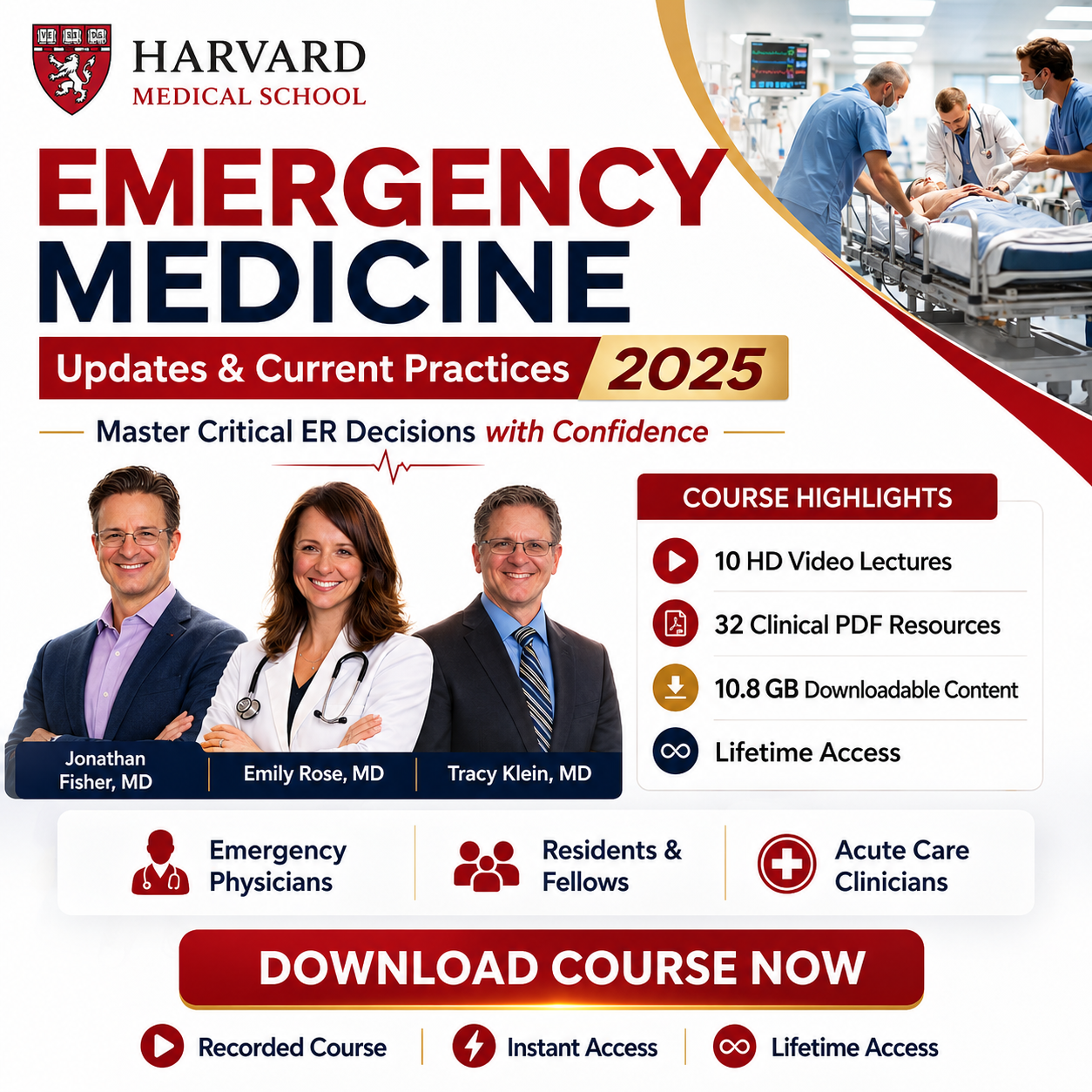
Harvard Emergency Medicine Updates & Current Practices 2025
A practical emergency medicine update designed for clinicians who manage acute, critical, traumatic, infectious, neurologic, cardiovascular, pediatric, geriatric, obstetric, and high-risk emergency presentations in fast-paced clinical settings.
Harvard Emergency Medicine Updates & Current Practices 2025 is a recorded medical course package focused on modern emergency care, acute decision-making, critical care emergencies, trauma, sepsis, cardiac arrest, stroke, airway management, POCUS, pediatric emergencies, geriatric care, and ED systems improvement.
Included: 10 videos, 32 PDF resources, total size 10.8 GB.
About This Course
Emergency medicine requires rapid recognition, evidence-based intervention, clear communication, and strong systems thinking. This course provides practical updates across common and high-risk ED presentations.
The curriculum includes critical care, trauma, POCUS, airway, sepsis, stroke, pulmonary embolism, cardiac arrest, burns, pediatric emergency care, geriatric falls, obstetric emergencies, health equity, clinical informatics, and ED innovation.
Why Choose This Course
Key Highlights
- Focused 2025 update in emergency medicine and current ED practice
- Includes 10 recorded videos and 32 downloadable PDF resources
- Covers septic shock, airway advances, cardiac arrest, ARDS, PE, stroke, trauma, and POCUS
- Practical updates for emergency physicians, primary care doctors, PAs, NPs, nurses, and EMTs
- Includes pediatric, geriatric, obstetric, infectious disease, and systems-based emergency care topics
- Useful for improving ED readiness, acute diagnosis, and high-risk clinical decision-making
Core Learning Areas
Complete Curriculum
Sepsis, Shock & Critical Care
- Personalized management in septic shock
- Sepsis updates
- Vasopressors and shock pearls
- Circulatory shock quiz bowl concepts
- ARDS updates
- Push-dose pressors
- Phenobarbital for severe alcohol withdrawal
- Strategies to prevent hemodynamic collapse
Cardiac, Stroke & Vascular Emergencies
- Cardiac arrest updates
- Update on ventricular fibrillation cardiac arrest
- Reading cardiac ischemia on ECGs
- Acute ischemic stroke updates
- First hours of intracerebral hemorrhage
- Diagnosis and treatment of pulmonary embolism
- Considerations in anticoagulation reversal
- Latest evidence-based algorithms for PE and DVT management
Trauma, Burns & Surgical Emergencies
- Approach to the critically ill trauma patient
- Pediatric trauma and concussion
- Mild head trauma
- Burns
- Acute compartment syndromes
- Hand emergencies
- Necrotizing soft tissue infection
- Scrotal pain and priapism management
POCUS, Airway & Procedures
- Point-of-care ultrasound procedures
- Ultrasound-guided peripheral IV and lumbar puncture
- POCUS eFAST
- Cardiac and lung ultrasound
- Pediatric POCUS cases
- Fever POCUS algorithm
- Airway advances
- Physiologically difficult airway cases
Pediatric, Geriatric & Obstetric Emergencies
- Bronchiolitis: what’s known and what’s new
- What’s new in pediatric emergency medicine literature
- Current practice in newborn fever
- Neonatal resuscitation
- Geriatric falls
- Frailty in emergency care
- Atypical presentations of disease in older adults
- Postpartum hemorrhage
ED Operations, Innovation & Communication
- Improving ED patient experience
- Systems engineering and innovation in the ED
- Clinical informatics in emergency medicine
- Digital transformation of emergency medicine
- Virtual observation and redefining ED care delivery
- Best-practice communication to keep ED staff and patients safe
- Medical jargon and patient communication
- Emergency medicine burnout
Infectious Disease, Equity & Public Health
- Sexually transmitted infections
- Emergency preparedness
- Supporting humanitarian disasters with digital health
- Scaling humanitarian aid from Ebola to Ukraine
- Operationalizing health equity in the ED
- Social determinants of health in emergency medicine
- Environmental impacts of healthcare
- Predictive model evaluation
Learning Objectives
By Completing This Course, You Will Be Able To:
- Identify underlying tachy-dysrhythmia in emergency presentations
- Recognize up-to-date therapeutics for cardiac arrest
- Integrate evidence-based strategies for acute hemorrhagic stroke
- Use current algorithms and strategies for PE and DVT management
- Improve ED management of sepsis, shock, ARDS, airway emergencies, trauma, and POCUS-guided procedures
- Apply practical updates to pediatric, geriatric, obstetric, infectious disease, and psychiatric emergency care
- Strengthen communication, patient safety, ED operations, and systems-based emergency medicine practice
Who Should Take This Course
This course is designed for emergency medicine physicians, primary care physicians, specialty physicians, physician assistants, nurse practitioners, nurses, EMTs, residents, fellows, urgent care clinicians, and healthcare professionals involved in acute care, emergency response, trauma, critical care, or ED operations.
Delivery & Access
This course package is provided for recorded learning access. No CME points or certificate are associated with this product.
Reviews
A strong emergency medicine update. The sepsis, shock, cardiac arrest, and trauma topics are practical and directly useful for ED practice.
The recorded format makes it easy to review at my own pace. The PDF materials are helpful for quick clinical refreshers.
Excellent coverage of current emergency protocols, POCUS, trauma care, airway, and critical care updates.
FAQ
Who is this course best suited for?
It is ideal for emergency medicine physicians, primary care physicians, specialty physicians, PAs, NPs, nurses, EMTs, residents, fellows, urgent care clinicians, and acute care professionals.
What is included in the course package?
The package includes 10 recorded videos and 32 PDF resources, with a total size of 10.8 GB.
What topics are covered?
The course covers septic shock, sepsis updates, airway advances, POCUS, ARDS, burns, cardiac arrest, pulmonary embolism, ischemic stroke, intracerebral hemorrhage, trauma, geriatric falls, pediatric bronchiolitis, newborn fever, postpartum hemorrhage, STIs, ED operations, health equity, clinical informatics, and emergency preparedness.
Does this product include CME or a certificate?
No. This course package does not include CME points or a certificate.
Who can I contact for support?
You can contact us at [email protected].


Dr. John M. –
“Accessing the course materials online was seamless. The updates on emergency protocols are essential for my practice!”
Nurse Emily R –
“Having the course available for download made it easy to fit into my busy schedule. Highly recommend it!”
Dr. Alex T –
“The content was incredibly informative! I can now confidently implement new practices in my emergency department.”
Dr. Rachel L. –
“The Google Drive access allowed me to learn at my own pace, which was perfect for my hectic work life.”
Dr. Sarah K. –
“The recorded sessions were a game changer! I loved being able to revisit key topics anytime through the Google Drive link.”
Nurse Practitioner Lisa G. –
“The case studies were practical and relatable. I appreciated having them at my fingertips for quick reference.”
Dr. Brian H. –
“This course exceeded my expectations! The direct download link made accessing materials a breeze.”
Dr. Mia S. –
“I loved the mix of theory and practical skills. Being able to review lectures anytime helped solidify my understanding.”
Dr. Kevin J. –
“The faculty’s expertise shone through in every session. The downloadable content is a fantastic resource.”
Dr. Jenna P. –
“The updates on trauma care were especially insightful. I’m grateful for the easy access via Google Drive!”
Dr. Peter F. –
“This course is a must for any emergency medicine professional. The recorded format made it so convenient!”
Nurse Anna W. –
“I learned invaluable communication strategies for high-stress situations. The course is well worth it!”
Dr. Tom N. –
“The ability to pause and replay sessions was incredibly helpful. I feel better prepared for emergencies now.”
Dr. Nicole Y. –
“The content was well-organized and accessible. The Google Drive link made it easy to navigate.”
Dr. Sam O. –
“I appreciated the diversity of topics covered. I can’t wait to implement what I’ve learned in my practice!”
Dr. Lisa T. –
“This course revitalized my approach to emergency care. Accessing materials online was super convenient!”
Dr. Mark Z. –
“The direct download link made it easy to get started right away. I’m so glad I enrolled in this course!”