
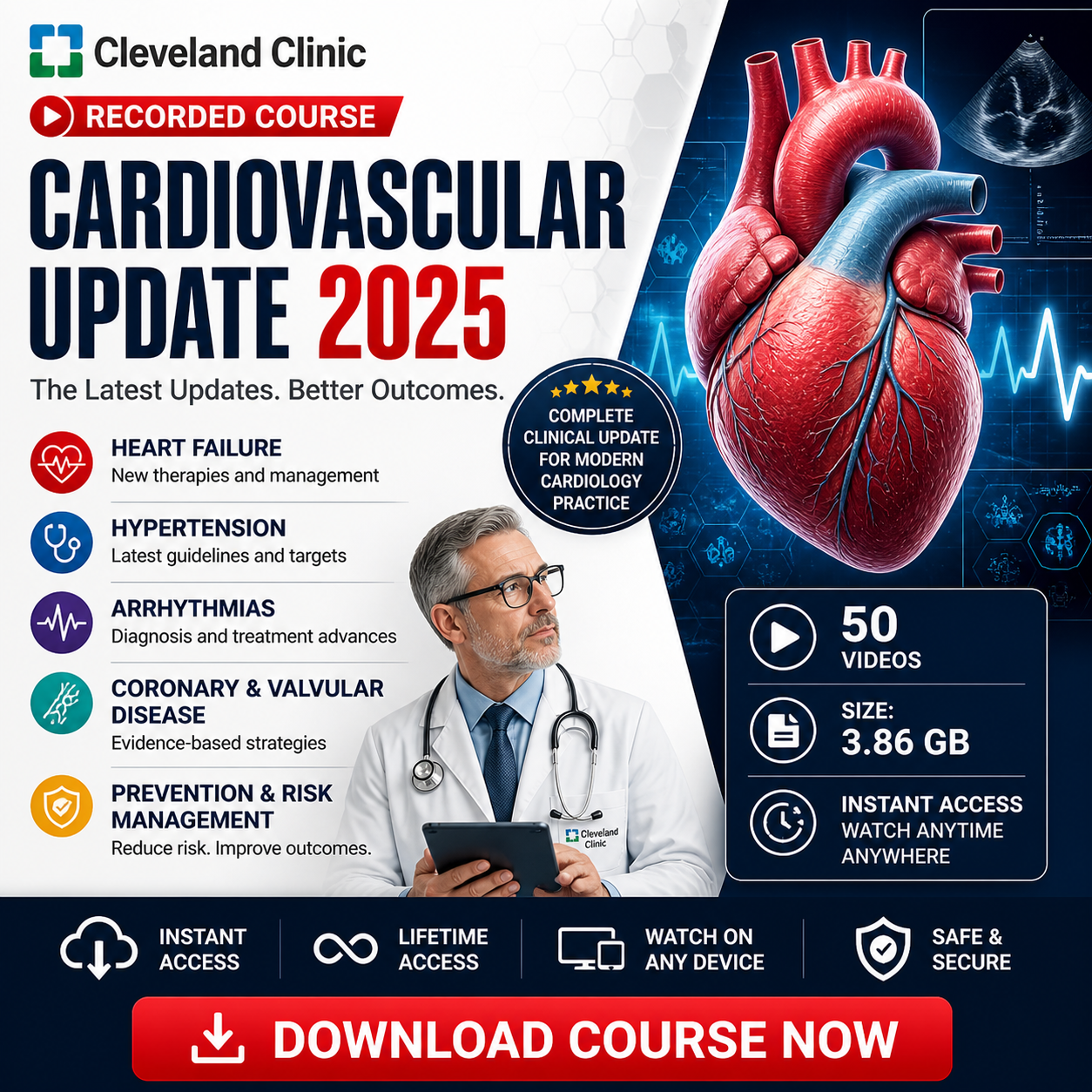
Cleveland Clinic Cardiovascular Update 2025
A comprehensive Cleveland Clinic cardiovascular medicine update designed to help clinicians stay current with prevention, cardiovascular risk management, lipid therapy, diabetes and cardiometabolic care, resistant hypertension, women’s heart health, sports cardiology, cardio-oncology, ischemic heart disease, structural heart disease, heart failure, and rhythm disorders.
Course Details:
Cleveland Clinic Cardiovascular Update 2025 includes 50 recorded video lectures organized across 7 major cardiovascular medicine sessions, covering prevention, risk reduction, special populations, ischemic heart disease, structural heart disease, heart failure, and heart rhythm management.
Focus: Lp(a), apoB, non-HDL-C, statin initiation, non-statin lipid lowering therapy, diabetes cardiovascular risk reduction, SGLT2 inhibitors, GLP-1 receptor agonists, weight loss pharmacotherapy, diet controversies, resistant hypertension, social determinants of health, hormone therapy, chronic kidney disease, coronary artery calcium, geriatric cardiology, women’s heart health, pregnancy and cardiovascular disease, athletes with heart disease, cardio-oncology, advanced imaging, stable angina, ANOCA, INOCA, MINOCA, post-MI management, cardiac rehab, PAD, aortic stenosis, mitral valve disease, tricuspid regurgitation, bicuspid valve disease, anticoagulation after structural heart therapies, hypertrophic cardiomyopathy, heart failure, ATTR-CM, LVADs, transplant recipients, CRT, atrial fibrillation, SVT, PVCs, syncope, pacemakers, ICDs, and wearables for arrhythmia care.
About This Course
Cardiovascular medicine continues to change rapidly with new prevention tools, evolving lipid targets, diabetes and obesity therapies that reduce cardiovascular risk, advanced imaging pathways, newer structural heart interventions, guideline-directed heart failure treatment, and wearable technologies for rhythm care.
Cleveland Clinic Cardiovascular Update 2025 provides a structured review of these developments with practical, clinically focused lectures from cardiovascular experts. The program is designed to help clinicians apply updated evidence to risk assessment, diagnosis, treatment selection, referral decisions, and long-term patient management.
The course is especially valuable for healthcare professionals who manage cardiovascular risk, coronary disease, heart failure, structural heart disease, arrhythmias, cardiometabolic disease, and complex cardiovascular patients across primary care, internal medicine, cardiology, and specialty practice settings.
Why Choose This Course
- Cleveland Clinic 2025 cardiovascular medicine update with 50 recorded video lectures
- Organized into 7 focused sessions covering prevention, special populations, ischemic heart disease, structural heart disease, heart failure, and rhythm care
- Reviews modern cardiovascular prevention tools including Lp(a), apoB, non-HDL-C, CAC, statins, non-statin lipid lowering therapies, and population health strategies
- Covers cardiometabolic risk reduction including diabetes therapies, SGLT2 inhibitors, GLP-1 receptor agonists, obesity pharmacotherapy, diet, and CKD-related risk
- Includes advanced clinical topics such as ANOCA, INOCA, MINOCA, advanced imaging, PAD, post-MI care, cardiac rehab, and stable angina pathways
- Provides practical updates in structural valve disease, hypertrophic cardiomyopathy, heart failure phenotypes, GDMT, ATTR-CM, LVADs, transplantation, CRT, and pacing
- Useful for cardiologists, internists, hospitalists, primary care physicians, advanced practice providers, nurses, fellows, residents, and cardiovascular care teams
Core Learning Areas
Cardiovascular Prevention
Lipid markers, statin initiation, non-statin therapy, CAC scoring, resistant hypertension, diabetes risk reduction, weight loss therapy, diet, and population health.
Ischemic & Vascular Disease
Advanced imaging, stable angina pathways, ANOCA, INOCA, MINOCA, post-MI management, DAPT, cardiac rehab, PAD, and structured risk assessment.
Structural Heart & HF
Aortic stenosis, mitral valve disease, tricuspid regurgitation, bicuspid valve disease, HCM, HFrEF, HFpEF, ATTR-CM, LVADs, transplant care, CRT, and pacing.
Heart Rhythm & Special Populations
Atrial fibrillation, LAA closure, SVT, PVCs, syncope, pacemakers, ICDs, wearables, women’s heart health, pregnancy, athletes, geriatrics, and cardio-oncology.
Complete Curriculum
- Tools in CVD prevention and risk management: Lp(a), apoB, and non-HDL-C
- Statin initiation for primary prevention among statin-naïve adults
- Reasons for statin nonadherence and practical adherence strategies
- When statins are not enough: non-statin lipid-lowering therapies
- Managing residual cardiovascular risk with additional lipid therapy
- Diabetes therapies for cardiovascular risk reduction: SGLT2 inhibitors, GLP-1 receptor agonists, or both
- Weight loss pharmacotherapy using current and next-generation therapies
- Diet controversies: keto, low carb, plant-based diets, and intermittent fasting
- Old and evolving strategies for treatment-resistant hypertension
- Social determinants of health and cardiovascular disease
- Panel discussion and faculty Q&A on prevention and risk management
- Hormone therapy and heart health: myths, evidence, and clinical application
- Intersection of cardiovascular disease and chronic kidney disease
- Strategies for reducing cardiovascular risk in CKD patients
- Who should get coronary artery calcium testing
- How often CAC should be used and how to interpret results
- Using CAC to assess risk and guide preventive therapy
- Management of cardiovascular issues in older adults
- Geriatric cardiology and individualized treatment planning
- Population health interventions to control cardiovascular risk factors
- Current status of cardiovascular population health management
- Panel discussion and faculty Q&A on prevention strategies
- Cardiac disease as a leading cause of mortality in women
- Current strategies to address cardiovascular disease in women
- Cardiovascular disease and pregnancy
- Optimizing maternal and fetal health in patients with cardiovascular disease
- Competitive sports participation in athletes with heart disease
- Evaluation and management of athletes with cardiovascular conditions
- Cardio-oncology and balancing cancer outcomes with cardiac success
- Cardiovascular risk in cancer patients and survivors
- Collaborative care for special cardiovascular populations
- Panel discussion and Q&A on women, pregnancy, athletes, and cardio-oncology
- Advanced imaging for ischemic heart disease
- CT, CMR, nuclear imaging, and advanced echocardiography
- Creating a stable angina management pathway in clinic
- Structured risk assessment and clinical decision-making for stable angina
- ANOCA, INOCA, and MINOCA: definitions and diagnostic approach
- Diagnostic testing and therapeutic management of non-obstructive coronary syndromes
- Post-MI management including DAPT guidelines and duration
- Cardiac rehabilitation after myocardial infarction
- Improving access and compliance with cardiac rehab
- Peripheral artery disease assessment and clinical decision-making
- Panel discussion and Q&A on essential cardiovascular disease management
- Aortic stenosis diagnosis and management in the modern era
- Mitral regurgitation and mitral valve disease evaluation
- When to refer patients with mitral valve disease
- Current options for mitral valve disease management
- Natural history of tricuspid regurgitation
- Current and future management strategies for tricuspid valve disease
- Bicuspid and aneurysm-associated aortic valve disease
- Timing of intervention and role of family screening
- Anticoagulation guidance following structural heart therapies
- Hypertrophic cardiomyopathy co-management in the era of precision therapies
- Panel discussion and Q&A on structural heart disease
- Heart failure stages, phenotypes, and diagnosis
- Screening for heart failure in the primary care setting
- HFrEF essentials of guideline-directed medical therapy initiation and titration
- Managing comorbidities in heart failure: frailty, anemia, sleep apnea, atrial fibrillation, and obesity
- Essentials of diagnosis and management for HFpEF
- Diagnosis and management of transthyretin amyloid cardiomyopathy
- Strategies to enhance GDMT implementation and adherence
- Managing long-term LVADs and transplant recipients in the community setting
- Collaboration between electrophysiology and heart failure teams
- CRT and novel pacing approaches
- Panel discussion and Q&A on heart failure management
- Diagnosis and management of new-onset atrial fibrillation
- Atrial fibrillation and left atrial appendage closure
- Current and future directions in LAA closure
- Evaluation and management of patients with PVCs
- Evaluation and management of supraventricular tachycardia
- Syncope evaluation and management in young adults
- Follow-up of pacemakers and ICDs for non-electrophysiologists
- Wearables for arrhythmia care
- Current challenges and future prospects of wearable rhythm technology
- Practical rhythm-care decision-making for general cardiology and primary care
- Panel discussion and Q&A on heart rhythm management
- Diabetes therapies that reduce cardiovascular risk
- Choosing SGLT2 inhibitors, GLP-1 receptor agonists, or combination therapy
- Weight loss pharmacotherapy in cardiovascular risk reduction
- Next-generation weight loss medications
- Dietary patterns and cardiovascular outcomes
- Obesity, hypertension, diabetes, and cardiovascular risk clustering
- Practical patient counseling for cardiometabolic risk reduction
- Use of Lp(a), apoB, and non-HDL-C in prevention
- Primary prevention statin initiation
- Managing statin intolerance and nonadherence
- Non-statin lipid lowering therapies
- Residual risk assessment after statin therapy
- Integrating lipid biomarkers with global risk assessment
- Clinical decision-making for advanced lipid management
- Coronary artery calcium scoring in prevention
- Advanced imaging in ischemic heart disease
- CT, CMR, nuclear imaging, and echocardiography in clinical pathways
- Structured assessment for stable angina
- Imaging-supported diagnosis of ANOCA, INOCA, and MINOCA
- When to refer patients for advanced imaging or specialty care
- Practical integration of imaging results into treatment planning
- Modern approach to aortic stenosis
- Mitral valve disease diagnosis and treatment options
- Tricuspid regurgitation natural history and emerging management strategies
- Bicuspid aortic valve and aneurysm-associated disease
- Family screening considerations in aortic valve disease
- Anticoagulation after structural heart therapies
- Referral timing and multidisciplinary valve team decision-making
- Heart failure diagnosis and screening in primary care
- HFrEF guideline-directed medical therapy initiation and titration
- HFpEF diagnosis and management essentials
- ATTR-CM recognition and treatment considerations
- Managing heart failure comorbidities
- Improving GDMT adherence and implementation
- Community management of LVADs and transplant recipients
- New-onset atrial fibrillation diagnosis and management
- Left atrial appendage closure options
- PVC and SVT evaluation
- Syncope in young adults
- Pacemaker and ICD follow-up for non-electrophysiologists
- Wearable devices for rhythm monitoring
- Collaboration between electrophysiology and other cardiovascular teams
Learning Objectives
- Apply updated cardiovascular prevention strategies using lipid markers, CAC scoring, statin therapy, non-statin therapy, and population health approaches
- Improve management of cardiovascular risk in patients with diabetes, obesity, chronic kidney disease, resistant hypertension, and complex cardiometabolic conditions
- Recognize cardiovascular care considerations in women, pregnancy, athletes, older adults, and patients with cancer
- Use advanced imaging and structured pathways to evaluate ischemic heart disease, stable angina, ANOCA, INOCA, MINOCA, and post-MI patients
- Improve clinical decision-making for PAD, cardiac rehabilitation, DAPT duration, and post-myocardial infarction care
- Evaluate aortic stenosis, mitral valve disease, tricuspid regurgitation, bicuspid valve disease, and structural heart therapy referral decisions
- Apply current approaches to heart failure diagnosis, HFrEF, HFpEF, ATTR-CM, GDMT implementation, LVAD care, transplant recipient management, CRT, and novel pacing
- Manage common rhythm disorders including atrial fibrillation, PVCs, SVT, syncope, and device follow-up
- Understand the role of wearable technologies in arrhythmia care
- Translate expert Cleveland Clinic cardiovascular updates into practical patient care decisions
Who Should Take This Course
This course is designed for cardiologists, internists, hospitalists, primary care physicians, family physicians, advanced practice providers, nurses, fellows, residents, and healthcare professionals who manage cardiovascular patients.
It is especially useful for clinicians involved in cardiovascular prevention, lipid management, diabetes and obesity-related cardiovascular risk reduction, ischemic heart disease, structural heart disease, heart failure, rhythm disorders, cardiac imaging, cardio-oncology, women’s cardiovascular health, sports cardiology, and geriatric cardiology.
Delivery & Access
50 Videos
Recorded cardiovascular update lectures covering prevention, risk management, ischemic disease, structural heart disease, HF, and rhythm care.
7 Sessions
Structured curriculum organized into focused cardiovascular medicine sessions.
3.86 GB
Complete recorded course package with high-quality video learning content.
Support
Course Highlights
Complete Cardiovascular Update
Covers prevention, special populations, ischemic heart disease, structural heart disease, heart failure, and rhythm disorders.
Practical Risk Reduction
Strong focus on lipids, CAC, diabetes therapies, obesity pharmacotherapy, CKD, hypertension, diet, and population health.
Advanced Cardiology Topics
Includes structural interventions, HCM precision therapies, ATTR-CM, LVADs, transplant care, CRT, pacemakers, ICDs, and wearables.
FAQ
Who is this course best suited for?
This course is best suited for cardiologists, internists, hospitalists, primary care physicians, family physicians, advanced practice providers, nurses, fellows, residents, and healthcare professionals who manage cardiovascular patients.
What is included in this course?
The course includes 50 recorded video lectures organized across 7 cardiovascular medicine sessions, with a total package size of 3.86 GB.
What topics are covered?
Topics include cardiovascular prevention, lipid management, Lp(a), apoB, non-HDL-C, statins, non-statin therapies, diabetes and cardiovascular risk, SGLT2 inhibitors, GLP-1 receptor agonists, weight loss pharmacotherapy, diet, resistant hypertension, CKD, CAC scoring, women’s heart health, pregnancy, athletes, cardio-oncology, advanced imaging, stable angina, ANOCA, INOCA, MINOCA, post-MI care, PAD, aortic stenosis, mitral valve disease, tricuspid regurgitation, heart failure, ATTR-CM, LVADs, transplant care, atrial fibrillation, SVT, PVCs, pacemakers, ICDs, and wearable rhythm technology.
Does this course cover cardiovascular prevention?
Yes. The course includes cardiovascular risk assessment, lipid markers, statin initiation, non-statin lipid therapies, CAC scoring, diabetes-related risk reduction, obesity pharmacotherapy, diet, resistant hypertension, and population health strategies.
Does this course cover heart failure?
Yes. The course covers heart failure stages, phenotypes, screening, HFrEF, HFpEF, GDMT initiation and titration, comorbidities, ATTR-CM, LVADs, transplant recipients, CRT, and novel pacing.
Does this course cover arrhythmias and devices?
Yes. The course includes new-onset atrial fibrillation, left atrial appendage closure, PVCs, SVT, syncope, pacemaker follow-up, ICD follow-up, and wearable devices for arrhythmia care.
Is this a recorded course?
Yes. This product is provided as recorded course access so you can review the material at your own pace.
Does this course include CME or a certificate?
No. CME credits and certificates are not included with this course package.
Who can I contact for support?
You can contact support at [email protected].


Emily Johnson –
“The Cleveland Clinic Cardiovascular Update 2025 is an outstanding course! The material is comprehensive, and the Google Drive access makes it easy to revisit key lectures anytime.”
Michael Thompson –
“This course exceeded my expectations! The lectures were highly informative, and I loved that all the resources were uploaded to Google Drive for easy access.”
Matthew Green –
Matthew Green
“This course is filled with valuable resources and insights. I was able to quickly reference materials as needed, which was incredibly helpful.”
Patricia Scott –
“The well-structured content made complex topics easy to understand. I found it very beneficial for my study schedule.”
Amanda King –
“I highly recommend this course to any healthcare professional. The valuable information shared was essential for my continuing education.”
James Anderson –
“The Cleveland Clinic Cardiovascular Update 2025 offers a comprehensive overview of current practices. The content was well-organized and easy to follow!”
Rebecca Hall –
“The course provided a user-friendly experience from start to finish. I appreciated being able to review materials offline.”
David Lee –
“I appreciated the convenience of the Google Drive uploads! This course provided essential updates in cardiovascular medicine, and I can refer back to the materials whenever I need.”
Jessica Brown –
“This course offers cutting-edge knowledge in cardiovascular care. The Google Drive access allowed me to study at my own pace, which was incredibly helpful!”
Daniel Wilson –
“The engaging format of the Cleveland Clinic Cardiovascular Update 2025 kept me captivated throughout. Plus, the Google Drive organization made it easy to find specific topics.”
Brian Taylor –
“The expert insights shared in this course were transformative for my practice. The resources provided are fantastic for ongoing learning.”