
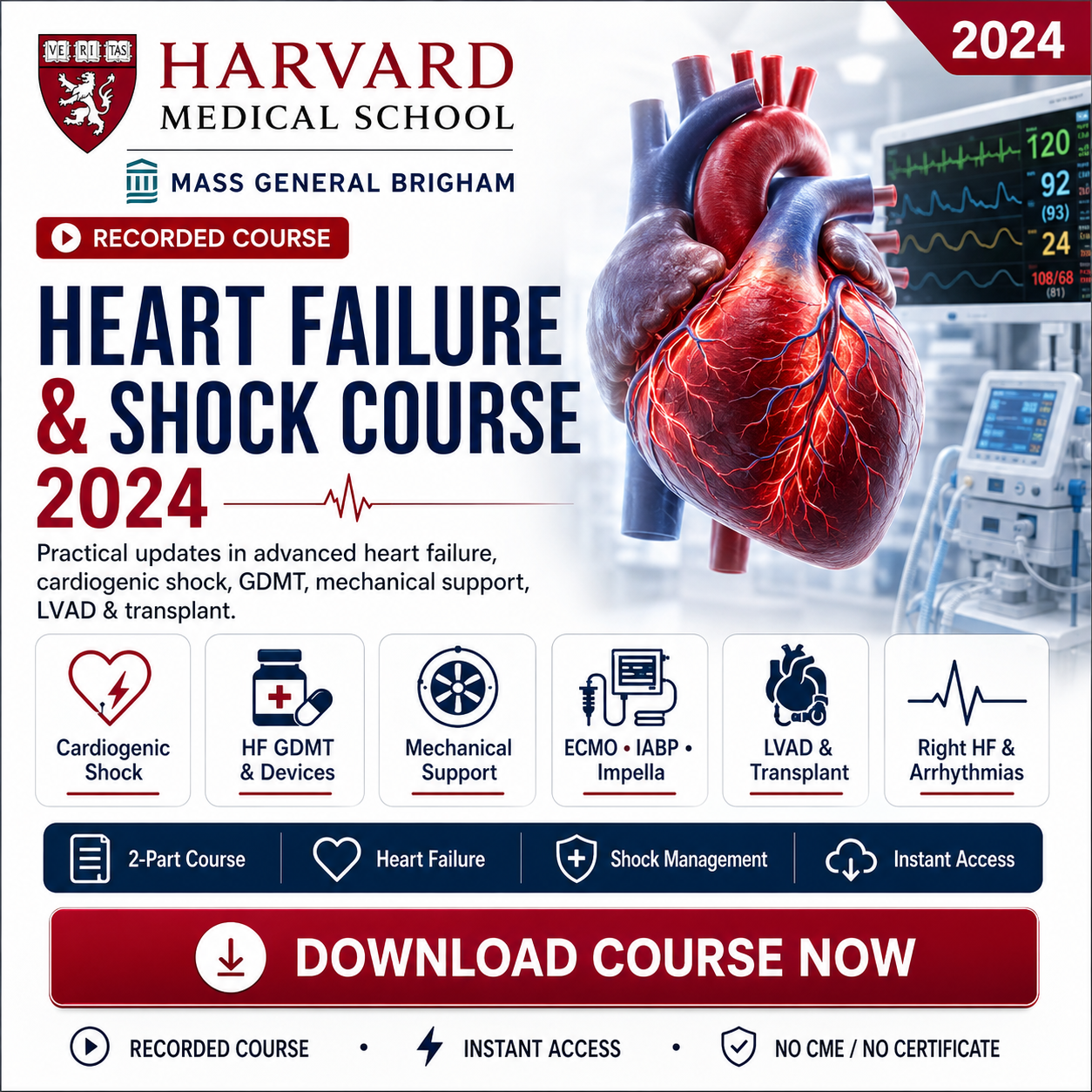
Harvard The Mass General Brigham Heart Failure & Shock Course 2024
A comprehensive heart failure and cardiogenic shock course designed for clinicians managing patients with advanced heart failure, shock, mechanical circulatory support, device-based therapies, arrhythmias, LVAD, transplantation, right heart failure, and modern guideline-directed medical therapy.
Harvard The Mass General Brigham Heart Failure & Shock Course 2024 is a recorded cardiovascular course focused on practical management of heart failure and cardiogenic shock. The course is structured into two major parts: cardiogenic shock review and advanced heart failure care with GDMT, device-based therapies, technology, and clinical trials.
Focus: Heart failure, cardiogenic shock, temporary mechanical circulatory support, GDMT, LVAD, transplantation, right heart failure, arrhythmias, and team-based cardiovascular care.
About This Course
Heart failure and cardiogenic shock require rapid diagnosis, careful risk stratification, coordinated team-based care, and timely use of medical, device, and advanced therapies. This course provides practical insights from Mass General Brigham experts and guest faculty for clinicians involved in cardiovascular care.
The first part of the program focuses on cardiogenic shock, including shock pathophysiology, phenotypes, trajectories, diagnosis, temporary mechanical circulatory support, ECMO, IABP, Impella, shock systems, and disparities in shock care.
The second part focuses on heart failure, including HFpEF, HFrEF, GDMT, device-based therapies, LVAD, transplantation, right heart failure, atrial fibrillation, ventricular tachycardia, CRT alternatives, cardiac contractility modulation, baroreflex activation, palliative care, lifestyle support, and future heart failure innovations.
Why Choose This Course
Key Highlights
- Comprehensive 2-part course covering cardiogenic shock and heart failure care
- Focused review of shock diagnosis, shock trajectories, and management systems
- Practical updates on temporary mechanical circulatory support, ECMO, IABP, Impella, LVAD, and transplant
- Detailed heart failure care including GDMT, HFpEF, HFrEF, device therapy, and advanced HF options
- Covers arrhythmia management in heart failure including AF ablation, VT, and CRT alternatives
- Designed for cardiovascular clinicians, APPs, primary care physicians, nurses, pharmacists, and specialty physicians
Core Learning Areas
Complete Curriculum
Part I: Big Ideas in Cardiogenic Shock
- Cardiogenic shock: where the field has been and where it is going
- The “golden day” of shock diagnosis
- Centralized versus localized shock care
- Door-to-PAC timing and early invasive assessment
- Pre-emptive versus selective LV unloading in VA-ECMO
- ECMO and IABP indications, configuration, and troubleshooting
- Shock phenotypes, trajectories, and patient deterioration patterns
Special Topics in Cardiogenic Shock
- Cardiogenic shock treatment in adult congenital heart disease
- Disparities in shock care and strategies to improve equity
- ARDS and cardiogenic shock overlap
- Temporary MCS as bridge to durable LVAD or transplant
- Cardio-obstetric shock management dilemmas
- Impactful shock trials and evolving clinical evidence
- Creating MCS and ECMO programs in community hospitals
Heart Failure Basics & Diagnostic Evaluation
- Overview of HF pathophysiology and epidemiology
- HFpEF and HFrEF clinical phenotypes
- What to do when heart failure is suspected
- Diagnostic evaluation of heart failure in 2024
- Role of echocardiography in HF diagnosis and management
- Exercise-hemodynamic assessment and CPET in HF phenotyping
- Clinical trial updates shaping future HF care
GDMT and Practical HF Management
- Guideline-directed medical therapy and beyond
- Emerging heart failure therapies
- Diabetic cardiomyopathy and repurposing diabetes drugs in HF
- Role of artificial intelligence in heart failure care
- Prior authorization and practical GDMT acquisition
- Starting GLP-1 agonists in appropriate patients
- When and how to give IV iron
- Outpatient diuretics: oral versus subcutaneous or IV options
HFpEF, Right Heart Failure & Pulmonary Hypertension
- HFpEF phenotyping and treatment strategy
- Infiltrative cardiomyopathies and diagnostic considerations
- Optimizing care for patients with HFpEF
- Right ventricular dysfunction in heart failure
- Optimization of the right ventricle in right heart failure
- Pulmonary hypertension in heart failure
- Medication versus temporary mechanical support in right heart failure
Arrhythmias, Device Therapy & Advanced HF
- CRT updates and CRT alternatives
- His bundle pacing, left bundle branch pacing, and leadless LV pacing
- Atrial fibrillation in heart failure: ablation considerations
- PVCs and ventricular tachycardia management updates
- Cardiac contractility modulation and BAROSTIM debate
- Durable LVAD surgical considerations
- Heart transplantation updates
- Advanced coronary artery disease and valve intervention debates
Team-Based HF Care, Lifestyle & Palliative Care
- Comprehensive team-based heart failure management
- Co-management with APPs and partner hospitals
- Stress and anxiety management in heart failure
- Caregiver burnout and patient support
- When to call palliative care
- Safe and effective physical activity augmentation
- Equity and disparities in heart failure treatment
Learning Objectives
By Completing This Course, You Will Be Able To:
- Explain heart failure pathophysiology and diagnostic evaluation
- Apply current evidence-based medical and device therapies for heart failure
- Identify HFpEF and HFrEF phenotypes using clinical and exercise-hemodynamic assessment
- Recognize the importance of APP co-management, partner hospitals, lifestyle care, palliative care, and equity
- Diagnose cardiogenic shock early and institute timely therapy
- Describe indications and management of temporary mechanical circulatory support
- Summarize the design of a system of shock care
- Recognize shock trajectories and predict which patients may improve or worsen
- Address race and sex disparities in outcomes and treatment for cardiogenic shock
Who Should Take This Course
This course is designed for nurses, primary care physicians, physician assistants, specialty physicians, pharmacists, nurse practitioners, cardiologists, intensivists, heart failure clinicians, emergency physicians, hospitalists, residents, fellows, and healthcare professionals involved in heart failure, cardiogenic shock, critical care, mechanical circulatory support, or advanced cardiovascular disease management.
Delivery & Access
This course package is provided for recorded learning access. No CME points or certificate are associated with this product.
Reviews
A very practical course for advanced heart failure and cardiogenic shock. The GDMT, MCS, and LVAD discussions were especially useful.
Excellent structure. The shock sections, ECMO discussions, and case-based approach helped clarify difficult ICU decisions.
The outpatient diuretic, IV iron, lifestyle, and team-based care sessions were directly relevant to everyday heart failure management.
FAQ
Who is this course best suited for?
It is ideal for nurses, primary care physicians, physician assistants, specialty physicians, pharmacists, nurse practitioners, cardiologists, intensivists, hospitalists, residents, fellows, and clinicians involved in heart failure or cardiogenic shock care.
What is the structure of the course?
The course is structured into two major parts: an in-depth review of cardiogenic shock and a heart failure section focused on GDMT, device therapies, technology-based care, and advanced HF management.
What topics are covered?
The course covers cardiogenic shock, shock diagnosis, ECMO, IABP, Impella, temporary MCS, LVAD, transplantation, HFpEF, HFrEF, GDMT, IV iron, outpatient diuretics, AI in HF, arrhythmias, CRT alternatives, right heart failure, pulmonary hypertension, and team-based HF care.
Does this product include CME or a certificate?
No. This course package does not include CME points or a certificate.
Who can I contact for support?
You can contact us at [email protected].


Dr. Emily R., Cardiothoracic Surgeon –
“This course exceeded my expectations! The faculty were top-notch, and the materials provided on Google Drive made it easy to revisit essential information. I feel much more confident in managing patients with heart failure and shock.”
Dr. Sarah L., Nurse Practitioner –
“An outstanding educational experience! The combination of expert lectures and interactive discussions kept me engaged. I left with practical tools and strategies that I could implement in my clinical practice right away.”
Dr. Jessica A., Cardiologist –
“The Mass General Brigham Heart Failure & Shock Course was exceptional! The instructors were highly knowledgeable, and the course content was both comprehensive and practical. I appreciated the case studies that made complex concepts easier to understand.”
Dr. Mark B., Internal Medicine Physician –
“This course provided invaluable insights into the management of heart failure and shock. The access to recorded sessions allowed me to review key topics at my convenience. Highly recommended for anyone involved in cardiovascular care!”