
Harvard Anesthesiology Update 2025
A comprehensive anesthesiology update covering cardiac, regional, thoracic, obstetric, pediatric, neuro, office-based, and critical care anesthesia, with practical updates on patient safety, airway management, POCUS, AI, hemodynamic monitoring, transfusion, pain management, and perioperative care.
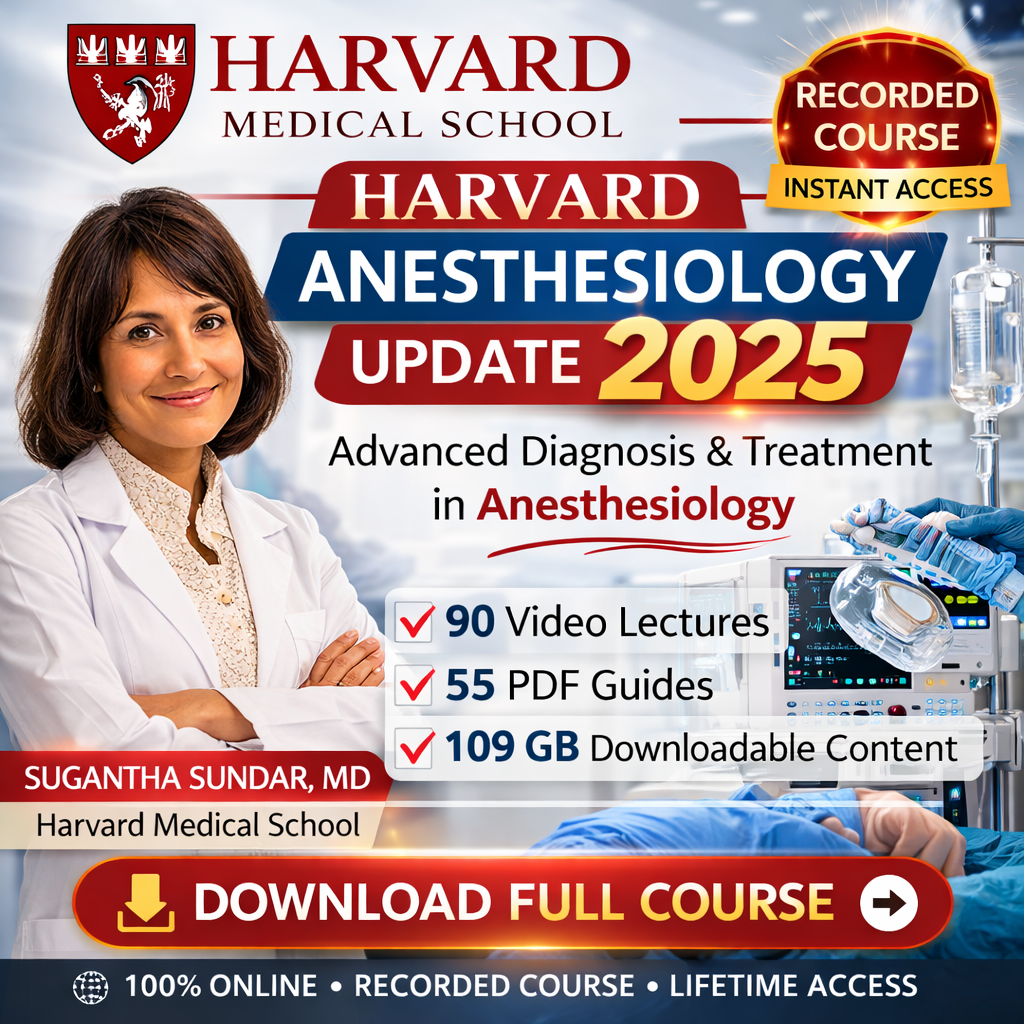
Harvard Anesthesiology Update 2025 is a recorded medical course package focused on current anesthesiology practice, perioperative medicine, anesthesia subspecialties, patient safety, risk reduction, and practical clinical decision-making.
Included: 90 videos, 55 PDF resources, total size 109 GB.
About This Course
Anesthesiology practice continues to evolve rapidly with new technology, updated safety recommendations, advanced monitoring, ultrasound-guided procedures, and changing perioperative standards.
This course provides a broad and practical update across major anesthesiology subspecialties, helping clinicians improve patient safety, reduce complications, manage high-risk cases, and incorporate new evidence into perioperative care.
Why Choose This Course
Key Highlights
- Comprehensive 2025 anesthesiology update across major subspecialties
- 90 recorded video sessions with 55 PDF learning resources
- Practical coverage of patient safety, airway, POCUS, AI, and risk reduction
- Includes cardiac, regional, thoracic, obstetric, pediatric, neuro, and office-based anesthesia
- Designed for anesthesiologists, nurse anesthetists, anesthesiologist assistants, residents, and fellows
Core Learning Areas
Complete Curriculum
Patient Safety, Technology & AI
- APSF priorities: current focus and future directions
- Urgent and upcoming threats to patient safety
- Technology, artificial intelligence, and criminalization of medical error
- Medication safety in anesthesia practice
- Research fraud and impact on anesthesia practitioners
- Rethinking the anesthesiology workforce and patient care
- Ethical issues in the application of AI in anesthesia practice
- Machine learning, preoperative risk prediction, and intraoperative AI tools
Airway, Regional Anesthesia & Pain Management
- Management of the impossible airway
- Scanning the airway horizon and defining landmarks
- Airway challenges in the pediatric patient
- Brachial plexus blocks below the clavicle
- Head and neck blocks for awake craniotomy
- Ultrasound-guided neuraxial blocks
- Management of rebound pain after peripheral nerve block
- Perioperative methadone and opioid-sparing strategies
- Multimodal anesthesia: getting it right
Cardiac, Hemodynamics & Critical Care
- Management of massive hemorrhage in the operating room
- Point-of-care coagulation testing
- Myocardial injury after noncardiac surgery
- Aortic stenosis management for non-cardiac cases
- Point-of-care cardiac ultrasound
- Point-of-care lung ultrasound
- Right heart risk: when to suspect and what to do
- Hemodynamic monitoring in critically ill patients
- Fluid balance and perioperative management
Obstetric, Pediatric & Special Population Anesthesia
- Maternal infections
- Maternal morbidity and mortality from an anesthesia perspective
- Technology for postpartum hemorrhage management
- Optimal neuraxial labor analgesia
- Pediatric advanced life support updates
- Patient safety in pediatric day surgery
- Preparing children for anesthesia
- Geriatric assessment and evidence-based care
- Perioperative management of patients with diabetes
Neuroanesthesia, Brain Health & ICU Care
- Brain health and perioperative neurocognitive disorders
- Emergence from general anesthesia and EEG insights
- From brain to consciousness: lessons from coma
- Neurophysiological markers of connectedness and disconnectedness
- Brain death and organ donation
- Biomarkers in sepsis and ARDS
- Nutrition in the ICU
- Palliative care in the ICU
Thoracic, Office-Based, NORA & Emerging Topics
- Non-operating room anesthesia and remote location safety
- Day surgery and ambulatory anesthesia updates
- Thoracic and cardiothoracic analgesia strategies
- Trauma management recent advances
- Burn care management updates
- Space medicine and anesthesia practice
- End-of-life communication and comfort symptom management
- History and future directions of anesthesia practice
Learning Objectives
By Completing This Course, You Will Be Able To:
- Apply updated anesthesiology guidelines and patient safety recommendations
- Improve perioperative risk assessment and patient-specific anesthesia planning
- Use ultrasound and monitoring strategies to support safer clinical decisions
- Manage difficult airway, regional anesthesia, and pain-related challenges
- Recognize evolving applications of AI and technology in anesthesia practice
- Improve care for obstetric, pediatric, geriatric, and critically ill patients
- Reduce complications through evidence-based perioperative and systems-based approaches
Who Should Take This Course
This course is designed for anesthesiologists, nurse anesthetists, anesthesiologist assistants, residents, fellows, student nurse anesthetists, perioperative clinicians, and healthcare professionals involved in anesthesia, critical care, perioperative medicine, pain management, or surgical patient safety.
Delivery & Access
This course package is provided for recorded learning access. No CME points or certificate are associated with this product.
Reviews
A very practical anesthesiology update. The patient safety, airway, and POCUS sessions were especially useful for daily perioperative practice.
Comprehensive and well organized. I appreciated the focus on regional anesthesia, pediatric safety, obstetric care, and hemodynamic monitoring.
Excellent course for reviewing high-yield anesthesia updates and complex case management across multiple subspecialties.
FAQ
Who is this course best suited for?
It is ideal for anesthesiologists, nurse anesthetists, anesthesiologist assistants, residents, fellows, student nurse anesthetists, and perioperative clinicians.
What is included in the course package?
The package includes 90 recorded videos and 55 PDF resources, with a total size of 109 GB.
What topics are covered?
The course covers cardiac anesthesia, regional anesthesia, critical care, ambulatory and office-based anesthesia, pediatric anesthesia, obstetric anesthesia, thoracic anesthesia, transfusion medicine, neuroanesthesia, pain management, patient safety, POCUS, airway management, AI, and ERAS.
Does this product include CME or a certificate?
No. This course package does not include CME points or a certificate.
Who can I contact for support?
You can contact us at [email protected].


Sarah Johnson –
“An outstanding experience! The course covered the latest advancements in anesthesiology. Highly recommend it!”
Michael Lee –
“Fantastic faculty! Their expertise made complex topics easy to understand. I learned so much.”
Emily Davis –
“The interactive sessions were incredibly engaging. I appreciated the real-world applications of the material.”
Jessica Brown –
“The case studies were particularly helpful. They provided practical insights that I can apply in my practice.”
Robert Wilson –
“I was impressed by the quality of the presentations. The course exceeded my expectations!”
Karen Thompson –
“Excellent networking opportunities! I connected with many professionals in the field.”
Chris Garcia –
“The curriculum was well-organized and covered a broad range of topics. I felt fully engaged throughout.”
Laura Harris –
“I loved the emphasis on regional anesthesia. The instructors were top-notch!”
James Robinson –
“This course provided practical tools that I can use immediately in my practice. Highly beneficial!”
Olivia Clark –
“The updates on sedation techniques were particularly enlightening. I feel much more confident now!”
Kevin Green –
“The faculty’s depth of knowledge was impressive. I learned from the best in the field.”
Nancy Adams –
“A fantastic course! The interactive format kept me engaged and motivated to learn.”
Daniel Walker –
“I appreciated the focus on evidence-based practices. It’s essential for modern anesthesiology.”
Rachel Scott –
“The resources provided were excellent. I look forward to revisiting the materials.”
Timothy Young –
“The course was well-paced, and the information was relevant to my practice. Highly recommend!”
Megan Hall –
“Incredible experience! The discussions on perioperative care were particularly useful.”
Joshua King –
“I left feeling inspired and better prepared for my practice. Thank you to the faculty!”
Victoria Wright –
“The environment was supportive and collaborative. I loved sharing ideas with fellow attendees.”
Benjamin Lopez –
“The case discussions were interactive and insightful. I learned a lot from my peers.”