
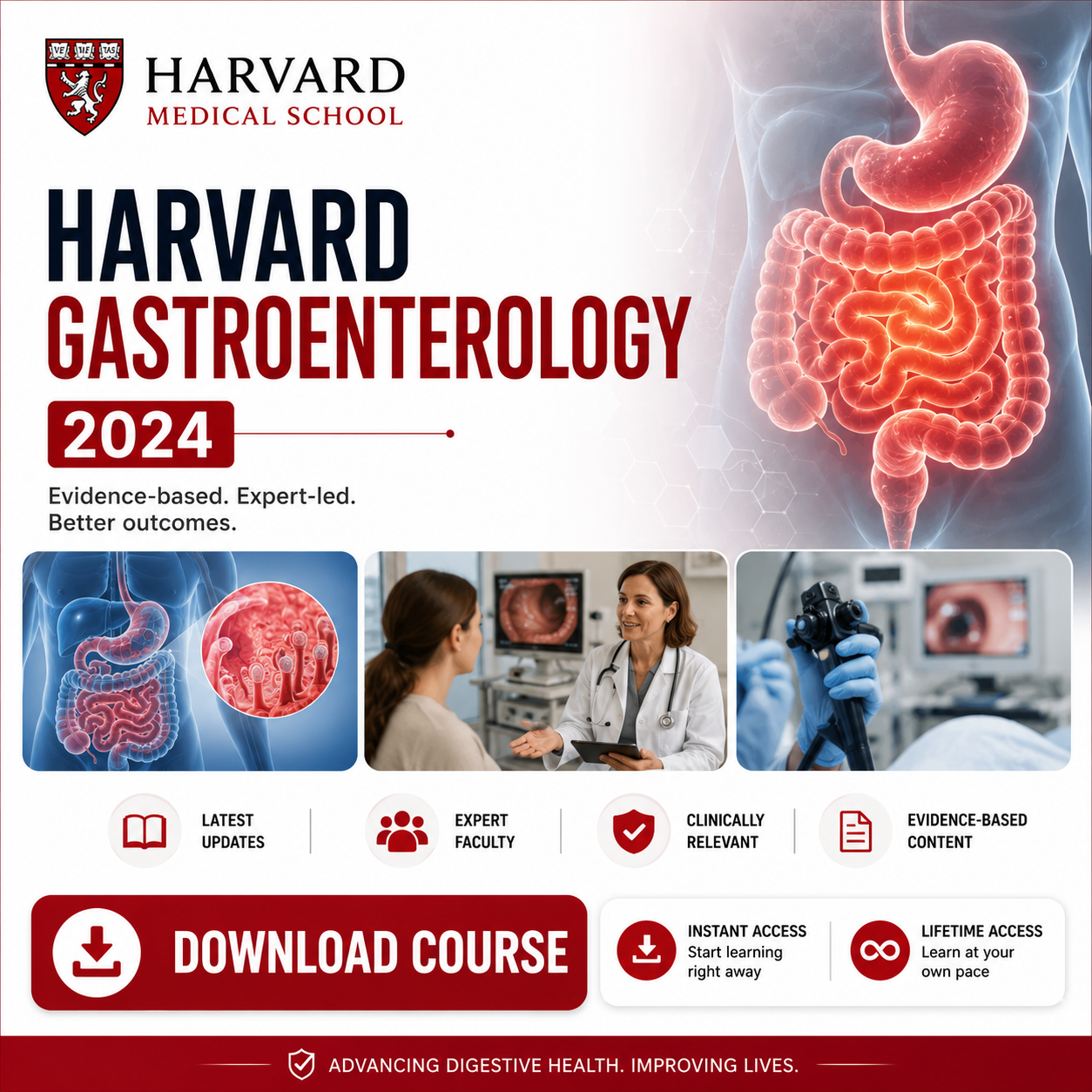
Harvard Gastroenterology 2024
A comprehensive Harvard gastroenterology update focused on state-of-the-art GI strategies, clinical best practices, new guidelines, inflammatory bowel disease, liver disease, endoscopy quality, GI bleeding, GERD, IBS, C. difficile, hereditary GI cancer syndromes, and emerging advances in digestive disease care.
Course Details:
Harvard Gastroenterology 2024 is a recorded comprehensive GI update designed to help clinicians stay current with recent advances, updated guidelines, and practical treatment strategies across the full spectrum of gastroenterology.
Focus: IBD, biologic therapies, therapeutic drug monitoring, older adults with IBD, C. difficile infection, GI complications of immunotherapy, IBS, fecal incontinence, refractory GERD, hereditary GI cancer syndromes, fatty liver disease, cirrhosis, adenoma detection rate, colonoscopy quality, acute GI bleeding, endoscopic obesity management, fecal microbiota transplantation, COVID-related GI disease, Barrett’s esophagus, eosinophilic esophagitis, microscopic colitis, autoimmune hepatitis, pancreatitis, and celiac disease.
About This Course
Gastroenterology is rapidly advancing with new therapies, updated national guidelines, improved diagnostic strategies, and evolving approaches to chronic digestive disease management.
Harvard Gastroenterology 2024 provides a practical and evidence-based review of key GI topics, helping clinicians incorporate new recommendations into day-to-day patient care.
The course features updates and best practices presented by nationally recognized GI experts and master clinicians, with emphasis on improving patient outcomes through better diagnosis, treatment selection, monitoring, and procedural quality.
Why Choose This Course
- Harvard 2024 comprehensive gastroenterology update
- Reviews recent advances and their impact on clinical approaches and patient outcomes
- Covers updated guidelines for biologics in IBD and therapeutic drug monitoring
- Includes key updates in C. difficile, IBS, GERD, fatty liver disease, cirrhosis, GI bleeding, and hereditary GI cancer syndromes
- Discusses endoscopy quality, adenoma detection rate, high-quality colonoscopic care, and acute GI bleeding control
- Explores emerging areas such as the stool microbiome, endoscopic obesity management, AI-assisted ADR improvement, and new therapeutic strategies
- Useful for gastroenterologists, internists, surgeons, nurse practitioners, physician assistants, residents, fellows, and clinicians managing GI disorders
Core Learning Areas
Inflammatory Bowel Disease
Biologic therapy selection, therapeutic drug monitoring, refractory pouchitis, older adults with IBD, microscopic colitis, and treatment optimization.
Liver & Pancreatic Disease
Fatty liver disease, cirrhosis, alcohol-related liver disease, autoimmune hepatitis, acute pancreatitis, chronic pancreatitis, and liver-focused updates.
Endoscopy & Cancer Prevention
Adenoma detection rate, colonoscopy quality, hereditary GI cancer syndromes, Barrett’s esophagus, high-risk colorectal cancer, and GI bleeding.
Common GI Disorders
IBS, refractory GERD, eosinophilic esophagitis, celiac disease, fecal incontinence, C. difficile, immunotherapy-related GI complications, and microbiome care.
Complete Curriculum
- Updated guidelines for the use of biologics in IBD
- How to choose which biologic agent to start with
- How to monitor patients during IBD treatment
- Role of therapeutic drug monitoring in IBD care
- When to switch therapy and how to approach loss of response
- New agents now available for inflammatory bowel disease
- Management of older adults with IBD and complex comorbidities
- Managing refractory pouchitis
- Diagnosis and treatment of microscopic colitis
- GI complications of immunotherapy
- Recognition of heterogeneous immune-mediated GI presentations
- Effective treatment strategies for immunotherapy-related GI disease
- Approach to chronic diarrhea and inflammatory mimics
- Practical management strategies for complex IBD-related conditions
- Updated guidelines for treatment of C. difficile infection
- When fecal microbiota transplantation is indicated
- The stool microbiome and clinical applications
- Understanding microbiome science behind emerging therapies
- Practical management of recurrent C. difficile
- Antibiotic and non-antibiotic treatment considerations
- Future directions in microbiome-based gastroenterology care
- Improved management of irritable bowel syndrome
- New strategies to treat common GI problems
- Tips for managing fecal incontinence
- Patient-centered approaches to chronic functional GI symptoms
- Differentiating functional symptoms from organic disease
- Practical therapies for symptom control and quality of life improvement
- Applying guideline-based care to common outpatient GI presentations
- Management of refractory GERD
- Barrett’s esophagus updates
- Eosinophilic esophagitis diagnosis and treatment
- Choosing between drug therapy and dietary therapy in eosinophilic esophagitis
- Evaluation of persistent reflux symptoms
- Risk-based management and surveillance strategies
- Practical treatment selection for esophageal disorders
- Management of fatty liver disease in 2024
- Diagnosis and management of cirrhosis
- Alcohol-related liver disease updates
- Autoimmune hepatitis review
- Risk stratification and monitoring of chronic liver disease
- Practical care strategies for patients with liver disease
- When to refer and how to coordinate multidisciplinary liver care
- Acute pancreatitis evaluation and management
- Chronic pancreatitis updates
- Clinical approach to pancreatic disease in GI practice
- Celiac disease diagnosis and serologic interpretation
- Making sense of multiple celiac serologic tests
- New therapeutic strategies on the horizon for celiac disease
- Practical long-term management of pancreatic and celiac disorders
- Techniques to effectively control acute GI bleeding
- Initial stabilization and endoscopic treatment strategies
- Approach to high-risk colorectal cancer patients
- Expanded genetic testing options to diagnose hereditary GI cancer syndromes
- Risk assessment and surveillance planning
- Practical recommendations for hereditary cancer syndrome evaluation
- Improving outcomes through timely detection and appropriate follow-up
- How to improve adenoma detection rate
- Why adenoma detection rate is critical to measure
- Steps to ensure delivery of high-quality colonoscopic care
- Strategies to improve endoscopy performance
- Use of artificial intelligence to increase adenoma detection rate
- Quality improvement in colonoscopy practice
- Practical systems for better colorectal cancer prevention
- Endoscopic management of obesity
- Emerging approaches to obesity treatment in gastroenterology
- Impact of COVID on the GI tract
- New diagnostic and treatment strategies for common GI problems
- Future directions in gastroenterology care
- Inspiring and cutting-edge topics from world-renowned GI experts
- Translating recent advances into practical clinical recommendations
Learning Objectives
- Apply updated gastroenterology guidelines to daily clinical practice
- Use current recommendations for biologic therapies and therapeutic drug monitoring in IBD
- Manage older adults with IBD and complex treatment considerations
- Improve diagnosis and treatment of C. difficile infection, IBS, GERD, and fecal incontinence
- Recognize and treat GI complications of immunotherapy
- Evaluate hereditary GI cancer syndromes and high-risk colorectal cancer patients
- Improve adenoma detection rate and delivery of high-quality colonoscopic care
- Apply current approaches to fatty liver disease, cirrhosis, autoimmune hepatitis, and alcohol-related liver disease
- Use evidence-based strategies for acute GI bleeding, pancreatitis, celiac disease, Barrett’s esophagus, and eosinophilic esophagitis
- Integrate new advances, microbiome science, AI-assisted endoscopy concepts, and endoscopic obesity management into GI practice
Who Should Take This Course
This course is designed for gastroenterologists, internists, surgeons, nurse practitioners, physician assistants, residents, fellows, primary care physicians, and clinicians involved in the diagnosis and management of digestive diseases.
It is especially useful for clinicians who want a practical update in IBD, liver disease, endoscopy quality, colorectal cancer prevention, common GI disorders, GI bleeding, esophageal disease, pancreatic disease, celiac disease, and emerging gastroenterology strategies.
Delivery & Access
Recorded Course
Review the comprehensive gastroenterology update at your own pace.
2024 Edition
Updated GI strategies, clinical practices, and guideline-based recommendations.
4-Day Program
Broad coverage across IBD, liver disease, endoscopy, GI bleeding, GERD, IBS, and more.
Support
Reviews
Dr. Samantha Lee
A clinically useful GI update with practical strategies that can be applied directly to patient care.
Dr. Michael Chen
Excellent depth in IBD, biologic therapy selection, and personalized treatment approaches.
Dr. Sarah Patel
Valuable review for clinicians managing GI complaints, diagnostics, treatment guidelines, and specialty referrals.
FAQ
Who is this course best suited for?
This course is best suited for gastroenterologists, internists, surgeons, nurse practitioners, physician assistants, residents, fellows, primary care physicians, and clinicians involved in GI care.
What topics are covered?
Topics include IBD, biologic therapies, therapeutic drug monitoring, C. difficile infection, GI complications of immunotherapy, microscopic colitis, fatty liver disease, Barrett’s esophagus, eosinophilic esophagitis, alcohol-related liver disease, autoimmune hepatitis, IBS, refractory GERD, acute pancreatitis, chronic pancreatitis, celiac disease, GI bleeding, high-risk colorectal cancer, adenoma detection rate, colonoscopy quality, endoscopic obesity management, fecal microbiota transplantation, microbiome science, and COVID-related GI effects.
Does this course cover IBD updates?
Yes. The course covers updated biologic therapy guidelines, therapeutic drug monitoring, management of older adults with IBD, refractory pouchitis, and treatment optimization strategies.
Is this course practical for daily gastroenterology practice?
Yes. The course provides evidence-based recommendations, best practices, updated guidelines, and practical strategies for improving patient outcomes in GI care.
Is this a recorded course?
Yes. This product is provided as recorded course access so you can review the material at your own pace.
Does this course include CME or a certificate?
No. CME credits and certificates are not included with this course package.
Who can I contact for support?
You can contact support at [email protected].


Dr. Samantha Lee, Gastroenterologist –
"This was the most impactful gastroenterology conference I've attended in my 15-year career. The Harvard faculty did an outstanding job translating cutting-edge research into practical strategies I can immediately implement to improve patient outcomes. I left feeling energized and equipped with the latest evidence-based best practices."
Dr. Michael Chen, Inflammatory Bowel Disease Expert –
"As a seasoned IBD specialist, I was blown away by the breadth and depth of the content covered at the Harvard Gastroenterology Review. The sessions on novel biologic therapies and personalized treatment algorithms were absolute game-changers. I highly recommend this program to any gastroenterologist seeking to elevate their clinical skills."
Dr. Fatima Sharma, Gastroenterology Hospitalist –
"This comprehensive review course exceeded all of my expectations. Not only did it provide essential updates across the full spectrum of gastroenterology, but it also featured cutting-edge research on the gut microbiome and its implications for patient care ."
Dr. David Nguyen, Gastroenterology Fellow –
"The Harvard Gastroenterology Review is a must-attend event for any GI clinician. The faculty presentations were engaging, the content was clinically relevant, and the networking opportunities were invaluable. I'm already looking forward to next year's program."
Dr. David Nguyen, Gastroenterology Fellow –
"The Harvard Gastroenterology Review is a must-attend event for any GI clinician. The faculty presentations were engaging, the content was clinically relevant, and the networking opportunities were invaluable. I'm already looking forward to next year's program."
Dr. Sarah Patel, Family Medicine Physician –
"As a primary care physician, I found the Harvard Gastroenterology Review to be an immensely valuable investment of my time. The sessions on GI diagnostics, treatment guidelines, and interprofessional collaboration have already transformed the way I approach GI health in my practice."
Dr. Amelia Flores, Chief of Gastroenterology –
"This conference single-handedly reignited my passion for gastroenterology. The innovative research, cutting-edge therapies, and emphasis on holistic patient care have inspired me to think more creatively about GI disease management. Bravo to the Harvard team for organizing such an exceptional event!"