
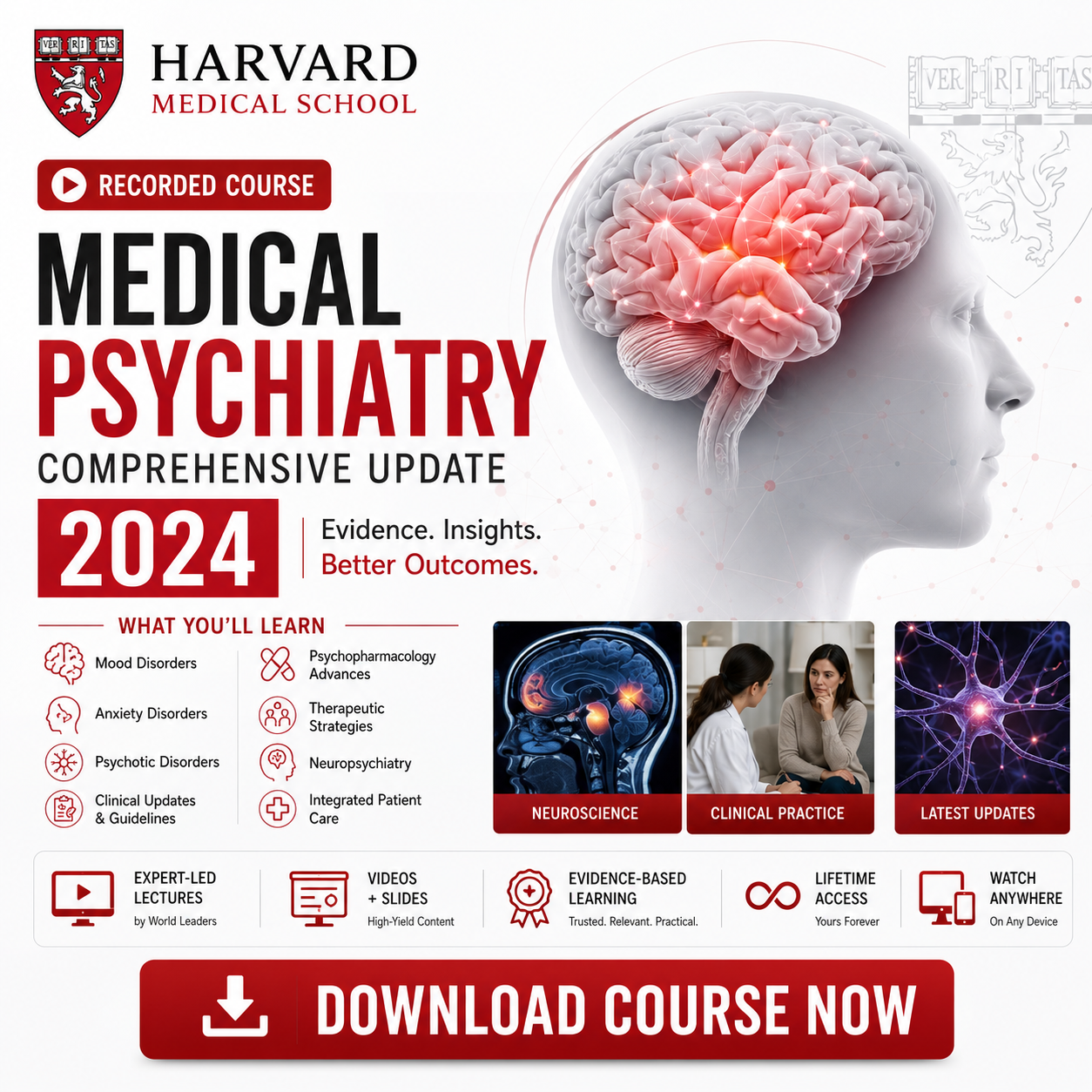


Harvard Medical Psychiatry: Comprehensive Update 2024
A comprehensive Harvard medical psychiatry course focused on the interface between medicine and psychiatry, helping clinicians evaluate and manage neuropsychiatric symptoms, psychiatric complications of medical illness, consultation-liaison psychiatry challenges, substance use, delirium, catatonia, neurocognitive disorders, and complex psychiatric care in medical settings.
Course Details:
Harvard Medical Psychiatry: Comprehensive Update 2024 is a recorded educational course designed for clinicians working at the intersection of psychiatry and medicine, including general hospital, emergency, inpatient, outpatient, oncology, transplant, critical care, trauma, and specialty medical settings.
Focus: Psychiatric consultation, neuropsychiatric symptoms in medical illness, delirium, catatonia, capacity assessment, agitation, suicide risk, substance use disorders, women’s mental health, critical care psychiatry, psycho-oncology, transplant psychiatry, neurocognitive disorders, movement disorders, infectious disorders, and functional neurologic symptoms.
About This Course
Medical psychiatry is a rapidly growing field that brings together psychiatric expertise and medical knowledge to care for patients with complex conditions across hospital and outpatient settings.
This course focuses on the evaluation and treatment of patients whose psychiatric symptoms are connected to medical, surgical, gynecologic, oncologic, neurologic, infectious, transplant, trauma, or critical care conditions.
The program is designed to strengthen diagnostic work-up, differential diagnosis, evidence-based treatment planning, psychiatric consultation skills, inter-professional care, and practical management of challenging neuropsychiatric presentations.
Why Choose This Course
- Harvard 2024 comprehensive update in medical psychiatry and consultation-liaison psychiatry
- Focused on patients with psychiatric symptoms in medical and surgical settings
- Covers delirium, catatonia, agitation, suicide risk, capacity assessment, and psychiatric emergencies
- Includes psychiatry in critical care, cardiology, oncology, transplant, trauma, women’s health, infectious disease, and neurology settings
- Reviews substance use disorders, pain, medical cannabis counseling, and addiction-related care
- Useful as a comprehensive review for clinicians involved in medical psychiatry and complex patient management
- Designed for specialty physicians, primary care physicians, physician assistants, nurse practitioners, psychologists, residents, fellows, and healthcare professionals
Core Learning Areas
Consultation Psychiatry
Psychiatric consultation in medical and surgical settings, capacity assessment, psychosocial formulation, agitation, emergencies, and suicide risk.
Medical & Critical Care Psychiatry
Psychiatry in ICU, cardiology, transplant, burn, trauma, emergency, inpatient, and complex hospital-based clinical environments.
Women’s Health & Substance Use
Pregnancy, menopause, PMDD, substance use disorders, pain and addiction, cannabis counseling, and psychiatric medication considerations.
Neuropsychiatry & Specialty Care
Neurocognitive disorders, functional neurologic symptoms, movement disorders, epilepsy, stroke, oncology, infectious disease, and autoimmune illness.
Complete Curriculum
- Consultation-liaison psychiatry and its role in modern medical care
- Psychiatric assessment in general hospital and surgical settings
- Psychosocial formulation for complex medical patients
- Capacity assessment, ethical issues, and legal considerations
- Management of agitation and behavioral emergencies
- Psychiatric emergencies including catatonia, neuroleptic malignant syndrome, and serotonin syndrome
- Suicide risk assessment and acute psychiatric management in emergency care settings
- Cardiac considerations for consultation-liaison psychiatry
- QTc prolongation and psychiatric medication risk management
- Risk stratification for challenging medical-psychiatric cases
- Critical care psychiatry in ICU settings
- Delirium pathophysiology, prevention, and treatment
- Psychiatric care of medically unstable patients
- Interdisciplinary management of psychiatric symptoms in critical illness
- Psychopharmacologic considerations during pregnancy
- Management of substance use disorders in pregnancy
- Premenstrual dysphoric disorder and menopause-related psychiatric concerns
- Risk-benefit planning for psychiatric medication use
- Women’s mental health in medical psychiatry practice
- Integrated care for psychiatric and medical conditions across the reproductive life cycle
- Comprehensive psychiatric evaluation in transplant settings
- Care of complicated burn and trauma patients
- Trauma-informed care in hospital settings
- Psychiatric assessment of medically complex patients
- Team-based care for high-risk inpatient populations
- Psychiatric support for patients undergoing major medical or surgical interventions
- Interface of pain and addiction in consultation-liaison psychiatry
- Management of substance use disorders in the medical setting
- Clinical counseling around medical cannabis use
- Psychiatric complications of substance use in hospitalized patients
- Patient-centered strategies for addiction-related care
- Interdisciplinary approaches to pain, substance use, and psychiatric symptoms
- Foundations of psycho-oncology in medical psychiatry
- Psychological health in patients with hematologic malignancies
- Management of psychiatric symptoms near the end of life
- Neurocognitive effects related to cancer treatment
- Addressing spirituality and meaning in oncology patients
- Supporting patients and families through complex oncologic illness
- Psychiatric disorders in gastrointestinal diseases
- Endocrine and metabolic disorders from a medical psychiatry perspective
- Inflammation, autoimmune disease, and psychiatric illness
- Neuropsychiatric symptoms in HIV and other infectious disorders
- Pharmacologic considerations in medically complex infectious disease patients
- Integrated care for psychiatric symptoms related to systemic illness
- Functional neurocircuitry and neuroanatomy of psychiatric symptoms
- Neurocognitive impairment and dementia assessment
- Clinical principles for bedside neuropsychiatric evaluation
- Psychiatric considerations in epilepsy and stroke
- Neuropsychiatry of movement disorders
- Assessment and management of functional neurologic and somatoform disorders
Learning Objectives
- Evaluate relationships between medical and psychiatric subspecialties in medically ill patients
- Generate clinically meaningful differential diagnoses for neuropsychiatric symptoms in medical settings
- Apply team-based approaches to assessment and treatment of psychiatric symptoms in medically complex patients
- Use updated diagnostic criteria and assessment methods for psychiatric symptoms in medical illness
- Implement evidence-based treatment recommendations and monitor patient response
- Improve psychiatric consultation skills in inpatient, emergency, outpatient, and specialty medical settings
- Recognize and manage delirium, catatonia, agitation, capacity issues, and psychiatric emergencies
- Apply psychiatric care principles in oncology, transplant, trauma, critical care, cardiology, women’s health, and neuropsychiatry
- Improve clinical decision-making for substance use, pain, and addiction-related presentations
- Strengthen integrated medical and psychiatric care for complex patients
Who Should Take This Course
This course is designed for specialty physicians, psychiatrists, consultation-liaison psychiatrists, primary care physicians, physician assistants, nurse practitioners, psychologists, residents, fellows, and healthcare professionals involved in the care of patients with both medical and psychiatric conditions.
It is especially useful for clinicians working in hospitals, emergency departments, outpatient clinics, oncology, transplant, critical care, neurology, women’s health, addiction medicine, and medically complex care settings.
Delivery & Access
Recorded Course
Study the course material at your own pace.
2024 Edition
Updated medical psychiatry and consultation-liaison psychiatry content.
Clinical Focus
Medical, psychiatric, neuropsychiatric, addiction, oncology, transplant, and critical care topics.
Support
Reviews
Dr. Laura Bennett
A very useful course for clinicians managing patients with overlapping medical and psychiatric conditions in hospital settings.
Dr. Michael Harris
Excellent coverage of consultation-liaison psychiatry, delirium, capacity, addiction, oncology, and neuropsychiatry.
Dr. Sarah Collins
Well-organized and clinically practical. The content is helpful for complex inpatient and outpatient medical psychiatry cases.
FAQ
Who is this course best suited for?
This course is best suited for psychiatrists, consultation-liaison psychiatrists, specialty physicians, primary care physicians, physician assistants, nurse practitioners, psychologists, residents, fellows, and healthcare professionals caring for medically complex psychiatric patients.
What topics are covered?
Topics include consultation-liaison psychiatry, psychiatric consultation, capacity assessment, agitation, catatonia, delirium, suicide risk, critical care psychiatry, transplant psychiatry, trauma-informed care, substance use disorders, pain and addiction, women’s mental health, psycho-oncology, neurocognitive disorders, functional neurologic symptoms, infectious disease psychiatry, and neuropsychiatry.
Is this course useful for hospital-based clinicians?
Yes. The course is highly relevant for clinicians working in inpatient medicine, emergency departments, critical care, oncology, transplant, neurology, and consultation-liaison psychiatry settings.
Does this product include CME?
No. CME points and certificates are not included with this course.
Is this course recorded?
Yes. This product is provided as recorded course access so you can review the material at your own pace.
Who can I contact for support?
You can contact support at [email protected].
Reviews
There are no reviews yet.