
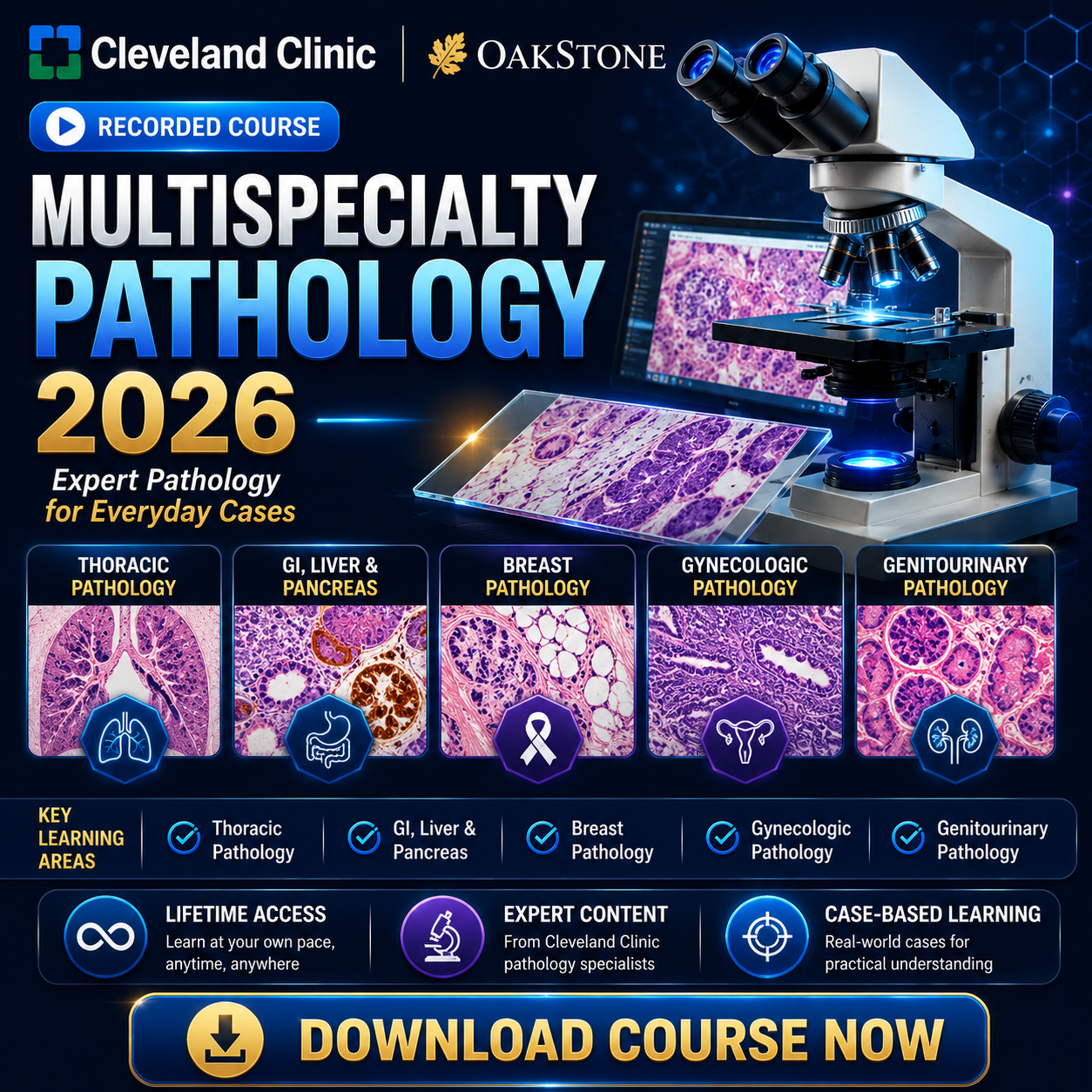
Oakstone Cleveland Clinic Multispecialty Pathology 2026
A practical multispecialty pathology video course featuring Cleveland Clinic subspecialists, designed to help pathologists strengthen diagnostic accuracy, improve confidence at the microscope, and apply high-yield pathology insights across multiple organ systems.
Oakstone Cleveland Clinic Multispecialty Pathology 2026 is a recorded pathology course focused on practical diagnostic challenges encountered in everyday pathology practice. Through case-based instruction, expert faculty share high-yield diagnostic tips, microscope-level reasoning, and practical approaches across multiple organ systems.
Included: 20 videos, 1 PDF, total size 4.98 GB.
About This Course
Multispecialty pathology requires strong diagnostic pattern recognition, careful use of immunohistochemistry, awareness of emerging entities, and practical knowledge across genitourinary, thoracic, gastrointestinal, liver, pancreatic, breast, and gynecologic pathology.
This course focuses on real-world pathology cases and high-yield diagnostic problems rather than unnecessary esoterica. It is designed to help learners improve diagnostic confidence and apply expert-level pathology reasoning in everyday practice.
Why Choose This Course
Key Highlights
- Cleveland Clinic multispecialty pathology update for 2026
- Includes 20 recorded videos and 1 downloadable PDF
- Focused on practical, case-based diagnostic pathology instruction
- Covers genitourinary, thoracic, liver, pancreas, gastrointestinal, breast, and gynecologic pathology
- Reviews prostate cancer grading, high-value immunostains, frozen sections, neuroendocrine neoplasia, and difficult tumor entities
- Designed for pathologists, pathology residents, and pathology fellows
Core Learning Areas
Complete Curriculum
Genitourinary Pathology
- Prostate Cancer Grading: The Cleveland Clinic Approach
- Six Diagnoses to Know in Genitourinary Pathology
- Mesenchymal Tumors of the Genitourinary Tract
- Morphologic-Molecular Correlates in Genitourinary Pathology
- Practical diagnostic approach to GU pathology cases
- Integrating morphology with molecular findings
- Improving diagnostic confidence in common and challenging GU specimens
Thoracic and Mediastinal Pathology
- Six Really Helpful Immunostains That Help Clinch Diagnoses in Thoracic Consults
- Mediastinal Pathology: Thymoma and Beyond
- Mesothelioma vs Its Differentials: Which Immunostains Are Most Helpful
- Twelve Diagnoses in Thoracic Pathology You Can Make on H&E
- High-yield immunohistochemistry for thoracic consults
- Practical differential diagnosis in thoracic pathology
- Diagnostic pearls for mediastinal and pleural pathology
Liver, Pancreas and Gastrointestinal Pathology
- Diagnosis and Reporting of Steatotic Liver Disease
- Beyond Acute Appendicitis: Important Diagnoses in Appendectomy Specimens
- Neuroendocrine Neoplasia of the Gastrointestinal Tract and Pancreas: Diagnosis and Pitfalls
- Common Questions in Frozen Section Pathology of the Liver and Pancreas
- Diagnostic challenges in liver and pancreas pathology
- Frozen section decision-making in hepatopancreatobiliary pathology
- Practical recognition of GI and pancreatic neoplasia
Breast Pathology
- Lobular Lesions: A Look at Their Many Looks
- Triple-Negative Breast Carcinomas: Rare Favorable Subtypes and Diagnostic Challenges
- Papillary Breast Tumors: Review of Common, Uncommon, and Unexpected Variants
- Beyond Metaplastic: Spectrum of Spindle Cell Lesions of Breast
- Distinguishing lobular carcinoma from mimics
- Diagnostic approach to papillary and spindle cell lesions
- High-yield breast pathology pearls for daily practice
Gynecologic Pathology
- Endometrial Carcinomas: Old and New Entities That Should Not Be Missed
- Uterine Mesenchymal Neoplasms: Some Old and Some New
- Classification of Vulvar Squamous Neoplasia: Updates and Current Practice
- Ovarian Mucinous Neoplasms: Common Diagnostic Dilemmas
- Diagnostic approach to emerging gynecologic pathology entities
- Practical review of endometrial, uterine, vulvar, and ovarian pathology
- Common pitfalls in gynecologic tumor diagnosis
Immunostains, Molecular Correlation and Practical Diagnosis
- High-value immunohistochemical markers in thoracic pathology
- Immunostains for mesothelioma and its differentials
- Morphologic-molecular correlation in GU pathology
- Integrating ancillary testing with morphology
- Choosing stains that provide meaningful diagnostic value
- Avoiding overuse of unnecessary testing
- Improving diagnostic accuracy with targeted ancillary studies
Case-Based Multispecialty Pathology Practice
- Practical solutions for real-world diagnostic challenges
- Case-based instruction across multiple organ systems
- Microscope-level diagnostic pearls from subspecialty experts
- High-yield pathology topics for everyday practice
- Building diagnostic confidence through expert pattern recognition
- Applying practical pathology reasoning without unnecessary esoterica
- Improving patient care through accurate pathology diagnosis
Learning Objectives
By Completing This Course, You Will Be Able To:
- Review neuroendocrine neoplasia of the gastrointestinal tract and pancreas
- Accurately grade prostate cancer using a practical diagnostic approach
- Review endometrial carcinoma, including old and new entities
- Discuss helpful immunohistochemical markers in thoracic pathology
- Distinguish between lobular breast carcinoma and its mimics
- Apply practical diagnostic strategies across GU, thoracic, GI, liver, pancreas, breast, and gynecologic pathology
- Use case-based pathology reasoning to improve confidence in everyday diagnostic practice
Who Should Take This Course
This course is designed for pathologists, pathology residents, pathology fellows, practicing diagnostic pathologists, academic pathologists, and pathology professionals who want practical multispecialty updates across major organ systems.
Delivery & Access
This course package is provided for recorded learning access. No CME points are associated with this product.
Reviews
A practical pathology update with strong coverage of GU, thoracic, breast, GI, liver, pancreas, and gynecologic pathology. Very useful for daily sign-out.
Excellent case-based course. The immunostain discussions and diagnostic pitfalls make the content immediately useful at the microscope.
Well organized and high-yield. The course focuses on real diagnostic challenges rather than obscure topics, which makes it very practical.
FAQ
Who is this course best suited for?
It is ideal for pathologists, pathology residents, fellows, practicing diagnostic pathologists, academic pathologists, and pathology professionals seeking practical multispecialty updates.
What is included in the course package?
The package includes 20 recorded videos and 1 PDF file, with a total size of 4.98 GB.
What topics are covered?
The course covers prostate cancer grading, genitourinary pathology, thoracic immunostains, mediastinal pathology, steatotic liver disease, appendectomy specimens, breast lobular lesions, triple-negative breast carcinoma, endometrial carcinoma, uterine mesenchymal neoplasms, mesothelioma differentials, thoracic H&E diagnoses, GI and pancreatic neuroendocrine neoplasia, frozen section pathology of the liver and pancreas, vulvar squamous neoplasia, ovarian mucinous neoplasms, papillary breast tumors, and spindle cell lesions of the breast.
Is this course practical for daily pathology diagnosis?
Yes. The course is case-based and designed to provide practical diagnostic solutions, high-yield microscope tips, and useful pathology insights across multiple organ systems.
Does this product include CME?
No. This course package does not include CME points.
Who can I contact for support?
You can contact us at [email protected].
Reviews
There are no reviews yet.