
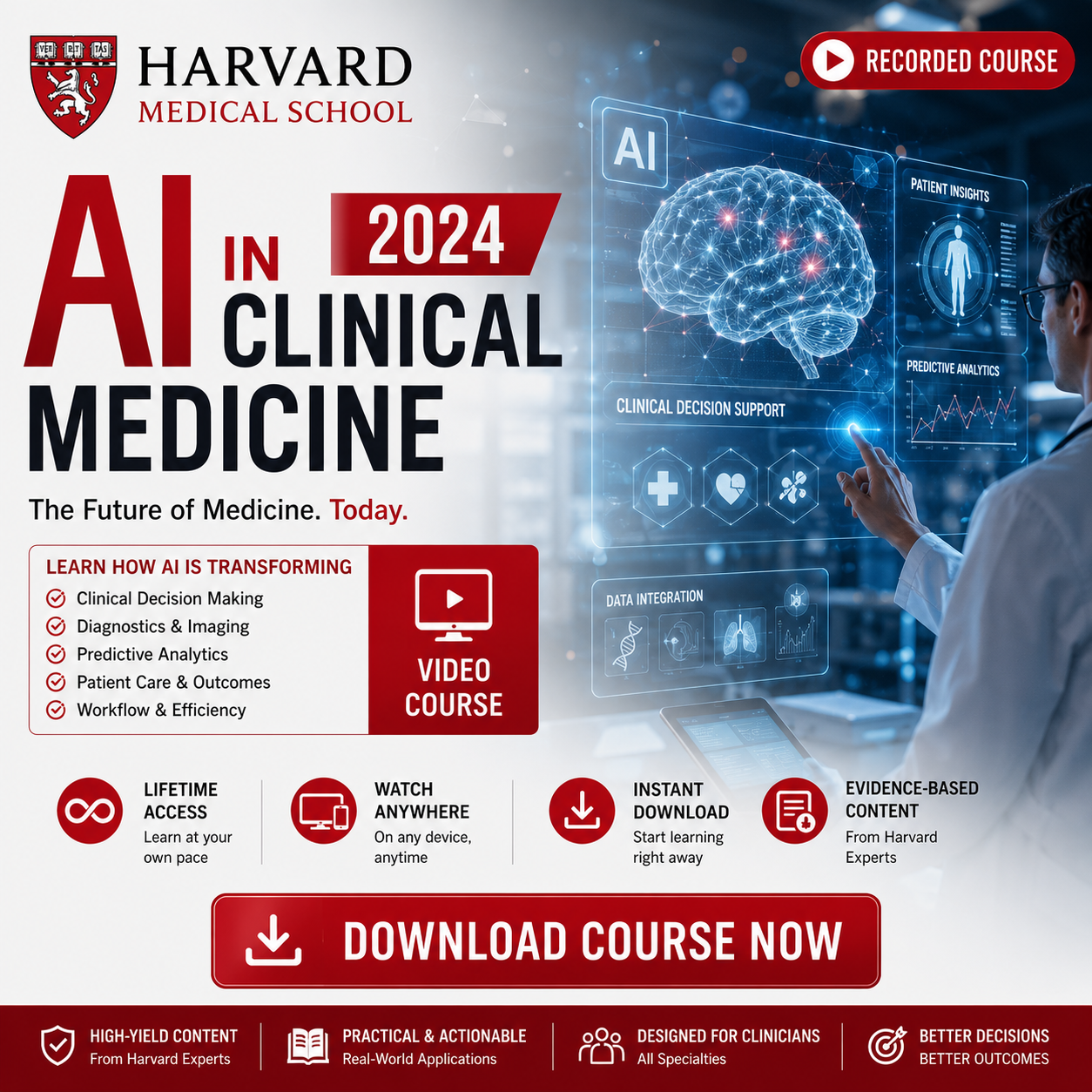
Harvard AI in Clinical Medicine 2024
A practical clinical medicine course designed to help physicians and healthcare professionals understand how artificial intelligence is transforming diagnosis, clinical decision support, patient communication, medical education, research, risk prediction, and personalized treatment across modern healthcare.
Harvard AI in Clinical Medicine 2024 is a recorded medical education course focused on the clinical use of artificial intelligence, including machine learning, deep learning, large language models, medical data, AI scribes, chatbots, diagnostic support, personalized treatment, ethical considerations, regulation, and real-world clinical applications.
Focus: AI foundations, clinical implementation, risk stratification, medical education, ethics, regulation, image processing, drug discovery, oncology, and specialty-specific AI use cases.
About This Course
Artificial intelligence is rapidly changing clinical medicine. From AI medical scribes and clinical decision support tools to diagnostic systems, predictive analytics, imaging applications, and personalized treatment planning, healthcare professionals need a practical understanding of how AI can be used safely and effectively.
This course helps clinicians cut through the hype and understand the realistic opportunities, limitations, risks, and responsibilities of integrating AI into patient care, medical education, healthcare operations, and biomedical research.
Why Choose This Course
Key Highlights
- Focused introduction to artificial intelligence in clinical medicine
- Explains machine learning, deep learning, large language models, and medical data
- Covers AI medical scribes, chatbots, clinical decision support, and risk prediction
- Includes ethical, legal, regulatory, and bias-related considerations
- Reviews AI applications in pathology, dermatology, gastroenterology, radiology, ophthalmology, and critical care
- Useful for physicians, nurses, nurse practitioners, clinical leaders, educators, and healthcare administrators
Core Learning Areas
Complete Curriculum
AI Foundations for Clinicians
- Paging Dr. AI: how AI is changing clinical care
- Learning the AI lingo: machine learning, deep learning, and large language models
- The AI healthcare odyssey: historical development of AI in medicine
- Technical background for clinicians
- Medical data as the backbone of AI
- Barriers to clinical AI implementation
AI Tools in Daily Clinical Practice
- AI medical scribes and clinical documentation
- Medical chatbots and patient communication
- AI-assisted charting
- Clinical decision support
- Using AI tools to inform medical diagnosis
- AI for heart failure management
- AI as a risk stratification tool
Ethics, Law, Regulation & Leadership
- Ethics and AI in healthcare
- Law and regulation in AI
- Ethical implications of AI in diagnosis and treatment planning
- Bias in algorithms and clinical decision-making
- Quality, accuracy, and long-term safety of AI technologies
- AI leadership in the digital healthcare era
Medical Education, Burnout & Healthcare Operations
- AI learning revolution in medical education
- Content generation and evaluation in medical education
- Using AI while maintaining educational alignment and quality
- AI and reducing physician burnout
- AI for improving workflow and healthcare operations
- How AI can help improve revenue and administrative efficiency
Biomedical Innovation & Personalized Medicine
- AI and machine learning in biomedical innovation
- AI and image processing
- AI in drug discovery and pharmaceutical development
- Precision medicine and personalized treatment in oncology
- AI-based diagnostic and predictive tools
- Future opportunities for AI-enabled clinical research
Specialty-Specific Clinical Applications
- Clinical applications of AI in pathology
- Clinical applications of AI in dermatology
- Clinical applications of AI in gastroenterology
- Clinical applications of AI in radiology
- Clinical applications of AI in ophthalmology
- Clinical applications of AI in critical care
- Real-world case studies and field-specific breakout sessions
Learning Objectives
By Completing This Course, You Will Be Able To:
- Define the unique challenges and opportunities for integrating AI into specialized healthcare fields
- Understand the role of machine learning, deep learning, large language models, and medical data in clinical AI
- Discuss ethical considerations and potential bias in AI algorithms used for patient care
- Review the current regulatory landscape for AI and its impact on healthcare practice
- Assess the long-term quality, accuracy, and safety of AI technologies
- Develop approaches for integrating AI into medical education and clinical workflows
- Identify practical AI applications across diagnosis, risk prediction, documentation, treatment planning, and research
Who Should Take This Course
This course is designed for physicians, nurses, nurse practitioners, clinical leaders, healthcare administrators, medical educators, researchers, residents, fellows, and healthcare professionals interested in understanding how artificial intelligence is changing clinical medicine and patient care.
Delivery & Access
This course package is provided for recorded learning access. No CME points or certificate are associated with this product.
Reviews
A practical and eye-opening course. The AI foundations, clinical applications, and ethical discussions made the topic much easier to understand.
Very useful for clinicians who want to understand AI beyond the hype. The real-world case studies and specialty applications were especially valuable.
Excellent overview of AI in modern medicine. The course explains both the opportunities and the risks in a clear, clinically relevant way.
FAQ
Who is this course best suited for?
It is ideal for physicians, nurses, nurse practitioners, clinical leaders, healthcare administrators, medical educators, researchers, residents, fellows, and clinicians interested in AI in medicine.
What topics are covered?
The course covers machine learning, deep learning, large language models, AI medical scribes, chatbots, clinical decision support, risk stratification, AI ethics, regulation, bias, medical education, drug discovery, image processing, personalized oncology treatment, and specialty-specific AI applications.
Is this course practical for clinicians?
Yes. The course focuses on real-world clinical applications, practical implementation barriers, ethical considerations, and specialty-specific case examples.
Does this product include CME or a certificate?
No. This course package does not include CME points or a certificate.
Who can I contact for support?
You can contact us at [email protected].


Dr. Sarah K. –
“This course was a game-changer! The integration of AI principles into clinical practice provided me with the tools to enhance patient care. Highly recommend it!”
Dr. Michael T. –
“I was initially skeptical about AI in medicine, but this program opened my eyes to its potential. The practical applications discussed were incredibly valuable for my practice.”
Dr. James L. –
“An essential course for anyone looking to stay ahead in healthcare. The case studies were particularly helpful in illustrating real-world applications of AI.”
Dr. Linda M. –
“I appreciated the focus on ethical considerations in AI. This course not only taught me how to use AI tools but also how to do so responsibly.”
Dr. Alex P. –
“The flexibility of the online format made it easy for me to balance my busy schedule. The recorded sessions are a fantastic resource for ongoing learning.”
Dr. Natalie S. –
“This course exceeded my expectations! The collaborative learning environment and expert insights provided a comprehensive understanding of AI’s role in modern medicine.”