
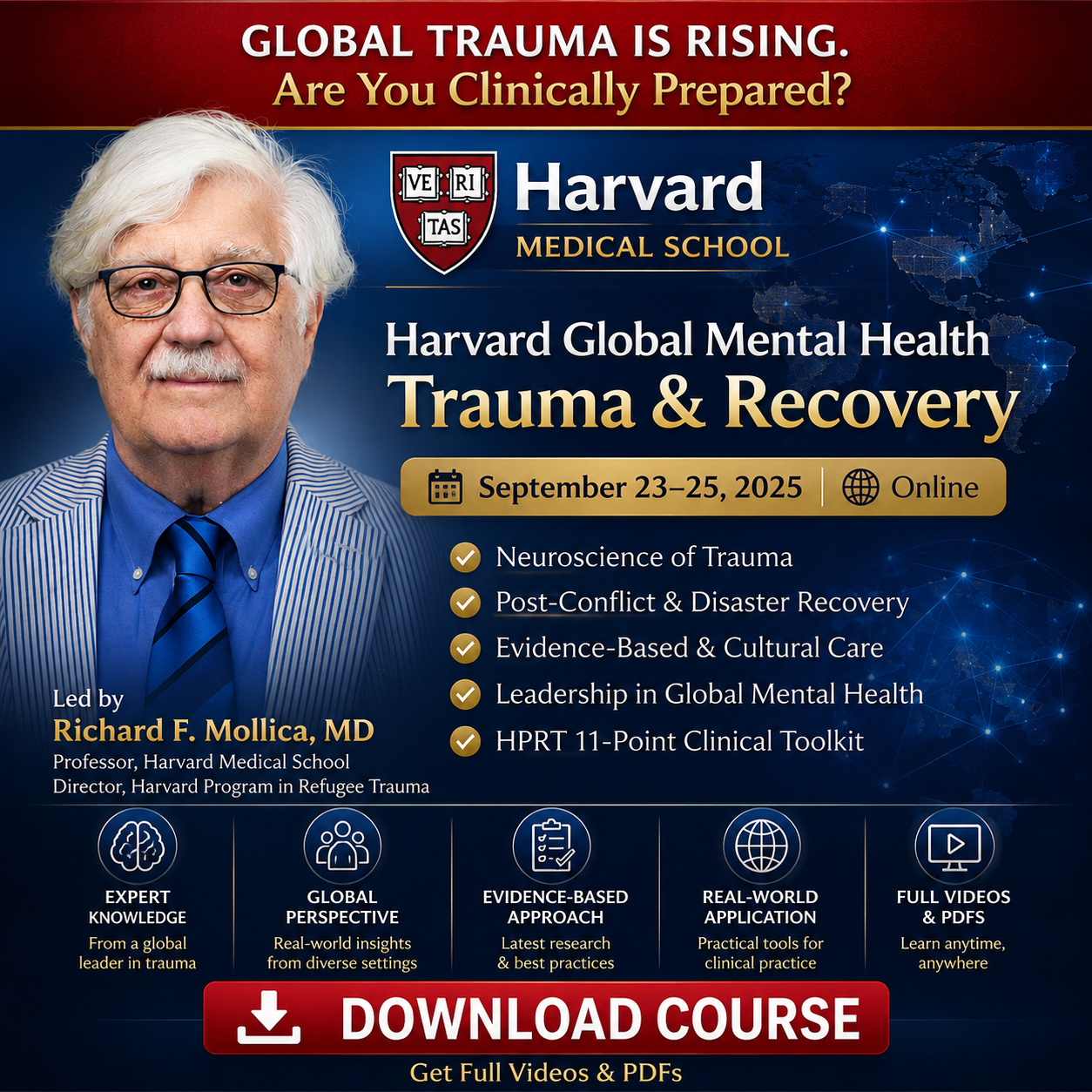
Harvard Global Mental Health: Trauma and Recovery 2025
A focused global mental health course exploring trauma recovery, humanitarian care, cultural psychiatry, neuroscience of trauma, human rights, climate-related distress, and practical approaches for supporting individuals and communities affected by violence, disasters, displacement, and post-conflict recovery.
Harvard Global Mental Health: Trauma and Recovery 2025 is a recorded educational course focused on trauma-informed care, global mental health recovery, culturally informed clinical practice, humanitarian response, and support for traumatized patients and communities.
Included: 16 videos + PDF resources.
About This Course
This course provides training for healthcare practitioners, humanitarian relief workers, policy planners, and mental health professionals working with traumatized individuals, families, and communities in diverse global settings.
The curriculum emphasizes an integrated, holistic approach to trauma recovery using science, culture, evidence-based knowledge, and practical field-informed strategies. It addresses the mental health impact of violence, natural disasters, displacement, climate change, health disparities, and post-conflict recovery.
Why Choose This Course
Key Highlights
- Focused training in global mental health, trauma, and recovery
- Practical approaches for work with traumatized patients and communities
- Integrates science, culture, human rights, and evidence-based clinical care
- Addresses violence, disasters, displacement, climate change, and recovery systems
- Useful for healthcare, humanitarian, policy, and mental health professionals
Core Learning Areas
Complete Curriculum
Trauma Science & Global Mental Health
- Phenomenological theory of trauma and recovery
- Epidemiology and neuroscience of trauma
- Bio-psycho-social and spiritual impact of trauma
- Historical and scientific approaches to trauma recovery
- Scientific and culturally informed mental health care
Clinical Practice & Trauma-Informed Care
- Trauma-informed care principles
- Mental health diagnosis and treatment
- Medical disorders associated with trauma exposure
- Evidence-based and culturally valid clinical practices
- HPRT 11 Point Clinical Toolkit approach
Humanitarian, Human Rights & Recovery Systems
- HPRT Global Mental Health Action Plan
- Human rights and rebuilding social capital
- Health disparities and their mental health impact
- Post-conflict and post-disaster recovery
- Climate change, ecocide, and mental health recovery
Field-Based Care, Teams & Leadership
- H5 Model for field-based psychosocial and clinical recovery
- Working in interdisciplinary medical teams
- Science- and culture-based leadership
- Professional development and ethical practice
- Self-care for professionals working with vulnerable populations
Learning Objectives
By Completing This Course, You Will Be Able To:
- Integrate science, culture, and evidence-based knowledge in trauma recovery work
- Apply advances in neuroscience and cultural knowledge to care for traumatized persons
- Understand effective approaches for survivors of extreme violence and climate change
- Analyze scientific and evaluation approaches to trauma recovery
- Apply professional development and ethical principles with vulnerable populations
- Recognize the bio-psycho-social and spiritual impact of trauma
- Use self-care methods while working in emotionally demanding settings
Who Should Take This Course
This course is designed for mental health professionals, psychiatrists, psychologists, primary care physicians, healthcare practitioners, humanitarian relief workers, policy planners, public health professionals, social workers, NGO staff, and clinicians involved in trauma recovery, refugee care, disaster response, and global mental health.
Delivery & Access
Reviews
A thoughtful and practical course for understanding trauma recovery across cultural and humanitarian settings. Very relevant for global mental health work.
The trauma-informed care and human rights sections were especially useful. The course offers a strong framework for working with vulnerable populations.
Excellent training for clinicians and humanitarian professionals involved in trauma, disaster recovery, displacement, and community mental health.
FAQ
Who is this course best suited for?
It is ideal for mental health professionals, healthcare practitioners, humanitarian relief workers, policy planners, public health professionals, social workers, NGO staff, and clinicians involved in trauma recovery or global mental health.
What is included in the course package?
The package includes 16 recorded videos and PDF resources.
What topics are covered?
The course covers trauma-informed care, neuroscience of trauma, global mental health recovery, human rights, disaster response, climate change, interdisciplinary teams, ethics, leadership, and self-care.
Who can I contact for support?
You can contact us at [email protected].


Dr. Sarah Jenkins – Psychiatrist, USA –
“This course gave me practical trauma-informed care tools I applied immediately with refugee patients. The Google Drive access made it easy to review complex PTSD protocols during clinic breaks.”
Dr. Michael Osei – Psychologist, –
“Harvard-level training finally accessible to clinicians in West Africa. The modules on collective trauma and community recovery were transformative for my practice.”
Dr. Elena Vasquez – Clinical Social Worker, Spain –
“I finally understand how to integrate cultural context into trauma therapy. The downloadable format meant I could share key resources with my entire team.”
Dr. Amanda Chen – Child Psychiatrist, Canada –
“Pediatric trauma protocols are finally demystified. I’ve already implemented new screening tools for adverse childhood experiences in my clinic.”
Dr. David Kim – Family Physician, South Korea –
“As a primary care doctor, I needed simple, effective tools for identifying trauma. This course delivered. Clear, evidence-based, and immediately useful.”
Dr. Fatima Al-Mansouri – Psychiatrist, UAE –
“The session on intergenerational trauma and displacement was deeply moving and academically rigorous. Harvard faculty at their absolute best.”
Dr. James Carter – Clinical Psychologist, Australia –
“I’ve taken many trauma courses. This one stands alone. The neuroscience behind memory reconsolidation and recovery was explained with exceptional clarity.”
Dr. Lucia Ramirez – Mental Health Counselor, Colombia –
“Working with survivors of political violence, this course gave me renewed hope and better strategies. The Google Drive format means I revisit it constantly.”
Dr. Robert Hayes – Military Psychiatrist, USA –
“Combat-related PTSD treatment has evolved, and this course brought me completely current. The downloadable videos let me train my entire clinic team.”
Dr. Nadia Petrova – Psychologist, Ukraine –
“In a country experiencing active war, this course was a lifeline. The acute trauma and resilience-building strategies have directly impacted how we support civilians.”
Dr. Carlos Mendez – Psychiatrist, Mexico –
“Complex trauma and dissociative disorders have always been challenging for me. This course provided clear diagnostic and treatment roadmaps I use weekly.”
Dr. Grace Wang – Neuropsychologist, Singapore –
“The intersection of trauma, memory, and neurobiology was brilliantly taught. I’ve recommended this to every colleague in my department.”
Dr. Lisa Thompson – Family Therapist, New Zealand –
“The family systems approach to intergenerational trauma transformed how I work with Māori and Pasifika communities. Deeply grateful.”
Dr. Ahmed Hassan – Psychiatrist, Egypt –
“Finally, a global mental health course that respects non-Western healing traditions while maintaining scientific rigor. Exceptional.”
Dr. Anders Lindgren – Psychiatrist, Sweden –
“Ethical challenges in humanitarian mental health settings were addressed with honesty and practical wisdom. A rare and valuable focus.”
Dr. Maria Santos – Pediatrician, Brazil –
“Identifying and supporting traumatized children in under-resourced settings is now something I do with confidence. Thank you for this gift.”
Dr. Yuki Tanaka – Psychiatrist, Japan –
“Post-disaster mental health care after earthquakes and natural disasters is my focus. The faculty expertise was world-class and immediately applicable.”
Dr. Amara Diallo – Psychologist, Senegal –
“Humanitarian settings require creative, low-resource interventions. This course delivered practical tools I can use tomorrow with zero budget.”
Dr. Benjamin Foster – Forensic Psychiatrist, UK –
“Trauma in incarcerated populations is often ignored. This course gave me evidence-based arguments and treatment strategies to advocate for better care.”
Dr. Camila Rodriguez – OB-GYN, Argentina –
“Birth trauma and reproductive mental health are finally getting attention. This course validated my patients’ experiences and gave me tools to help.”
Dr. Hassan Ali – Emergency Physician, Lebanon –
“In the ER, we see trauma’s immediate aftermath daily. Psychological first aid training from Harvard’s finest has changed how I stabilize both body and mind.”
Dr. Olivia Bennett – School Psychologist, Australia –
“Childhood trauma in educational settings requires informed, compassionate responses. This course equipped me to train teachers and support students better.”
Dr. Dimitri Papadopoulos – Psychiatrist, Greece –
“Working with unaccompanied refugee minors is heartbreaking and complex. This course provided both clinical strategies and emotional sustenance.”
Dr. Sofia Johansson – Clinical Psychologist, Norway –
“The research updates on EMDR, CBT-PTSD, and emerging therapies were comprehensive and unbiased. I now make better referrals and treatment choices.”
Dr. Chidi Nwosu – Psychiatrist, Nigeria –
“Terrorism and insurgency trauma in the Lake Chad region requires culturally adapted care. This course gave me frameworks to build locally relevant solutions.”