
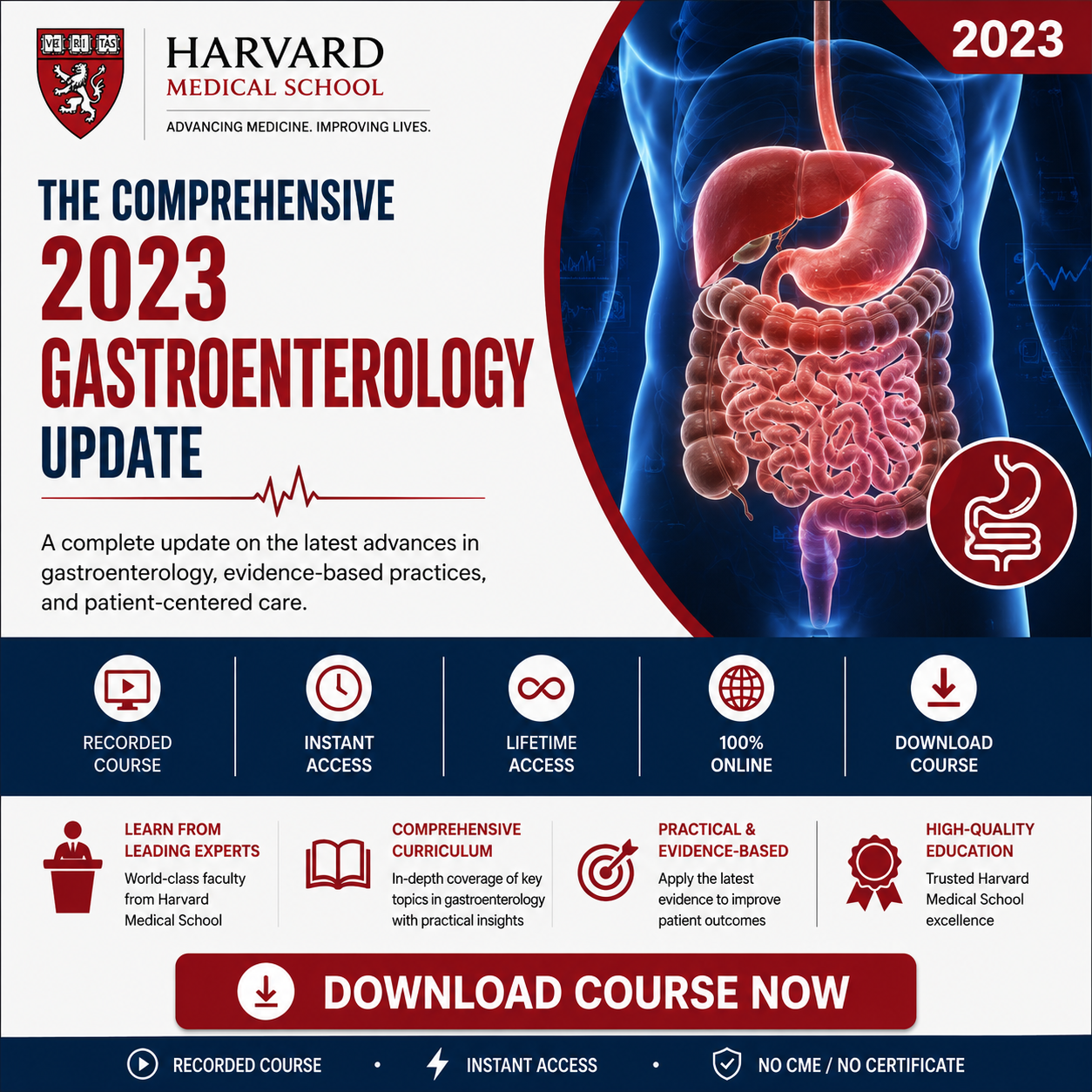

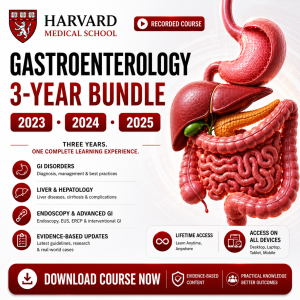
Harvard The Comprehensive 2023 Gastroenterology Update
A comprehensive gastroenterology update designed to help clinicians stay current with state-of-the-art GI strategies, clinical practices, recent advances, new guidelines, and practical recommendations that can be incorporated into daily patient care.
Harvard The Comprehensive 2023 Gastroenterology Update is a recorded medical course focused on recent advances in gastroenterology, updated guidelines, evidence-based management strategies, and practical recommendations for improving patient outcomes.
Focus: IBD, biologic therapies, therapeutic drug monitoring, C. difficile infection, GI complications of immunotherapy, IBS, pelvic floor disorders, refractory GERD, hereditary GI cancer syndromes, fatty liver disease, cirrhosis, colonoscopy quality, acute GI bleeding, FMT, COVID impact on GI practice, Barrett’s esophagus, eosinophilic esophagitis, pancreatitis, celiac disease, and colorectal cancer risk.
About This Course
Gastroenterology continues to evolve with new therapeutic options, updated practice guidelines, improved diagnostic pathways, advances in endoscopy quality, expanding genetic testing, and better strategies for chronic GI and liver disease management.
This program presents updates, best practices, and practical recommendations from nationally recognized GI experts and master clinicians, helping clinicians apply current evidence to day-to-day patient care.
Why Choose This Course
Key Highlights
- Comprehensive 2023 update in gastroenterology and hepatology
- Practical focus on updated guidelines and clinical decision-making
- Covers biologic therapy selection and monitoring in inflammatory bowel disease
- Includes updates on C. difficile infection, immunotherapy-related GI complications, IBS, and pelvic floor disorders
- Reviews fatty liver disease, cirrhosis, Barrett’s esophagus, GERD, pancreatitis, and celiac disease
- Addresses colonoscopy quality, adenoma detection rate improvement, acute GI bleeding, and colorectal cancer risk
- Useful for gastroenterologists, internists, hospitalists, primary care physicians, fellows, residents, NPs, PAs, and GI care teams
Core Learning Areas
Complete Curriculum
Inflammatory Bowel Disease & Biologic Therapy
- Updated guidelines for the use of biologics in IBD
- How to choose which biologic agent to start with
- Therapeutic drug monitoring in IBD treatment
- How to monitor patients during treatment
- When to switch therapies
- New agents available for IBD care
- Managing refractory pouchitis
- Microscopic colitis updates
Infections, Immunotherapy & Microbiome
- Updated guidelines for treatment of C. difficile infection
- When fecal microbiota transplantation is indicated
- GI complications of immunotherapy
- How to approach and treat immunotherapy-related GI disease
- The stool microbiome and clinical applications
- Impact of COVID on GI practice
- New strategies for common GI problems
Liver Disease & Hepatology
- Management of fatty liver disease in 2023
- How to diagnose and manage cirrhosis
- Alcohol-related liver disease
- Autoimmune hepatitis
- Risk stratification in liver disease
- Practical liver disease management strategies
- Evidence-based hepatology updates for daily practice
Esophageal and Upper GI Disorders
- Management of refractory GERD
- Barrett’s esophagus updates
- Eosinophilic esophagitis
- How to decide between drug therapy and dietary therapy in eosinophilic esophagitis
- Upper GI diagnostic and treatment strategies
- Applying updated guidance to chronic esophageal disease
IBS, Pelvic Floor Disorders & Functional GI Care
- Improved management of IBS
- Pelvic floor disorders
- Functional bowel disorder strategies
- Patient-centered management of chronic GI symptoms
- Practical care pathways for common functional GI presentations
- Integration of new evidence into daily GI care
Pancreatic and Small Bowel Disorders
- Acute pancreatitis
- Chronic pancreatitis
- Celiac disease
- Making sense of multiple serologic tests in celiac disease
- New therapeutic strategies on the horizon for celiac disease
- Clinical evaluation of complex pancreatic and small bowel presentations
Colonoscopy Quality, GI Bleeding & Cancer Risk
- How to improve adenoma detection rate
- Why adenoma detection rate is critical to measure
- Steps to ensure delivery of high-quality colonoscopic care
- Techniques to effectively control acute GI bleeding
- Expanded genetic testing options for hereditary GI cancer syndromes
- High risk for colorectal cancer
- Practical strategies for cancer prevention and early detection
Guidelines, Clinical Updates & Future Directions
- Comprehensive update of national guidelines
- Recent advances and their impact on clinical approaches
- Updates that improve patient outcomes
- Practical recommendations for day-to-day GI practice
- Future directions in gastroenterology
- Cutting-edge topics from world-renowned experts
Learning Objectives
By Completing This Course, You Will Be Able To:
- Apply updated gastroenterology guidelines to daily clinical practice
- Use current strategies for biologic therapy selection and monitoring in IBD
- Improve management of C. difficile infection, IBS, pelvic floor disorders, and refractory GERD
- Recognize and manage GI complications of immunotherapy
- Improve diagnosis and management of fatty liver disease, cirrhosis, pancreatitis, and celiac disease
- Use strategies to improve colonoscopy quality and adenoma detection rate
- Apply practical recommendations for acute GI bleeding, hereditary GI cancer risk, and colorectal cancer prevention
- Incorporate recent advances into patient-centered GI care
Who Should Take This Course
This course is designed for gastroenterologists, internists, hospitalists, primary care physicians, family physicians, GI fellows, residents, nurse practitioners, physician assistants, endoscopy teams, and clinicians involved in the diagnosis and management of digestive and liver diseases.
Delivery & Access
This course package is provided for recorded learning access. No CME points are associated with this product.
Reviews
A very practical gastroenterology update. The IBD, C. difficile, GERD, and liver disease sections are especially useful for daily patient care.
Excellent overview of modern GI practice. The colonoscopy quality and hereditary cancer risk sections were particularly valuable.
Well organized and clinically focused. The course gives clear recommendations that can be incorporated into day-to-day gastroenterology care.
FAQ
Who is this course best suited for?
It is ideal for gastroenterologists, internists, hospitalists, primary care physicians, family physicians, GI fellows, residents, NPs, PAs, endoscopy teams, and clinicians involved in digestive and liver disease care.
What topics are covered?
The course covers IBD, biologics, therapeutic drug monitoring, refractory pouchitis, C. difficile infection, FMT, GI complications of immunotherapy, microscopic colitis, fatty liver disease, cirrhosis, Barrett’s esophagus, eosinophilic esophagitis, IBS, pelvic floor disorders, refractory GERD, acute pancreatitis, chronic pancreatitis, celiac disease, GI bleeding, hereditary GI cancer syndromes, colorectal cancer risk, colonoscopy quality, adenoma detection rate, and COVID impact on GI practice.
Is this course practical for daily GI care?
Yes. The course focuses on updated guidelines, best practices, practical strategies, and clinical recommendations that can be incorporated into everyday gastroenterology practice.
Does this product include CME?
No. This course package does not include CME points.
Who can I contact for support?
You can contact us at [email protected].

Reviews
There are no reviews yet.