
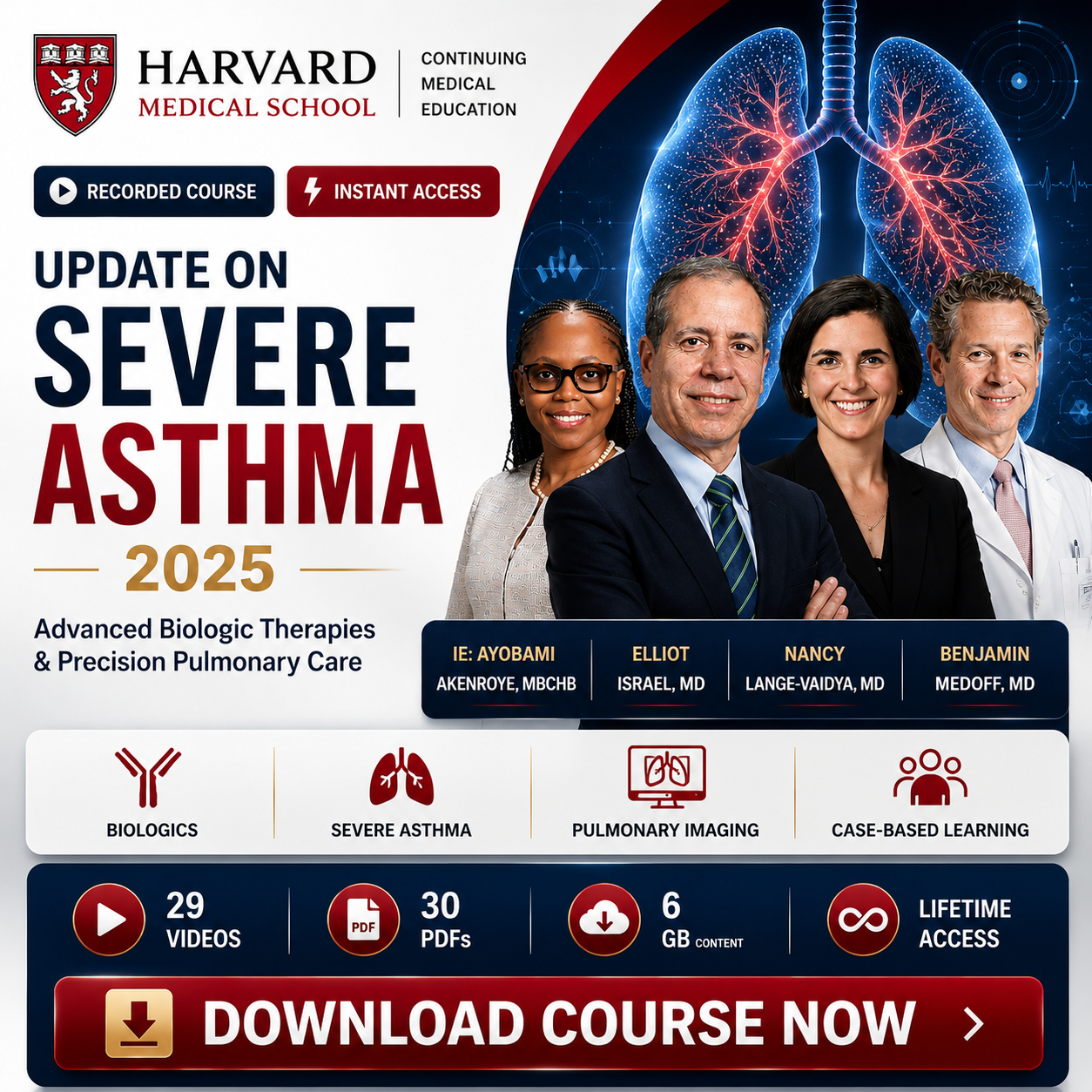
Harvard Update on Severe Asthma 2025
A focused severe asthma update designed to help clinicians systematically evaluate difficult-to-control asthma, identify severe asthma phenotypes and endotypes, and apply modern treatment strategies, biologic therapies, guideline-directed care, and practical case-based approaches in adult and pediatric asthma management.
Harvard Update on Severe Asthma 2025 is a recorded medical course package focused on severe asthma assessment, diagnostic frameworks, phenotyping, endotyping, comorbidities, mimics, biologic therapy selection, guideline-based treatment, and emerging therapeutic strategies.
Included: 29 videos, 30 PDF files, total size 6 GB.
About This Course
Severe asthma remains one of the most challenging areas in pulmonary and allergy medicine. Patients may have difficult-to-control symptoms due to airway inflammation, eosinophilic disease, allergic mechanisms, environmental exposures, obesity, GERD, upper airway disorders, chronic rhinosinusitis, nasal polyposis, occupational exposures, or asthma mimics.
This course provides a multidisciplinary update on modern severe asthma care, including adult and pediatric assessment, molecular sub-phenotypes, biologic therapy selection, pulmonary function interpretation, imaging insights, and real-world case discussions.
Why Choose This Course
Key Highlights
- Focused 2025 update on severe asthma diagnosis and management
- Includes 29 recorded videos and 30 downloadable PDF resources
- Covers systematic evaluation of difficult-to-control asthma
- Reviews severe asthma phenotypes, endotypes, genetics, environment, and molecular mechanisms
- Includes modern biologics, GINA and NAEPP guideline-directed care, and novel therapies in development
- Addresses pediatric asthma, adult asthma, asthma mimics, comorbidities, occupational asthma, AERD, and eosinophilic lung disease
- Useful for pulmonologists, allergists, primary care physicians, NPs, PAs, trainees, and clinicians managing respiratory disease
Core Learning Areas
Complete Curriculum
Program Overview & Key Updates
- Welcome and introduction to the online audience
- Update on Severe Asthma 2025: key changes and takeaways
- Current state of severe asthma investigation and care
- Multidisciplinary approach to severe asthma management
- Adult and pediatric severe asthma considerations
- Practical strategies for complex clinical decision-making
Disease Biology, Genetics & Phenotypes
- Asthma genetics and the environment in severe asthma
- Molecular sub-phenotypes in asthma
- Eosinophilic lung disease and overlap with asthma
- Allergic bronchopulmonary aspergillosis and eosinophilic airway disease
- Insights from the Severe Asthma Research Program
- Pathophysiologic insights from novel imaging techniques
- What distinguishes asthmatic versus non-asthmatic allergic airway responses
Diagnosis & Assessment
- Diagnostic assessment of severe asthma
- Practical framework for difficult-to-control asthma
- Diagnostic considerations in children with severe asthma
- Drivers of asthma in school-aged children
- Airway oscillometry in adults and very young children
- New recommendations for interpreting pulmonary function tests
- Identifying specific severe asthma phenotypes and endotypes
Environment, Triggers & Exposures
- Indoor environments and asthma exacerbations
- Occupational exposures and severe asthma
- Environmental contributions to severe asthma
- Microbiome and asthma: emerging evidence
- Smoking, COPD, and chronic obstructive asthma
- Asthma-COPD overlap considerations
- Trigger recognition and exposure-focused care planning
Comorbidities, Mimics & Overlap Syndromes
- Gastroesophageal reflux and severe asthma
- Laryngeal disordered breathing mimicking severe asthma
- Upper airway obstruction considerations
- Rhinosinusitis and nasal polyposis treatment
- Obesity, diabetes, and asthma metabolic links
- Asthma mimics such as tracheobronchomalacia
- Recognizing non-asthma causes of persistent respiratory symptoms
Pediatric Severe Asthma
- Managing severe asthma in children
- Diagnostic considerations in children with severe asthma
- Drivers of asthma in school-aged children
- Assessment of difficult-to-control pediatric asthma
- Pediatric phenotypes and treatment considerations
- Family-centered and school-age asthma management strategies
Treatment Strategies & Biologic Therapy
- Choosing among the biologics for severe asthma
- Utilizing novel asthma therapeutics with confidence
- Management of asthma with aspirin-exacerbated respiratory disease
- Anti-inflammatory rescue options and challenges
- Clinical remission in asthma as a goal of guideline-directed therapy
- Recent GINA and NAEPP guideline-based treatment strategies
- Novel therapies and future directions in severe asthma care
Interactive Case-Based Learning
- Interactive case discussions in real-world severe asthma
- Complex diagnostic dilemmas
- Complex therapeutic dilemmas
- Approach to patients who remain uncontrolled despite standard therapy
- Multidisciplinary case discussion and treatment planning
- Practical severe asthma protocol review
Learning Objectives
By Completing This Course, You Will Be Able To:
- Systematically evaluate difficult-to-control asthma
- Identify specific severe asthma phenotypes and endotypes
- Utilize novel asthma therapeutics with confidence
- Apply guideline-based severe asthma treatment strategies in adult and pediatric patients
- Recognize comorbidities and mimics that complicate asthma diagnosis and management
- Choose among biologic therapies based on patient characteristics and disease phenotype
- Integrate pulmonary function testing, oscillometry, imaging, and clinical history into severe asthma assessment
- Use case-based strategies to manage complex diagnostic and therapeutic dilemmas
Who Should Take This Course
This course is designed for pulmonologists, allergists, primary care physicians, specialty physicians, nurse practitioners, physician assistants, medical trainees, researchers, and healthcare professionals involved in asthma management, respiratory medicine, allergy care, and severe asthma treatment.
Delivery & Access
This course package is provided for recorded learning access. No CME points are associated with this product.
Reviews
A very practical severe asthma update. The biologics, phenotyping, and comorbidity sections are especially helpful for daily respiratory care.
Excellent course for pulmonology and allergy practice. The diagnostic framework and complex case discussions are clear and clinically useful.
Strong update on severe asthma management. The content is organized, practical, and useful for both adult and pediatric asthma care.
FAQ
Who is this course best suited for?
It is ideal for pulmonologists, allergists, primary care physicians, specialty physicians, NPs, PAs, medical trainees, researchers, and clinicians involved in severe asthma and respiratory medicine.
What is included in the course package?
The package includes 29 recorded videos and 30 PDF files, with a total size of 6 GB.
What topics are covered?
The course covers severe asthma assessment, difficult-to-control asthma, phenotypes and endotypes, asthma genetics, environmental triggers, eosinophilic lung disease, ABPA, SARP insights, pediatric severe asthma, oscillometry, pulmonary function testing, occupational asthma, GERD, laryngeal disordered breathing, rhinosinusitis, nasal polyposis, obesity, diabetes, tracheobronchomalacia, smoking, COPD, ACO, biologic therapy selection, AERD, anti-inflammatory rescue, clinical remission, GINA and NAEPP guidelines, and novel therapies.
Is this course practical for severe asthma management?
Yes. The course focuses on diagnostic assessment, phenotype-based care, treatment selection, biologics, comorbidities, mimics, guideline-directed therapy, and real-world case discussions.
Does this product include CME?
No. This course package does not include CME points.
Who can I contact for support?
You can contact us at [email protected].
Reviews
There are no reviews yet.