
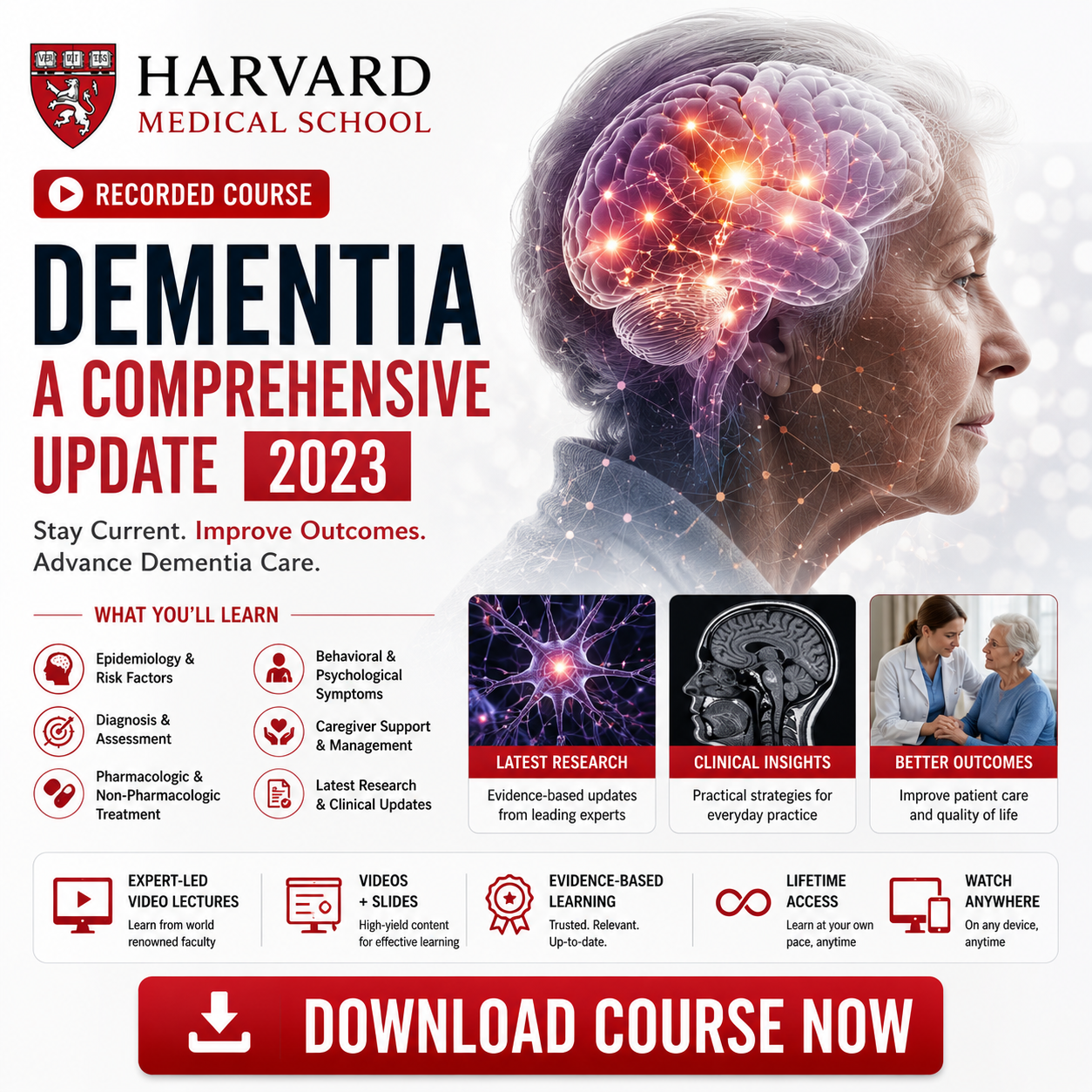

Harvard Dementia: A Comprehensive Update 2023
A comprehensive Harvard dementia course designed for clinicians involved in the diagnosis, management, and investigation of cognitive impairment, Alzheimer’s disease, mild cognitive impairment, neurodegenerative dementias, behavioral symptoms, biomarkers, caregiver support, medicolegal issues, and end-of-life care.
Course Details:
Harvard Dementia: A Comprehensive Update 2023 is a recorded 3.5-day annual review course designed by clinicians for clinicians. It provides a practical and multidisciplinary approach to understanding, diagnosing, and treating dementia and related cognitive and behavioral disorders.
Focus: Alzheimer’s disease, mild cognitive impairment, preclinical Alzheimer’s disease, vascular cognitive impairment, Lewy body dementia, frontotemporal degeneration, Parkinsonian dementias, Parkinson’s-plus syndromes, atypical dementias, cognitive testing, neuropsychology, biomarkers, CSF testing, MRI, FDG-PET, amyloid/tau PET, pharmacologic treatment, behavioral symptoms, caregiver support, chronic traumatic encephalopathy, delirium, capacity, driving safety, nursing home care, neuroethics, palliation, hospice, and advanced care planning.
About This Course
Dementia care requires a strong understanding of cognitive aging, early cognitive impairment, Alzheimer’s disease, neurodegenerative syndromes, behavioral symptoms, biomarkers, caregiver needs, safety issues, and long-term care planning.
Harvard Dementia: A Comprehensive Update 2023 provides a clinically oriented review of dementia diagnosis and management, organized around a practical framework that connects neuroanatomy, cognition, disease-specific presentations, testing strategies, treatment decisions, caregiver support, and ethical considerations.
The program is designed for healthcare professionals who evaluate, manage, or investigate disease states causing dementia, with an emphasis on multidisciplinary care and real-world clinical decision-making.
Why Choose This Course
- Harvard 2023 comprehensive dementia update with 39 recorded videos and syllabus
- Practical multidisciplinary approach to dementia diagnosis and management
- Covers Alzheimer’s disease, MCI, preclinical AD, vascular dementia, Lewy body dementia, FTD, Parkinsonian dementias, and less common dementias
- Reviews cognitive testing, office-based assessment, neuropsychological evaluation, biomarkers, CSF testing, MRI, FDG-PET, and amyloid/tau PET imaging
- Includes pharmacologic and non-pharmacologic management strategies for dementia and neuropsychiatric symptoms
- Addresses caregiver support, problem behaviors, diagnosis disclosure, safety, driving, capacity, competence, and medicolegal issues
- Useful for primary care physicians, specialty physicians, nurses, nurse practitioners, physician assistants, psychologists, and social workers
Core Learning Areas
Dementia Diagnosis
Cognitive aging, MCI, Alzheimer’s disease, atypical variants, vascular cognitive impairment, Lewy body dementia, FTD, and Parkinsonian dementias.
Testing & Biomarkers
Mental status exam, MoCA, neuropsychological testing, labs, MRI, FDG-PET, amyloid/tau PET, CSF biomarkers, and diagnostic interpretation.
Treatment & Behavior
Cholinesterase inhibitors, memantine, antipsychotics, antidepressants, behavioral symptoms, agitation, apathy, anxiety, depression, and psychosis.
Caregiver, Ethics & Safety
Caregiver support, driving, capacity, competence, neuroethics, long-term care, nursing home care, pain, palliation, hospice, and advanced care planning.
Complete Curriculum
- Normal cognitive aging and the spectrum of cognitive impairment
- Very mild cognitive impairment and progression to dementia
- Epidemiology, risk factors, and societal costs of dementia
- Pathobiology of Alzheimer’s disease and related disorders
- Clinical differences among common neurodegenerative dementias
- Challenges in distinguishing normal aging, MCI, and dementia
- Frameworks for early recognition and accurate clinical assessment
- Preclinical Alzheimer’s disease
- MCI due to Alzheimer’s disease and prodromal AD
- Alzheimer’s disease dementia phases
- Alzheimer’s Association clinical practice guideline concepts
- Diagnostic and management approaches to the AD spectrum
- Risk reduction, prevention, and future therapeutic strategies
- Clinical treatment considerations for patients and caregivers
- Dementia with Lewy bodies
- Vascular cognitive impairment and vascular-ischemic dementia
- Frontotemporal degeneration
- Parkinson’s disease with dementia
- Parkinson’s-plus syndromes
- Atypical Alzheimer’s disease variants
- Less common dementias and differential diagnosis strategies
- Neural processes supporting cognition
- Memory systems and dementia syndromes
- Language networks and primary progressive aphasias
- Attention and frontal-executive function
- Visuospatial and motor systems
- Posterior cortical atrophy and network-based presentations
- Linking neuroanatomy to bedside cognitive assessment
- Practical office-based dementia assessments
- Mental status examination for cognitive disorders
- Use of screening instruments such as MoCA
- Efficient approaches to cognitive screening in clinical practice
- Interpreting cognitive testing patterns across dementia syndromes
- Role of neuropsychological evaluation
- Using testing results to guide diagnosis, monitoring, and care planning
- Appropriate laboratory testing in dementia evaluation
- MRI in neurodegenerative dementia assessment
- FDG-PET in dementia diagnosis
- Amyloid and tau PET imaging
- CSF amyloid-beta and tau biomarkers
- Clinical versus research use of biomarkers
- Appropriate use criteria and diagnostic value of biomarker testing
- Data-supported pharmacologic management strategies
- Use of cholinesterase inhibitors in dementia
- Role of memantine in dementia care
- Potential benefits, risks, side effects, and warnings of dementia medications
- Antipsychotic use and cautions in dementia
- Antidepressants and behavioral symptom management
- Treatment nuance in interdisciplinary dementia care
- Managing problem behaviors in dementia
- Aggression, agitation, and behavioral distress
- Apathy, anxiety, depression, and psychosis
- Education and behavioral interventions as first-line approaches
- Environmental strategies to reduce symptoms and caregiver burden
- Balancing pharmacologic and non-pharmacologic approaches
- Holistic care for patients and families affected by dementia
- Disclosure of dementia diagnosis and risk
- Caregiver education and counseling strategies
- Recognizing caregiver burden and burnout
- Community resources and respite care
- Psychosocial and environmental support for patients and families
- Coordinated individualized care planning
- Quality-of-life considerations across the disease course
- Delirium and dementia overlap
- Recognition of encephalopathy in patients with cognitive impairment
- Chronic traumatic encephalopathy as a dementia-related entity
- Differentiating reversible and progressive cognitive symptoms
- Special clinical situations in dementia care
- Risks and complications in medically complex dementia patients
- Practical strategies for complex diagnostic presentations
- Capacity for medical care decisions
- Capacity for finances, contracts, and independent living
- Driving safety in dementia
- Undue influence and vulnerability concerns
- Medicolegal issues affecting patients and families
- Safety practices to support patients and caregivers
- Balancing autonomy, protection, and public safety
- Long-term care and nursing home care in dementia
- Neuroethics in dementia management
- Pain recognition and treatment in dementia
- Palliation and hospice care
- Advanced care planning for dementia patients
- Medical, legal, and ethical issues in end-stage dementia
- Supporting families through end-of-life decision-making
Learning Objectives
- Describe current understanding of cognitive aging, MCI, Alzheimer’s disease, and other neurodegenerative dementias
- Distinguish preclinical AD, MCI due to AD, prodromal AD, and AD dementia phases
- Apply tiered diagnostic and management approaches for Alzheimer’s disease and related dementias
- Differentiate Alzheimer’s disease from Lewy body dementia, vascular cognitive impairment, frontotemporal degeneration, Parkinsonian dementias, and less common dementias
- Use office-based cognitive screening, mental status examination, and neuropsychological evaluation in dementia care
- Incorporate laboratory testing, MRI, FDG-PET, amyloid/tau PET, and CSF biomarkers appropriately into dementia evaluation
- Apply pharmacologic strategies including cholinesterase inhibitors, memantine, antipsychotics, and antidepressants when appropriate
- Use non-pharmacologic and behavioral strategies as first-line approaches for neuropsychiatric symptoms
- Support caregivers through education, counseling, community resources, and respite care strategies
- Address medicolegal, safety, capacity, driving, long-term care, palliation, hospice, and end-of-life issues in dementia care
Who Should Take This Course
This course is designed for primary care physicians, specialty physicians, nurses, nurse practitioners, physician assistants, psychologists, social workers, and healthcare professionals involved in the diagnosis, management, and investigation of dementia and cognitive disorders.
It is especially useful for clinicians who care for patients with Alzheimer’s disease, MCI, Lewy body dementia, vascular cognitive impairment, frontotemporal degeneration, Parkinsonian dementias, neuropsychiatric symptoms, caregiver-related challenges, safety concerns, and long-term dementia care needs.
Delivery & Access
Recorded Course
Review all dementia update sessions at your own pace.
39 Videos
Complete recorded video package for structured learning.
Syllabus Included
Course syllabus included for easier review and reference.
Support
Course Highlights
Comprehensive Dementia Review
Covers Alzheimer’s disease, MCI, vascular dementia, Lewy body dementia, FTD, Parkinsonian dementias, and atypical presentations.
Practical Clinical Approach
Focuses on office-based assessment, cognitive testing, biomarkers, imaging, treatment decisions, and care planning.
Whole-Patient Dementia Care
Includes caregiver support, behavior management, safety, capacity, driving, neuroethics, long-term care, hospice, and palliation.
FAQ
Who is this course best suited for?
This course is best suited for primary care physicians, specialty physicians, nurses, nurse practitioners, physician assistants, psychologists, social workers, and healthcare professionals involved in dementia diagnosis and care.
What is included in the course package?
The package includes 39 recorded videos and a course syllabus.
What topics are covered?
Topics include Alzheimer’s disease, MCI, preclinical AD, Lewy body dementia, vascular cognitive impairment, frontotemporal degeneration, Parkinsonian dementias, cognitive testing, neuropsychology, biomarkers, MRI, FDG-PET, amyloid/tau PET, CSF testing, pharmacologic treatment, behavioral symptoms, caregiver support, delirium, CTE, capacity, driving, long-term care, neuroethics, palliation, hospice, and advanced care planning.
Does this course cover dementia biomarkers?
Yes. The course reviews appropriate use of biomarkers including CSF amyloid-beta/tau, MRI, FDG-PET, and amyloid/tau PET imaging in dementia evaluation.
Is this course practical for clinical dementia care?
Yes. The course focuses on practical diagnosis, office-based assessment, treatment planning, behavioral management, caregiver support, safety issues, and long-term care considerations.
Is this a recorded course?
Yes. This product is provided as recorded course access so you can review the material at your own pace.
Does this course include CME or a certificate?
No. CME credits and certificates are not included with this course package.
Who can I contact for support?
You can contact support at [email protected].


Reviews
There are no reviews yet.