
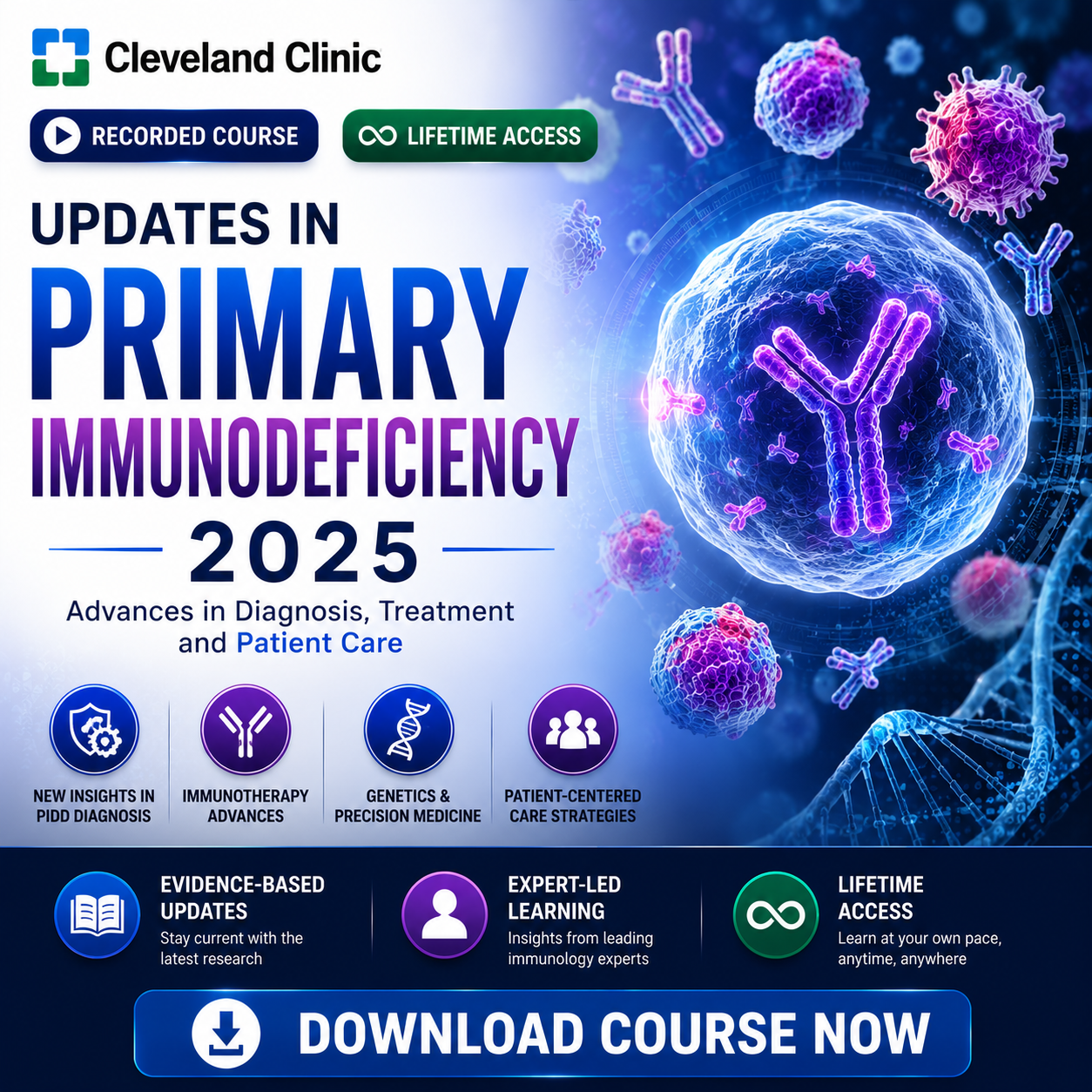
Cleveland Clinic Updates in Primary Immunodeficiency 2025
A focused Cleveland Clinic immunology course designed to enhance care for patients with immune system disorders, with practical updates in newly identified immunodeficiency syndromes, antibody deficiency, CVID, immune dysregulation, genetic testing, complement defects, NK cell deficiency, immunoglobulin replacement, prophylactic antibiotics, transplantation, vaccines, and recurrent or secondary infections.
Course Details:
Cleveland Clinic Updates in Primary Immunodeficiency 2025 includes 6 recorded videos and 21 PDF resources, offering a concise, high-yield update for busy clinicians who manage patients with recurrent infections, immune dysfunction, antibody deficiency, and complex immune system disorders.
Focus: Humoral deficiency, antibody deficiency, CVID, pulmonary complications of CVID, gastrointestinal disease in inborn errors of immunity, allergies in antibody deficiency, autoimmune disease and IEI, biologics for immune dysregulation, skin clues to immune dysfunction, artificial intelligence in immunodeficiency, genetics in clinical practice, variants of unknown significance, complement defects, mannose-binding lectin, NK cell deficiency, gene therapy, immunoglobulin replacement, prophylactic antibiotics, transplantation, secondary immunodeficiency, lab testing, and vaccines for immunocompromised patients.
About This Course
Primary immunodeficiency and inborn errors of immunity are increasingly recognized in both pediatric and adult patients, especially in individuals with recurrent infections, unusual inflammatory disease, autoimmune complications, pulmonary disease, gastrointestinal disease, and immune dysregulation.
Cleveland Clinic Updates in Primary Immunodeficiency 2025 provides a practical review of evolving diagnostic and management strategies, including the role of genetic testing, immune phenotype recognition, targeted therapies, immunoglobulin replacement, biologics, prophylactic antibiotics, and transplantation.
The program is designed as a compact, clinically useful update for immunologists, allergists, internists, infectious disease specialists, pediatricians, advanced practice providers, clinical educators, residents, and trainees seeking improved recognition and care of immune system disorders.
Why Choose This Course
- Cleveland Clinic 2025 focused update in primary immunodeficiency
- Includes 6 recorded videos and 21 PDF resources
- High-yield half-day style program tailored to real-world clinical practice
- Reviews newly identified immunodeficiency syndromes and clinical patterns
- Includes advanced genetic testing and its role in accurate diagnosis
- Covers immunoglobulin replacement, biologics, prophylactic antibiotics, gene therapy, and transplantation
- Includes real-world case examples to strengthen diagnostic reasoning and patient care confidence
- Useful for immunologists, allergists, internists, infectious disease specialists, pediatricians, APPs, clinical educators, residents, and trainees
Core Learning Areas
Humoral Deficiency
Antibody deficiency, CVID, allergies in antibody deficiency, GI disease in IEI, pulmonary complications, and clinical patterns of humoral immune disorders.
Immune Dysregulation
Autoimmune disease in IEI, skin disease as a clue to immune dysfunction, biologics for immune dysregulation, and complex immune-mediated presentations.
Diagnostics & Genetics
Advanced genetic testing, variants of unknown significance, AI in immunodeficiency, laboratory testing basics, and practical diagnostic decision-making.
Treatment & Prevention
Immunoglobulin replacement, prophylactic antibiotics, gene therapy, transplantation, vaccines for immunocompromised patients, and secondary immunodeficiency.
Complete Curriculum
- Focused update on primary immunodeficiency and immune system disorders
- Concise half-day learning experience for busy clinicians
- Clinical recognition of immune deficiency patterns
- Practical diagnostic and management strategies
- Real-world case examples and decision-making guidance
- Recorded video sessions with supporting PDF materials
- High-yield learning for clinical practice and teaching
- Humoral deficiency overview
- Allergies in antibody deficiency
- CVID: what we know
- Gastrointestinal disease in inborn errors of immunity
- Pulmonary complications of CVID
- Recognizing clinical patterns in antibody deficiency
- Practical evaluation of patients with recurrent sinopulmonary and systemic complications
- Complexities in inborn errors of immunity
- Autoimmune disease and IEI
- Biologics for the treatment of immune dysregulation
- Skin diseases as clues to immune dysfunction
- Recognition of inflammatory and autoimmune complications
- Clinical reasoning in immune dysregulation syndromes
- Optimizing management of complex immune-mediated presentations
- Artificial intelligence in immunodeficiency
- Using genetics in clinical practice
- Understanding variants of unknown significance
- Advanced genetic testing and diagnostic accuracy
- Interpreting genetic results in immune deficiency evaluation
- Practical diagnostic workflow for suspected primary immunodeficiency
- Future directions in immunodeficiency diagnosis and personalized care
- Complement defects: when to be concerned
- Mannose-binding lectin: to test or not
- Natural killer cell deficiency
- Recognition of non-humoral immune defects
- Clinical clues suggesting complement or innate immune dysfunction
- Testing considerations for specialized immune pathways
- Referral and management decisions for complex immune defects
- Gene therapy in immune deficiency
- Immunoglobulin replacement therapy
- Prophylactic antibiotics
- Transplantation in primary immunodeficiency
- Therapeutic updates for immune system disorders
- Balancing infection prevention, immune control, and long-term safety
- Individualizing treatment plans for patients with complex immune deficiency
- Hypogammaglobulinemia and secondary immunodeficiency
- Laboratory testing in a patient with infections: the basics
- Vaccines for the immunocompromised
- Evaluation of recurrent infections in adults and children
- Differentiating primary and secondary immune deficiency
- Practical vaccine and prevention strategies
- Improving long-term outcomes through timely diagnosis and prevention
Learning Objectives
- Recognize clinical patterns that suggest primary immunodeficiency and inborn errors of immunity
- Improve evaluation of patients with recurrent infections, antibody deficiency, CVID, and immune dysregulation
- Identify pulmonary, gastrointestinal, allergic, autoimmune, and skin manifestations that may indicate immune dysfunction
- Use advanced genetic testing more effectively in suspected immunodeficiency
- Interpret variants of unknown significance in the context of clinical findings
- Understand the role of artificial intelligence and emerging diagnostics in immunodeficiency care
- Recognize when to consider complement defects, mannose-binding lectin testing, and NK cell deficiency
- Review treatment updates including immunoglobulin replacement, prophylactic antibiotics, biologics, gene therapy, and transplantation
- Differentiate primary immunodeficiency from hypogammaglobulinemia and secondary immunodeficiency
- Apply practical vaccine and prevention strategies for immunocompromised patients
Who Should Take This Course
This course is designed for immunologists, allergists, internists, infectious disease specialists, pediatricians, advanced practice providers, clinical educators, trainees, and residents who want to improve recognition and management of primary immunodeficiency and immune system disorders.
It is especially useful for clinicians who manage patients with recurrent infections, complex immune dysfunction, antibody deficiency, CVID, autoimmune manifestations, inflammatory complications, unusual infections, immunocompromised vaccine questions, or suspected inborn errors of immunity.
Delivery & Access
6 Videos
Focused recorded sessions covering key areas of primary immunodeficiency and immune dysfunction.
21 PDFs
Supporting PDF materials included for review, study, and clinical reference.
8.02 GB
Complete recorded course package with video and PDF learning materials.
Support
Course Highlights
High-Yield Immunology Update
Concise Cleveland Clinic program focused on practical diagnosis and treatment of primary immunodeficiency.
Diagnostics & Genetics Focus
Includes genetic testing, variants of unknown significance, AI in immunodeficiency, and lab testing basics.
Real-World Treatment Updates
Covers immunoglobulin replacement, biologics, prophylactic antibiotics, gene therapy, transplantation, and vaccines.
FAQ
Who is this course best suited for?
This course is best suited for immunologists, allergists, internists, infectious disease specialists, pediatricians, advanced practice providers, clinical educators, residents, and trainees interested in primary immunodeficiency and immune system disorders.
What is included in this course?
The course includes 6 recorded videos and 21 PDF resources, with a total package size of 8.02 GB.
What topics are covered?
Topics include humoral deficiency, antibody deficiency, CVID, GI disease in IEI, pulmonary complications of CVID, autoimmune disease and IEI, biologics for immune dysregulation, skin disease clues, AI in immunodeficiency, genetics, variants of unknown significance, complement defects, mannose-binding lectin, NK cell deficiency, gene therapy, immunoglobulin replacement, prophylactic antibiotics, transplantation, secondary immunodeficiency, lab testing, and vaccines for immunocompromised patients.
Does this course cover CVID and antibody deficiency?
Yes. The course includes humoral deficiency, CVID, allergies in antibody deficiency, GI disease in IEI, and pulmonary complications of CVID.
Does this course cover genetic testing?
Yes. The course covers using genetics in clinical practice, variants of unknown significance, advanced diagnostics, and artificial intelligence in immunodeficiency.
Is this course practical for clinical care?
Yes. The course is designed as a concise, high-yield learning experience with practical insights, updated protocols, case-based reasoning, and real-world strategies for patient care.
Is this a recorded course?
Yes. This product is provided as recorded course access so you can review the material at your own pace.
Does this course include CME or a certificate?
No. CME credits and certificates are not included with this course package.
Who can I contact for support?
You can contact support at [email protected].
Reviews
There are no reviews yet.