
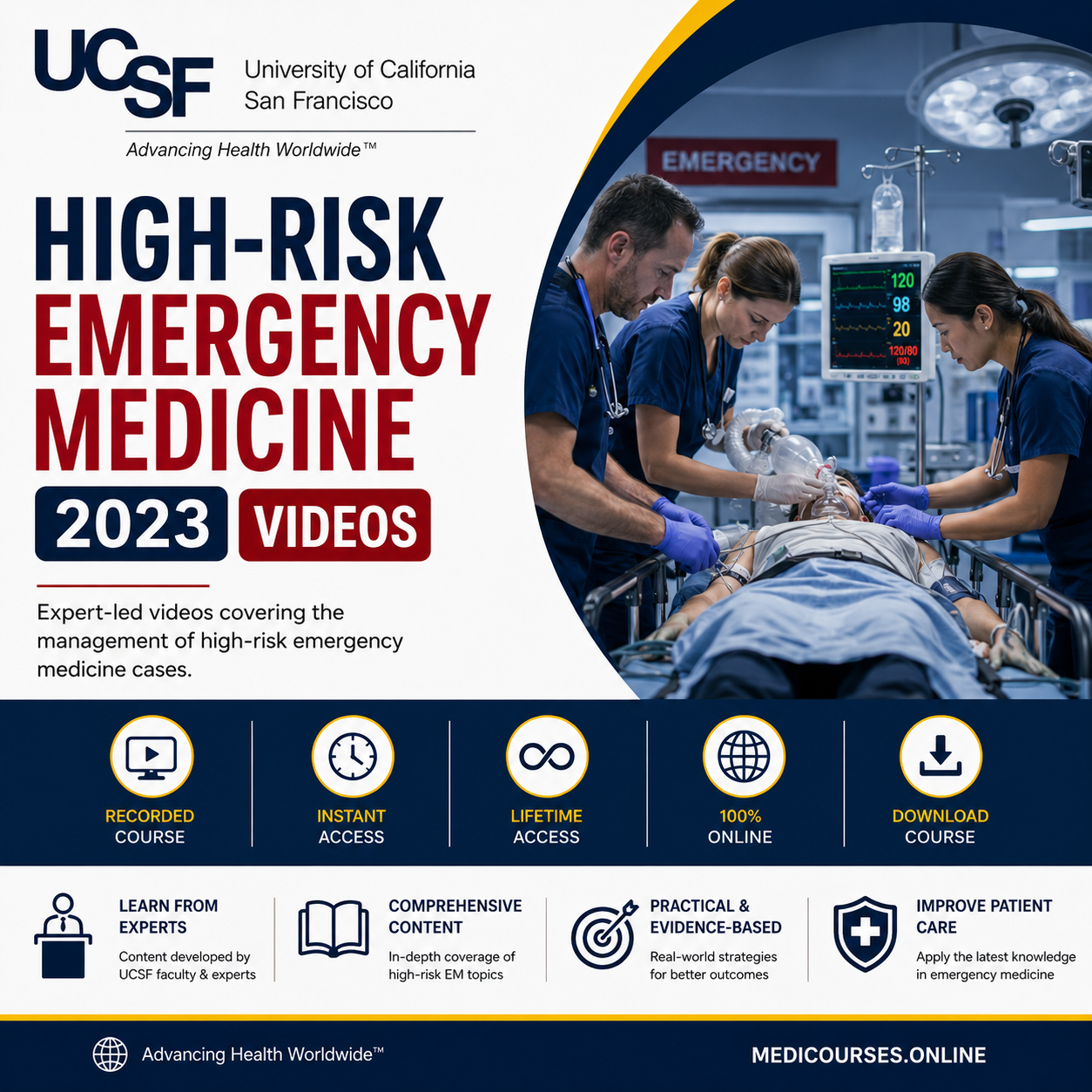
UCSF High Risk Emergency Medicine 2023
A focused emergency medicine course designed for clinicians who encounter high-risk conditions in urgent care, emergency department, and acute care settings. This course reviews critical diagnostic pitfalls, treatment decisions, procedural pearls, patient counseling, and emergency presentations with elevated risk of misdiagnosis or adverse outcomes.
UCSF High Risk Emergency Medicine 2023 is a recorded medical course focused on emergency presentations that carry a high risk of misdiagnosis, misadventure, or clinical deterioration. The course helps clinicians improve diagnosis, treatment, procedural decision-making, communication, and patient care in urgent and emergency settings.
Focus: Traumatic, cardiologic, neurologic, toxicologic, pediatric, airway, respiratory, infectious, cardiovascular, and high-risk emergency presentations.
About This Course
High-risk emergency medicine requires fast recognition, strong clinical judgment, and practical awareness of dangerous pitfalls. This course is designed around the cases and presentations that create the greatest concern for clinicians practicing in urgent care, emergency department, and high-acuity clinical settings.
The course includes expert-led video lectures that address diagnosis, treatment, procedures, patient counseling, trauma care, cardiac emergencies, airway failure, pediatric emergencies, toxicology, geriatric falls, bias and racism in the ED, workplace violence, and team care after difficult ED events.
Why Choose This Course
Key Highlights
- Focused UCSF course on high-risk emergency medicine presentations
- Includes 33 recorded video lectures
- Designed for clinicians working in urgent care, high-risk, and emergency department settings
- Covers traumatic, cardiac, neurologic, toxicologic, pediatric, airway, and respiratory emergencies
- Emphasizes practical pearls, pitfalls, procedures, diagnosis, treatment, and patient counseling
- Useful for emergency physicians, internists, family physicians, urgent care clinicians, PAs, NPs, residents, fellows, and acute care teams
Core Learning Areas
Complete Curriculum
Cardiology & Resuscitation
- Pearls and pitfalls in the ED management of CHF
- Pressors: pearls and pitfalls
- Wide complex tachycardia cases
- Cardiology literature 2023 update
- ACLS update
- ED management of atrial fibrillation
- Hypertensive emergency, urgency, or just high blood pressure
- Anticoagulation: pearls and pitfalls
Airway, Trauma & Imaging
- The failed airway
- Challenging trauma airway cases
- Challenging cases in patients with blunt trauma
- Challenging cases in patients with penetrating trauma
- Pitfalls in use of EFAST
- Trauma Q&A
- Pearls and pitfalls in emergency imaging
- Orthopedic critical care without an orthopedist
Toxicology, Acidosis & Metabolic Emergencies
- Acidosis: pearls and pitfalls
- Antidotes and antidonts
- Diabetic medications and devices: challenging cases
- High-risk metabolic presentations
- Medication-related emergencies and ED decision-making
- Clinical pitfalls in toxicologic and metabolic care
Neurologic, Vascular & Obstetric Emergencies
- Challenging cases in dizziness
- Aortic disasters
- The precipitous delivery
- Recognition of high-risk neurologic presentations
- Emergency diagnostic reasoning in time-sensitive cases
- Risk reduction in commonly missed presentations
Pediatric Emergency Medicine
- Infants with BRUE: is trouble BRUEing or is it all just a big BRUE-Ha-Ha?
- Dangerous and bad practices in kids
- A simplified approach to fever in infants
- Pediatric orthopedic can’t-miss injuries
- Approach to the critically ill infant
- Pediatric minor head and neck trauma cases
ED Systems, Safety & Communication
- Recognizing and managing patient and provider bias and racism in the ED
- De-escalation in the age of workplace violence
- Debrief after challenging ED events
- Taking care of the emergency care team
- Advanced wound repair: tips and tricks
- Geriatric falls: pearls and pitfalls
Learning Objectives
By Completing This Course, You Will Be Able To:
- Improve competence in diagnosis and treatment of high-risk emergency presentations
- Recognize common pitfalls in neurologic, traumatic, cardiovascular, respiratory, pediatric, infectious, and toxicologic emergencies
- Strengthen procedural decision-making and emergency department patient counseling
- Apply practical pearls to airway, trauma, cardiac, pediatric, geriatric, and toxicology cases
- Improve management of urgent care and emergency department patients with high-risk conditions
- Enhance communication, safety, de-escalation, and team support during difficult ED events
Who Should Take This Course
This course is designed for practicing emergency physicians, internists, family practitioners, urgent care clinicians, hospitalists, physician assistants, nurse practitioners, residents, fellows, nurses, and healthcare professionals who encounter high-risk conditions in urgent care, high-risk, or emergency department settings.
Delivery & Access
This course package is provided for recorded learning access. No CME points are associated with this product.
Reviews
A practical high-risk emergency medicine review. The cardiac, airway, trauma, and pediatric sections are especially useful for urgent and ED settings.
Excellent course for reviewing the cases clinicians worry about most. Clear pearls and pitfalls that are easy to apply in clinical practice.
Very useful for acute care practice. The lectures are focused, practical, and relevant for high-risk patient presentations.
FAQ
Who is this course best suited for?
It is ideal for emergency physicians, internists, family practitioners, urgent care clinicians, hospitalists, PAs, NPs, residents, fellows, nurses, and clinicians who work in urgent care, high-risk, or emergency department settings.
What is included in the course package?
The course includes 33 recorded video lectures focused on high-risk emergency medicine.
What topics are covered?
The course covers CHF, pressors, acidosis, wide complex tachycardia, dizziness, aortic disasters, precipitous delivery, wound repair, anticoagulation, toxicology, cardiology updates, geriatric falls, ACLS, failed airway, workplace violence, orthopedic critical care, blunt trauma, trauma airway cases, EFAST pitfalls, penetrating trauma, atrial fibrillation, diabetic devices, hypertensive emergencies, emergency imaging, BRUE, pediatric fever, pediatric orthopedic injuries, critically ill infants, and pediatric trauma.
Is this course practical for emergency department care?
Yes. It focuses on high-risk presentations, diagnostic pitfalls, treatment decisions, procedures, and patient counseling in urgent care and ED settings.
Does this product include CME?
No. This course package does not include CME points.
Who can I contact for support?
You can contact us at [email protected].
Reviews
There are no reviews yet.